
Editor’s note: second in a two-part series.
The year was 1925, and the Soldiers and Sailors Memorial Auditorium, Chattanooga’s living monument to the fallen from the Great War, was completed and open. The staff planned a holiday program fitting to the city’s most striking gathering site.
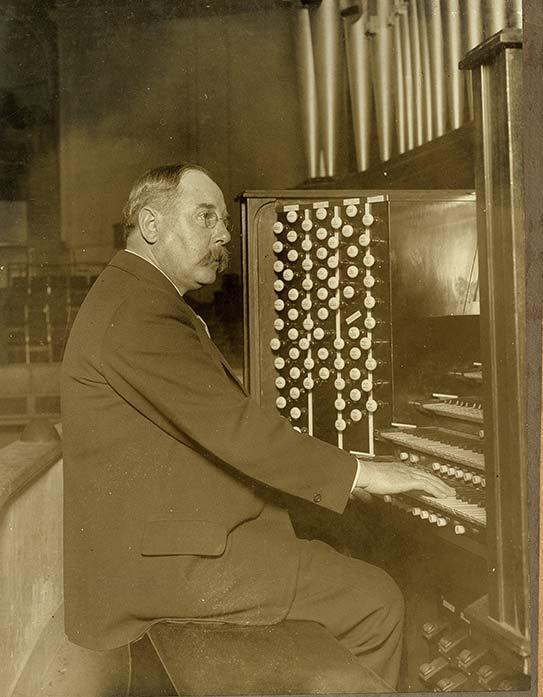
A special organ recital featuring original works by Chattanooga Civic Organist Edwin H. Lemare began at 4 p.m. Sunday, Dec. 27, and provided the closing notes to the special weekend.
His “Rondo Capriccio” and Pastorale in E were accompanied by Humperdinck’s prelude to “Hansel and Gretel.” Those were followed by Joseph S. Redding’s “Cavatina” and “Serenade,” billed as the most interesting choice from the composer’s new opera and “hailed as the first real American opera to have been premiered in Monte Carlo.” Redding had requested Lemare “arrange the piece,” which was to be “published by the well-known firm of Durand and Company of Paris.”
Who was Edwin Henry Lemare, and why were acclaimed composers from across the globe asking the Chattanooga organist to arrange their compositions? Lemare was a prolific composer and the highest paid organist of the late Romantic period. He was described as being a “technical wizard” and a performer with the “ability to uplift the spirits of the masses.”
So, why was he based in Chattanooga? The interesting story begins in 1865 on the Isle of Wight, off the south coast of England, where Edwin was born into a musical family. His grandfather, Frederick Lemare, and all six sons were organists. Edwin’s father moved in 1860 to “The Mount” on the Isle of Wight, where he formed an amateur singing group, the Ventnor Choral Society.
Once the island’s Holy Trinity Church was completed the following year, Frederick became Trinity’s first organist, holding that position for 66 years. By age five, Edwin was studying the piano, “composing” music, and as he recalled in his autobiography, “singing at the top of my voice.” At nine, he began organ lessons with his father and within weeks was playing for the Friday evening services. At age 12, he auditioned for the John Goss Scholarship at London’s Royal Academy of Music. Competing against a field of seven advanced students — three were 18 years old — Lemare was awarded the scholarship and became the youngest recipient in the award’s history.
During three years at the Royal Academy, Edwin studied with Walter Macfarren, a composer and instructor who served as music critic for The Queen newspaper for more than 40 years and musical editor for Ashdown and Parry’s Popular Classics. While with Ashdown and Parry, Macfarren arranged more than 240 major works, including Mozart’s complete piano pieces and Beethoven’s sonatas. Lemare credited Macfarren as an inspirational instructor and one who influenced Lemare’s arrangement techniques.
After studying with organist Dr. E.H. Turpin, the 17-year-old Lemare embarked on a strenuous concert schedule while also serving as the organist and choirmaster at St. John the Evangelist in London’s Brownswood Park. During the 1885 International Invention Exhibition World’s Fair in London — opened by Queen Victoria — he performed more than 134 recitals. Between May and October 1885, the “name Edwin H. Lemare appeared on the front page of the London Times” every weekend.
Acclaim followed his career for the next 30 years. In 1915, he was offered $10,000 to perform at San Francisco’s World’s Fair Panama-Pacific International Exposition. During the fair, Lemare played 121 concerts (at ten cents per person) to audiences that totaled more than 150,000. The city fell in love with the organist, and he remained its official performer until 1921, when he moved east to Portland, Maine. While the municipal organist for Portland, Lemare frequently performed in New York City and Boston while muttering about their abundance of snow.
In 1924, newspaperman Adolph Ochs asked Lemare to “come to Chattanooga, Tennessee,” where he designed and installed the large Austin organ in the city’s premier auditorium. He gave inaugural and regular public recitals using both standard repertoire and his own popular transcriptions. He served as the city’s leading concert organist during his residency and designed the organ for the Ochs Memorial Temple. Lemare’s undisclosed salary was underwritten by Ochs for the five years he resided in Chattanooga. Years later, Lemare reminisced that he “often gave the Ochs private recitals” and reminded listeners that his popular composition, “Above the Clouds,” was inspired by Lookout Mountain’s beauty and dedicated to his benefactor.
Christmas 1925 witnessed Lemare’s stunning performance on the Austin organ. Chattanooga responded with thunderous applause. He had found a welcoming home.
Linda Moss Mines is the official Chattanooga and Hamilton County historian. For more on local history, visit Chattahistoricalassoc.org.