
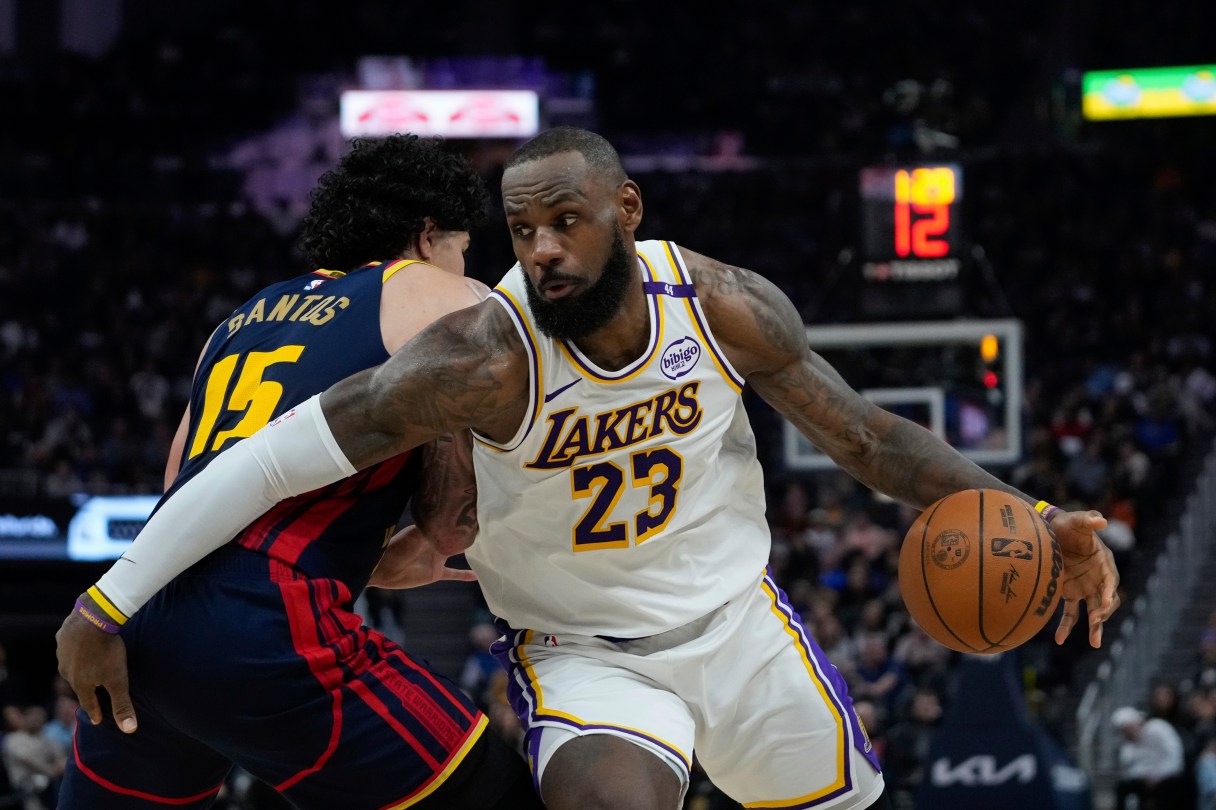
Aging athletes such as LeBron James, Cristiano Ronaldo and Lindsey Vonn are similar to racing cars: maintained by tinkering mechanics, data analysts, and shelves of replacement parts.
“If you look at many elite athletes now, they have an army of supporting staff like a Formula 1 team,” Hirofumi Tanaka, a Japan-born exercise physiologist at the University of Texas, told The Associated Press.
Los Angeles Lakers star James and World Cup skier Vonn just turned 40, and soccer’s Ronaldo will hit the big Four-Oh on Feb. 5. Add seven-time F1 champion Lewis Hamilton, the all-time grand prix wins leader on the international open-wheel circuit and another sports great who turned 40 just a few weeks ago before moving this season to Ferrari after a long run with Mercedes.
“They have physical therapists, dietitians, massage therapists, strength coaches and so on,” Tanaka added. “With this holistic approach, these elite athletes are helped to maintain their performance.”
Others such as quarterback Tom Brady, hockey’s Jaromir Jagr and pitcher Nolan Ryan retired mostly at the top despite beng well into their 40s. Tennis great Martina Navratilova won the U.S. Open mixed doubles title in 2006, just a month short of turning 50.
Then there’s Gordie Howe, who finished his last NHL season at 52 in 1980. Japanese soccer player Kazuyoshi Miura turns 58 in February and plans to play with fourth-tier club Suzuka in his 40th professional season.
And don’t forget National Baseball Hall of Fame pitcher Satchel Paige, who didn’t allow a run in a three-inning outing at age 59 with MLB’s Kansas City Athletics in 1965.
This isn’t exactly new, but it used to be rare. What has changed is the frequency, the array of aides supporting the stars, and the reality — the expectation — that athletes can compete longer and produce.
Watch any Grand Slam tennis tournament. The winner and losing finalist of any such major championship event inevitably thank their “teams” as a half-dozen staffers rise to stadium applause.
Tanaka analyzed Olympic data starting with the first modern Games in 1896, and he found the peak performance age for men has remained stable — from 20 to 30 — depending on the discipline.
Gradually, though, all Olympians are getting older, and the statistics for women bear this out.
“Women’s peak performance age was much younger 20 or 30 years ago,” he said. “But now that peak performance age is becoming very similar to men.”
Tanaka attributed this partly to cultural change in regard to marriage and having children, which used to prompt women to drop out earlier from elite competition.
Of course, there are exceptions such as Syrian table tennis player Hend Zaza. At 12, she was the youngest in the pandemic-delayed Tokyo Olympics in 2021.
The best evidence that athletes are staying longer and maintaining performance is seen in so-called Masters athletes. There is no standard age as each sport sets different parameters.
“Older athletes are getting closer and closer to younger athletes,” Tanaka said, speaking of both men and women. “And the older the Masters athlete is, the greater the improvement.”
James is reported to spend about $1.5 million annually on his body to stay fit for basketball, a number the NBA’s all-time leading scorer neither confirms nor denies. He can afford it with an estimated worth of more than $1 billion.
James talks about staying on top in the Netflix series “Starting 5.” Maybe he’s not getting better with age, but there is little drop-off.
“In some ways he’s a freak of nature,” NBA commissioner Adam Silver said. “I’ve been around a lot of great players, and he’s one of the hardest-working players I’ve been around. I mean, he doesn’t take a day off. He seems to not take an afternoon off.
“He’s always working on some part of his body. You meet with him, and he’s always soaking something or eating something or has some contraption attached to him.”
James, of course, has never been away after breaking into the NBA at age 18.
Vonn is making a comeback on the World Cup skiing circuit this winter after getting a new titanium right knee. But like James, she talks about the benefits of ice baths and new recovery methods that were not around earlier in her career.
Vonn said she gets inspiration from athletes such as Brady, Hamilton and tennis legend Serena Williams, who won her 23rd and last Grand Slam singles title at 35 at the Australian Open in 2017. Williams was several weeks pregnant at the time, which she didn’t announce until months later.
“Tom, Lewis, Serena. They’ve all done it,” Vonn said. “The resources that athletes have now allow for a better recovery. So even though you’re older, you’re still recovering faster than I was when I was in my 20s.”
Vonn told the AP during a recent interview in Cortina d’Ampezzo, Italy, that she might be doing less to stay fit, or at least less to keep her knee functioning.
“My knee doesn’t bother me,” she said. “I don’t wake up and have to do kneecap (exercises) for 15 minutes and do a 30-minute warmup just to walk out the door.
“I am doing a normal warmup like normal athletes do. I don’t have to do anything different, which takes a lot less energy, a lot less mental strain.”
Now she simply focuses on maintaining the other parts of her body.