
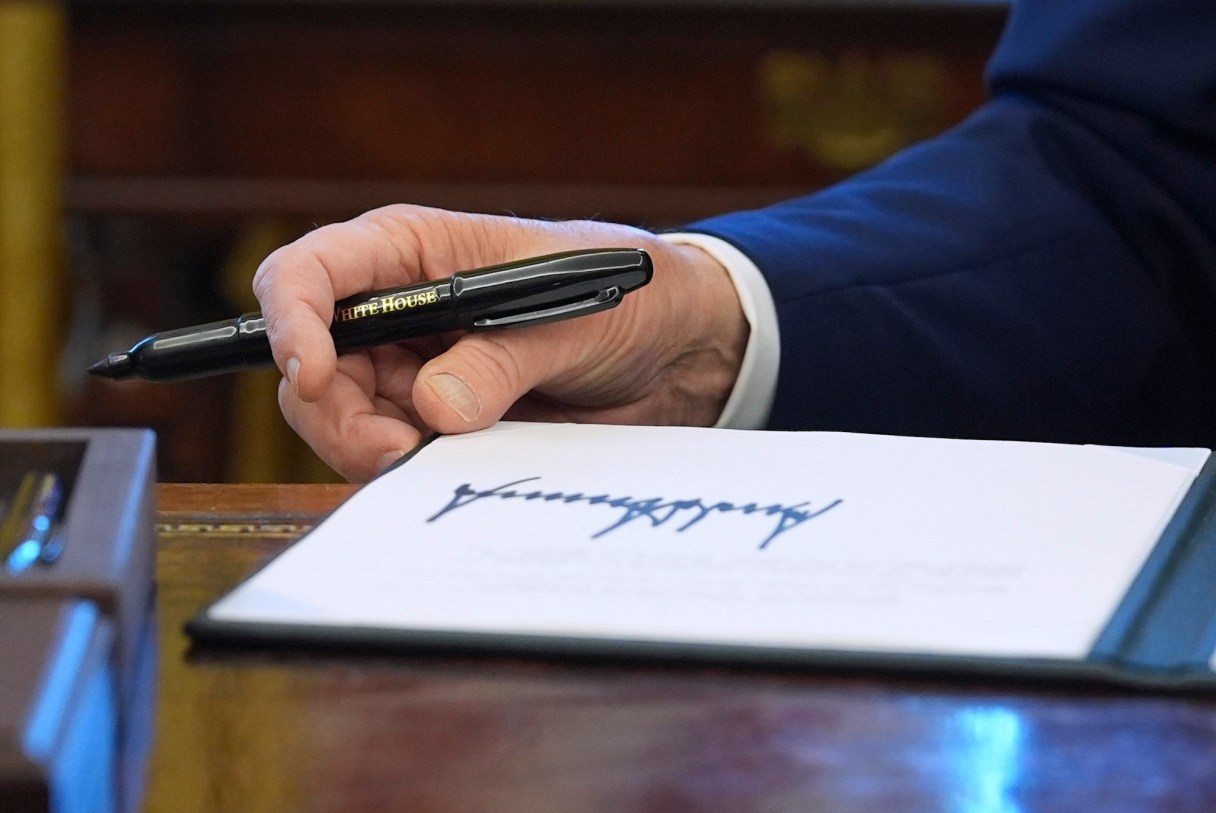
President Donald Trump has spent a lifetime in the courts as both plaintiff and defendant, filing lawsuits to justify his actions and benefit his businesses or to defend himself against charges of illegality.
For the next four years, however, he will mainly be a defendant as he forces the federal judicial system to confirm or reject his effort to vastly expand the president’s role.
Already, Trump has precipitated a whole new round of court cases with a broad swath of sweeping executive actions, many based on the unproven theory that the Constitution’s Article II gives the president unlimited power.
Trump’s actions represent the most concerted challenge ever to the federal government’s balance of powers.
He is basically daring the courts to stop him, seeking to wield nearly unlimited power until — or if — they do.
Trump has long questioned traditional limits on presidential power. In a 2019 speech, he said that, under Article II, “I have the right to do whatever I want as president.”
Trump hopes that courts all the way up to and including the Supreme Court — bolstered by his first term nominees — will uphold that theory and ratify his moves to reshape the government.
That would further erode the limits the Founding Fathers imposed on presidents to protect Americans from the prospect of tyranny.
Article II gives the president “the executive power,” details some specific powers and says, “he shall take care that the laws be faithfully executed.”
His new administration has taken sweeping, often questionable, actions, justifying them by citing the president’s inherent powers.
They include:
› Ending “birthright” citizenship: Trump issued an executive order requiring federal agencies to stop granting citizenship to babies of non-citizens, rejecting the 14th Amendment requirement that “all persons born or naturalized in the United States and subject to the jurisdiction thereof are citizens of the United States and of the state wherein they reside.”
A federal court promptly blocked its action, but the administration is appealing.
› Unilaterally halting federal spending: Though the Trump White House quickly reversed its order freezing all federal spending, it unilaterally cut off foreign aid and other federal programs and maintained its right to do so.
A federal judge in Rhode Island disagreed, saying “no federal law” justified such unilateral action.
› Firing federal officials: Trump fired an array of officials, including FBI agents who investigated the Jan. 6 Capitol insurrection, Justice Department lawyers who investigated him, staff members of the Office of Personnel Management and other agencies, both political appointees and those in civil service jobs.
Challenges are certain, either via civil service procedures or lawsuits.
The White House defended the action.
› Offering buyouts: In a move resembling how presidential adviser Elon Musk cut Twitter, now X, OPM offered all federal workers a job buyout, saying they would be paid until Sept. 30.
› Firing independent agency personnel: Trump fired 17 agency Inspectors General without giving the required 30 days congressional notice, and commissioners of the Equal Employment Opportunity Commission and the National Labor Relations Board whose terms had not ended.
His actions sparked predictable Democratic criticism, but far less from Republicans, who control both houses of Congress.
The stakes in these cases are enormous. They’ll redefine the limits — if any — of presidential power, possibly for decades.