
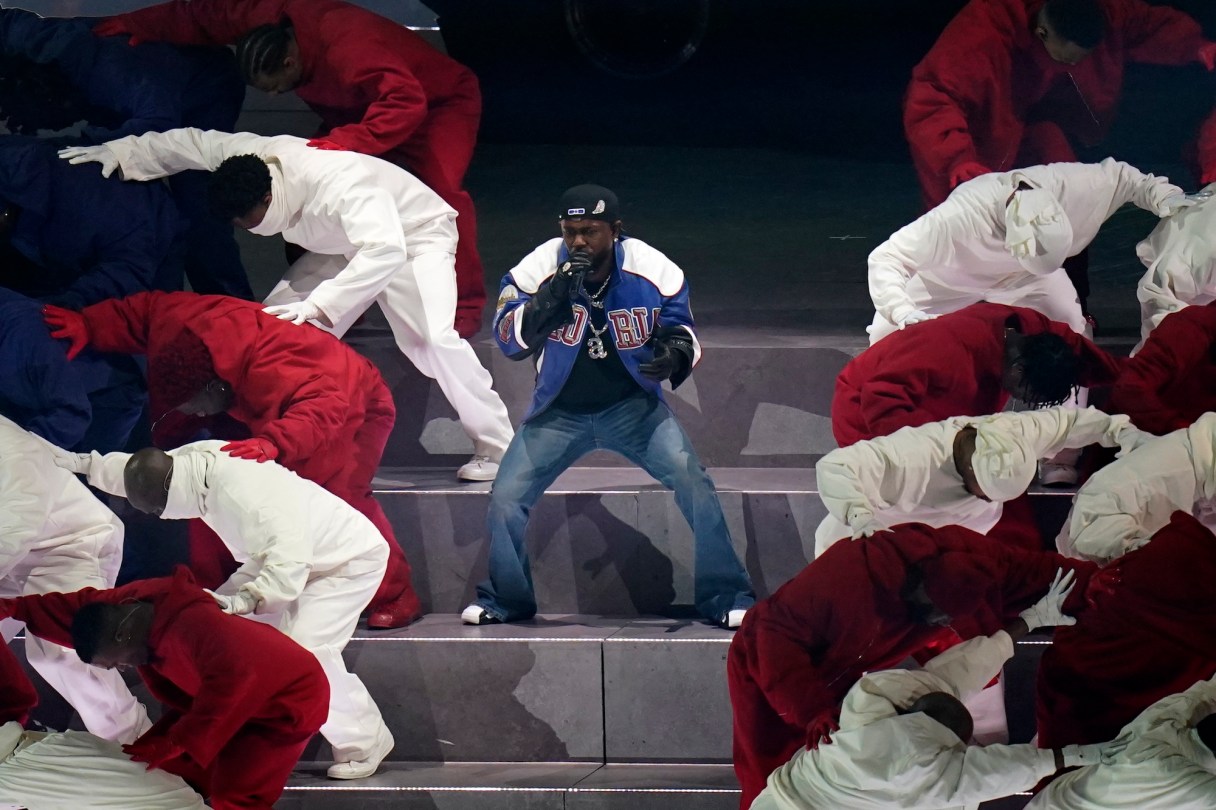
As a professional food writer, I promise any other time I’d be writing about Kendrick Lamar’s apparent fondness for the Italian pasta dish Cacio e Pepe, which he mentioned in “peekaboo,” a track from his latest project GNX.
However, as a 37-year-old Black man and an unabashed product of hip hop culture, the galvanizing performance from the Pulitzer-winning rapper during halftime of Super Bowl LIX was more important to me than any Cacio e Pepe I could ever twirl around a fork. I don’t care if the pecorino romano cheese is the finest the isle of Sardinia has to offer.
Besides, I’m more of a guanciale-bespeckled-carbonara type of guy.
Kendrick’s scrupulously orchestrated, 13-minute tour de force in New Orleans wasn’t the “Artist Formerly Known as Prince” crooning “Purple Rain” while it was actually raining at halftime of Super Bowl XLI. Nor was it the glitzy, pyrotechnical hoopla of Lady Gaga’s act at the midway mark of Super Bowl LI.
It wasn’t meant to be chummy to mainstream white America. It was defiant. It was anti-establishment. It was artfully revolutionary and filled to the brim with Kendrick’s marquee social consciousness.
Indeed, witnessing tennis legend Serena Williams crip walk while Kendrick rapped “Not Like Us” — the viral, Grammy-winning diss track against Toronto-based rapper Drake — may have been the proverbial cherry on top, but it was the cameo from Chattanooga native Samuel L. Jackson that was critical in the grand scheme of the show’s narrative.
Clad from head to toe in the good ol’ stars and stripes, à la “Uncle Sam,” Jackson, with his trademark bombastic vigor, popped up intermittently giving Kendrick instructions on how to win the “Great American Game.”
Jackson warned Kendrick that he was being “too loud,” “too reckless” and “too ghetto” and that to win the “Great American Game” as a Black man you have to be nice and calm — you have to “tighten up.”
This bolstered the ideology, as it pertains to Black men in America, that either you’re humble and docile or you’re unruly and defiant, and there’s hardly any middle ground in between.
If you’ve never stashed something in the Crown Royal pouch, never knew somebody named “Junebug,” never been in a neighborhood that had a candy lady selling cups of frozen Kool-Aid, never tied a durag, never watched somebody do the “cabbage patch” or “freak” a Black & Mild cigarillo, Kendrick’s performance probably left you too befuddled to bargain, too appalled to appreciate.
I get it. Millions of people tuned into the halftime show expecting to be entertained and ended up witnessing an unapologetically Black American spectacle that was both profound and poetic.
America has always wanted to consume Blackness on their terms, according to their rules, and if you decide to buck the system, the consequences will be drastic and damning. On that football field Sunday inside of the Caesars Superdome, Kendrick bucked the system, tradition and mainstream expectation.
As Kendrick put it while squatting on the hood of the jet black 1987 Buick Grand National in the opening minute of his performance: “Twenty years in, I still got that pen dedicated to bear hard truth.”
Indeed, a hard truth that America still isn’t ready to face.
Andre James, a former food writer with the Chattanooga Times Free Press, is a freelance journalist based in Myrtle Beach, South Carolina.