
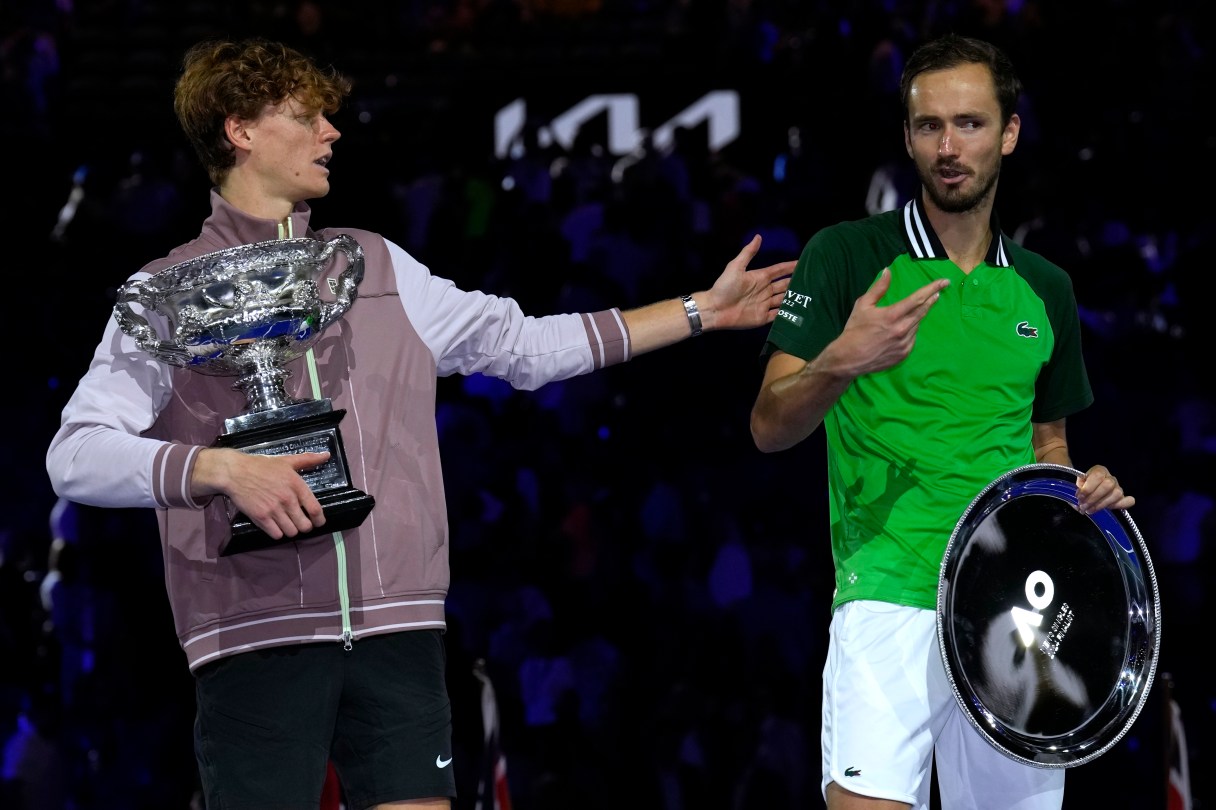
MELBOURNE, Australia — It is a topic that shadowed professional tennis in 2024 and is still a talking point as the 2025 Grand Slam season opens at the Australian Open on Sunday in Melbourne: doping and the cases involving Jannik Sinner — which is still not resolved — and Iga Swiatek.
Both players spent much of last year at No. 1 on their respective tours, and Sinner still will hold that spot in the ATP rankings when the 23-year-old Italian — coming off a U.S. Open title in the final major tournament of 2024 — steps on court at Melbourne Park to begin his bid to repeat as men’s singles champion.
Swiatek, a five-time major champ and the woman leading the WTA rankings most of the past three seasons, is currently No. 2 behind Aryna Sabalenka, who will be chasing her third consecutive title in Australia.
“Obviously, there are going to be some negative comments,” said Swiatek, a 23-year-old from Poland. “You’re not going to avoid that.”
Most players prefer to remain silent when asked about the cases, but there are those who have been happy to weigh in, including 24-time major champion Novak Djokovic. The situation has raised questions about whether Sinner and Swiatek were treated the same as other players facing similar circumstances and why their situations were kept under wraps for months.
“I sit and wonder, ‘Why such a big difference in treatment and judgment?'” was two-time major champion Simona Halep’s reaction to Swiatek’s punishment. “I can’t find, and I don’t think there can be, a logical answer.”
Halep initially was banned for four years after testing positive for the banned drug Roxadustat at the 2022 U.S. Open, then had that penalty reduced to nine months on appeal — although she already had been off the tour longer than that. She was supposed to compete at the Australian Open for the first time in three years but withdrew from qualifying this week because of knee and shoulder pain.
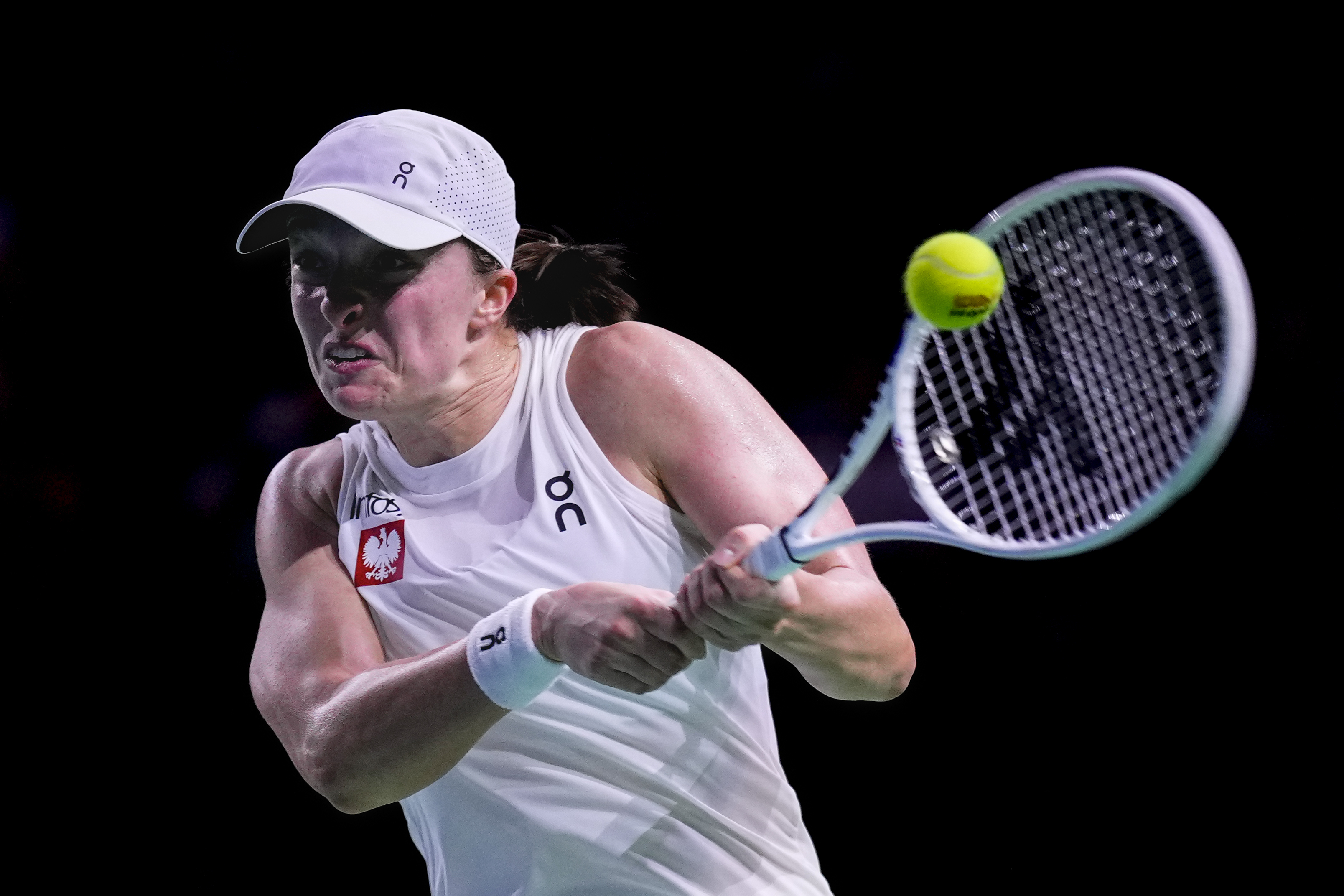 AP photo by Manu Fernandez / Iga Swiatek returns to Linda Noskova during the Billie Jean King Cup Finals on Nov. 16 in Malaga, Spain.
No one has been louder about the subject lately than Nick Kyrgios, the 2022 Wimbledon runner-up who missed nearly all of the past two seasons because of injuries. He has been commenting regularly, in real life and online, even taking a jab (that he said was in jest) at Cruz Hewitt after the 16-year-old son of Australian Davis Cup captain Lleyton Hewitt posted a photo with Sinner from a practice session.
“It’s been handled horrifically in our sport. Two world number ones, both getting done for doping, is disgusting for our sport,” Kyrgios said at the Brisbane International, the first event of his comeback. “It’s a horrible look.”
Where do things stand with Sinner’s positive drug tests?
He was the dominant player in men’s tennis last year, and there’s little reason to think that won’t continue. In 2024, he went 73-6 with eight titles, including at the U.S. Open, and led Italy to the Davis Cup. He heads into the Australian Open on a 14-match winning streak.
Hanging over it all is this: Two positive tests for a trace amount of an anabolic steroid in March were made public in August; the International Tennis Integrity Agency determined he shouldn’t be suspended because the exposure to Clostebol was considered accidental, the result of a massage from a trainer who used the substance after cutting his own finger.
The World Anti-Doping Agency was not entirely convinced about the exoneration and thinks a ban of one to two years would be appropriate. Its appeal, lodged in September, is still pending, and a final determination is expected after the Australian Open ends.
“It’s in (my) head a little bit,” Sinner said, adding that he is confident everything will go his way.
What happened with Swiatek’s failed doping test?
She accepted a one-month suspension in late November after testing positive for a banned heart medication known as TMZ. She failed an out-of-competition test in August, and the ITIA accepted her explanation that it was caused by the contamination of a nonprescription medication, melatonin, that Swiatek was taking for jet lag and resulting trouble sleeping
She missed three tournaments, although the real reason wasn’t revealed at the time, then finished serving her punishment after the season was done.
“This whole process was pretty abstract sometimes and hard to understand,” Swiatek said, surely speaking for many observers.
Which is why, perhaps, Netherlands captain Paul Haarhuis said what he did after his team lost to Sinner’s Italy in the Davis Cup finals.
“Jannik, in my personal opinion, is an unbelievably nice guy, great player,” Haarhuis said, “but we (might) never know what happened.”
Are there other noteworthy cases in tennis?
While Sinner and Swiatek will compete in Melbourne, another player involved in a recent ITIA case won’t: Max Purcell, who was part of men’s doubles championship victories at the U.S. Open in September and Wimbledon in 2022 and was a two-time runner-up in doubles at the Australian Open.
Purcell didn’t test positive, though. Instead, the 26-year-old Australian accepted a provisional suspension for, as he described it, having “unknowingly received an IV infusion of vitamins above the allowable limit.”
“I have no good words for it,” said fellow Aussie player Jordan Thompson, Purcell’s doubles partner in New York last year. “It is a joke.”