
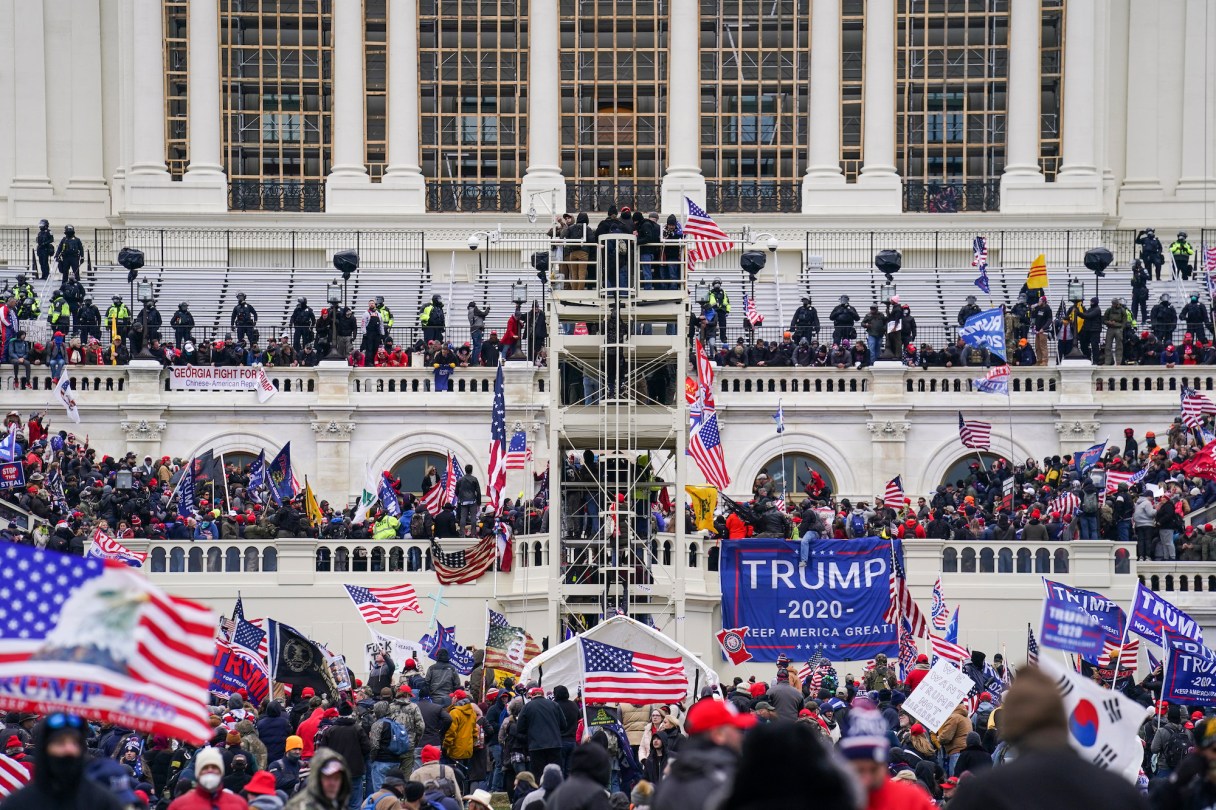
On Jan. 6, 2021, Philip Sean Grillo, a former Republican district leader in Queens, jumped through a broken window at the U.S. Capitol with a megaphone. He pushed his way past a line of Capitol Police officers and opened the exterior doors of the Rotunda to allow other rioters to enter the building and trash it. “We stormed the Capitol!” he exulted on video, and was seen smoking marijuana and high-fiving other Donald Trump supporters who were fighting police. “We shut it down! We did it!”
Last month, when he was sentenced to a year in prison, he had a special taunt for the federal district judge who sentenced him, Royce Lamberth.
“Trump’s going to pardon me anyways,” he yelled at the judge, just before he was handcuffed and led away.
He was right. On Monday evening, several hours after Trump was inaugurated, he fulfilled a promise he had repeatedly made to pardon nearly all the rioters who attacked and desecrated the Capitol in 2021 to prevent Joe Biden’s victory from being certified. Grillo and about 1,500 other rioters received full pardons from Trump, while 14 others received commuted sentences.
This not only makes a mockery of his jury’s verdict and of Lamberth’s sentence. Trump’s mass pardon effectively makes a mockery of a justice system that has labored for four years to charge nearly 1,600 people who tried to stop the Constitution in its tracks.
Most important, the mass pardon sends a message to the country and the world that violating the law in support of Trump and his movement will be rewarded. It loudly proclaims, from the nation’s highest office, that violence is a perfectly legitimate form of political expression and that no price need be paid by those who seek to disrupt a sacred constitutional transfer of power.
Trump used a mass pardon at the beginning of his term to write a false chapter of American history, to try to erase a crime committed against the foundations of American democracy.
By 2022, when he was under investigation by the House Jan. 6 committee, Trump began referring to the rioters as “political prisoners” persecuted by Democrats and openly suggesting that the FBI had helped stage the attack. By the time his presidential campaign was in full swing last year, he had completely transformed the day’s monstrous bloody fury into what he called a “day of love.”
More than 140 police officers were assaulted that day; Brian Sicknick, a Capitol Police officer, was killed, and other officers were smashed in the head with weapons; they were bruised, burned and lacerated; four later died by suicide.
“My concern is that people are going to believe that if they attack me or members of my family physically that Donald Trump will absolve them of their acts,” Michael Fanone, a former police officer attacked by the crowd Jan. 6, told the Times. “And who is to say he wouldn’t?”
Lamberth has been on the bench since 1987 and has seen it all, but in pronouncing one sentence against a rioter last January, he said he had never seen such a level of “meritless justifications of criminal activity” in the political mainstream.
“I have been shocked to watch some public figures try to rewrite history, claiming rioters behaved ‘in an orderly fashion’ like ordinary tourists or martyrizing convicted Jan. 6 defendants as ‘political prisoners’ or even, incredibly, ‘hostages,'” he wrote. “That is all preposterous. But the court fears that such destructive, misguided rhetoric could presage further danger to our country.”
On his first day back in public office, Trump provoked the danger that the judge dreads, setting loose hundreds of people found guilty of participating in a violent assault on the nation’s Capitol — not because they committed no crimes but because they committed their crimes in his name. In doing so, he invites such crimes to happen again.