
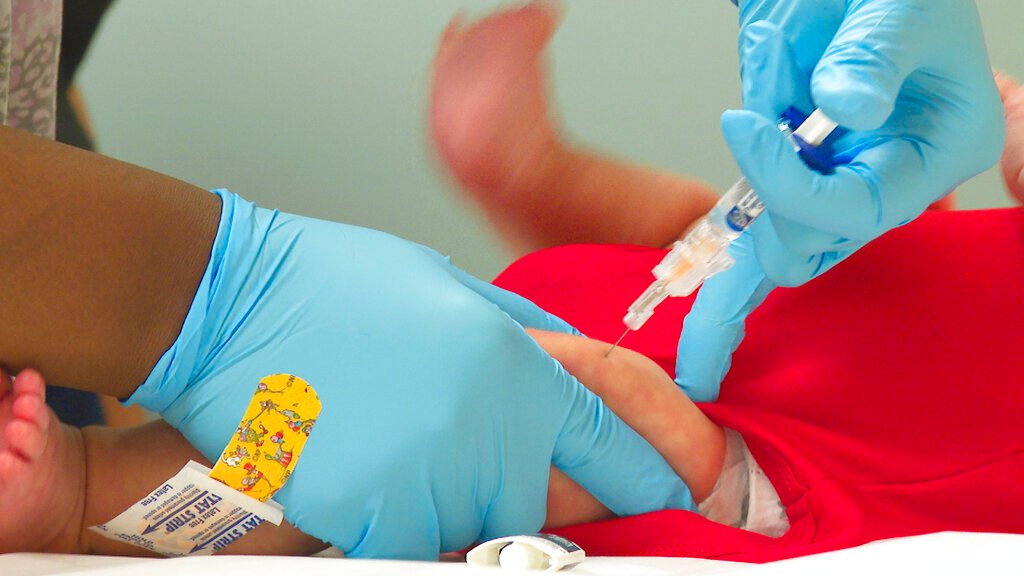
Tennessee saw over 300 more cases of whooping cough in 2024 compared to the previous year, according to the Tennessee Department of Health data.
The increase amounted to the highest number of cases in a decade, officials said. In 2024, 384 cases were documented compared to 81 in 2023, according to the Tennessee Department of Health.
Hamilton County saw the number of cases double from 13 in 2014 to 26 in 2024, the health department data showed.
Known medically as pertussis, whooping cough is a highly contagious respiratory illness caused by the bacteria for which it’s named, Bordetella pertussis, said Dr. Stephen Miller, the Health Officer for the Hamilton County Health Department.
“Found only in humans, it often starts with cold-like symptoms but can lead to prolonged coughing spells lasting weeks or even months,” he said in an emailed statement.
Its symptoms vary by age and vaccination status but typically appear between five and 10 days after exposure, Miller said. Whooping cough can be difficult to diagnose because early symptoms may resemble a cold.
“The illness worsens over time, and diagnosis often occurs only when coughing becomes severe,” he said. “Babies and young children may not cough but may struggle to breathe instead.”
Miller said the illness can cause severe and sometimes fatal complications, especially in babies and young children who are not fully vaccinated. Around 33% of babies under age 1 with whooping cough require hospitalization.
He said a vaccination for tetanus, diphtheria and acellular pertussis — commonly known by the abbreviation Tdap — during pregnancy protects 90% of babies from being hospitalized with whooping cough.
Whooping cough symptoms
Early symptoms (1-2 weeks):
— Runny or stuffed nose
— Low-grade fever (under 100.4 degrees)
— Mild, occasional cough
— Babies may have breathing pauses, turn blue or struggle to breathe, sometimes without coughing
Later symptoms (1-6+ weeks):
— Severe coughing fits
— “Whoop” sound when inhaling after a cough
— Vomiting or extreme tiredness after fits
— Difficulty sleeping, breathing or even rib fractures from coughing
— Symptoms often worsen over time, with many describing it as the worst cough of their lives
Source: Hamilton County Health Department
However, Dr. Matt Campbell with Pediatric Diagnostic Associates said babies are not the only people at risk. Other groups include pregnant women, those with immunodeficiency, people who have underlying medical conditions such as chronic lung disease or cystic fibrosis, and people who have contact with infants.
The illness gets its name from the involuntary “whoop” sound a person makes in between coughing fits as they attempt to increase their oxygen levels, Campbell said.
WHY THE INCREASE?
Campbell said he believes the reason whooping cough infection levels have increased is due to lower vaccination rates in the past four to five years.
With the Tdap shot, the immunity for whooping cough lasts up to 10 years, Campbell said, and the vaccine is updated every five to 10 years.
After five years, some studies show it’s wise to get a booster shot, he said.
But, he said, more people have an increased amount of vaccine hesitancy after the pandemic.
“I think a lot of it is mistrust with the government, the medical institution as a whole, because there was so much politicization of the COVID vaccine specifically, and that has filtered into all vaccines,” Campbell said by phone. “People have hesitancy at this point because they are not sure what they can trust.”
Whooping cough vaccines
DTaP for young children:
— 2, 4 and 6 months
— 15-18 months
— 4-6 years
Tdap for preteens:
— 11-12 years
Tdap for pregnant women:
— During the 27th to 36th week of each pregnancy
Tdap for adults:
— Anytime for those who have never received it
Source: U.S. Centers for Disease Control and Prevention
INFECTION AND SPREAD
Whooping cough spreads easily through the air when an infected person coughs or sneezes, Miller said. From the onset of symptoms and at least two weeks after coughing begins, those infected are contagious, and people with mild symptoms often unknowingly spread it.
“Many babies catch pertussis from older siblings, parents or caregivers who don’t realize they’re infected,” he said.
In the U.S., the preliminary number of cases in 2024 was five times that of 2023, Miller said. The increase is comparable to that of both Hamilton County and Tennessee.
Contracting whooping cough
— Living in the same household as an infected person
— Face-to-face exposure within three feet of a symptomatic patient
— Direct contact with respiratory, oral or nasal secretions from a symptomatic patient
— Sharing the same confined space in proximity with a symptomatic patient for an hour or more
Source: Pediatric Diagnostic Associates
The number of cases within the county increased as of Dec. 18, 2024, compared to 2023, Miller confirmed.
“Pertussis cases were lower than usual during and after the pandemic, but the U.S. is now returning to pre-pandemic levels, with over 10,000 cases typically reported annually,” he said, referring to the number of cases nationally. “In 2024, reported cases have risen, surpassing those seen in 2019, signaling a return to typical trends.”
Campbell with CHI Memorial said whooping cough can cause significant issues due to the intensity of the cough.
“You can throw up because you’re coughing so hard, and some people have been known to cough so hard that you can crack ribs,” he said. “Some people have even had strokes with it because it can get so bad.”
Patients can get secondary pneumonias, some may pop blood vessels in their eyes, pull muscles or experience bleeding issues, Campbell said.
Infants are at the highest risk for the illness because a child must be at least two months old to be vaccinated, he said. Children can cough so hard and for so long, their oxygen levels drop, and some babies have died.
Generally, the treatment for whooping cough is an antibiotic like azithromycin, or a Z-Pak, Campbell said.
The biggest part of the whooping cough equation is knowing it is vaccine-preventable, Campbell said. An immunization decreases the illness’ severity.
With an immunization, people are protecting themselves and others around them, he said, including small babies, elderly and immunocompromised individuals.
“If you’re covered, you’re also covering those around you,” Campbell said. “You’re being a (good) Samaritan and caring for your neighbor.”
Contact Leah Hunter at lhunter@timesfreepress.com or 423-757-6673.