
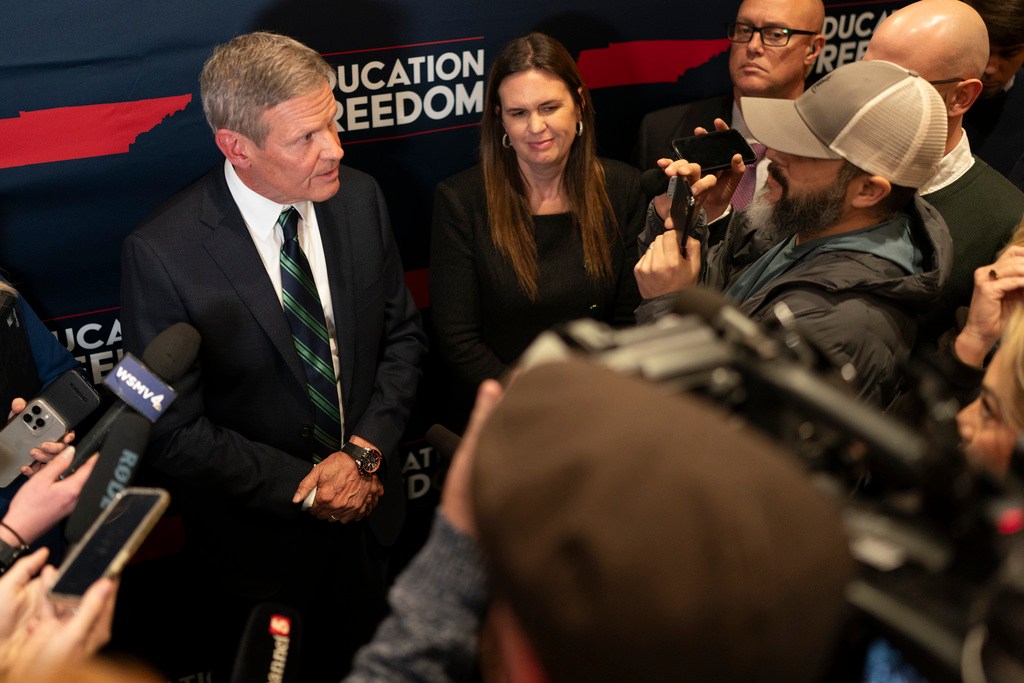
Tennessee lawmakers approved legislation Thursday that would give thousands of families across the state taxpayer funding to pay for private school tuition.
The Education Freedom Act would give up to 20,000 students $7,075 each in public funding to enroll in private schools, starting in the fall. The legislation would extend a three-county pilot program statewide.
Half of the grants would be reserved for students with disabilities, students eligible for the pilot program and families at or below 300% of the income limit to qualify for free or reduced-price lunches — about $175,000 for a family of four. Those requirements would be lifted after the first year.
The bill now heads to Gov. Bill Lee, a Republican who has made passing this legislation a key priority.
Hamilton County lawmakers were divided on the legislation, with state Rep. Michele Reneau, R-Hixson, breaking from the rest of the county’s Republican delegation to oppose the bill. State Rep. Yusuf Hakeem, of Chattanooga, the lone Democrat representing the county, also voted no.
“It is clear that there are a number of important issues within our education system that need to be addressed,” Reneau said in a statement to constituents earlier this week. “Based on your feedback, it is also clear that there is an overwhelming lack of confidence that this legislation will properly address those issues.”
In her statement, she expressed concerns that providing public funds to private education could undermine public schools and negatively affect taxpayers
(READ MORE: Hixson’s Reneau to oppose Tennessee governor’s tuition grants)
While a similar program already exists for low-income students in Hamilton County, the statewide legislation is expected to allow the parents or guardians of the thousands of students zoned for one of Southeast Tennessee’s other school districts to get public funds to send their child to private school. The change in income limits would also greatly increase the number of eligible Hamilton County students.
State Sen. Todd Gardenhire, R-Chattanooga, made a late decision to support the legislation.
“Up until this morning, I would have been a no vote,” he said, “but the majority of my concerns and objections have been removed.”
He said he intends to introduce a bill during the regular session to address his main objection. He did not say what that objection was and did not immediately respond to a text message from a reporter asking for clarification.
The legislation passed 54 to 44 in the house, narrowly clearing the 50 votes needed. Twenty-one Republicans joined Democrats in opposing the bill. It passed 20 to 13 in the state senate.
Locally, three lawmakers who represent parts of Bradley County — state Reps. Dan Howell and Kevin Raper, both Republicans of Cleveland, and state Sen. Tom Hatcher, R-Blount County — as well as the representative for Bledsoe, Rhea and Sequatchie counties, Ron Travis, R-Dayton, also voted against the legislation.
The bill faced opposition from some lawmakers in rural areas — many of which do not have an eligible private school — as well as public school advocates who questioned why the money being spent on this program was not being spent on public schools.
Parents have the responsibility to shape their children’s academic futures, state Rep. Greg Martin, R-Hixson, said, but too often their role is limited because of a lack of access and resources.
“Monopolies are rarely a good thing,” he said. “In fact, I think they’re about as popular as Nancy Pelosi is in East Tennessee, and yet what we’ve done is that we have allowed monopolies when it comes to education that there’s only certain people that can tell us what’s best and they’re those who control and benefit from it.”
Both Martin and state Sen. Bo Watson, R-North Chattanooga, referenced an executive order signed by President Donald Trump on Wednesday that directs federal agencies to issue guidance to states on how they can use federal funds to support school choice.
“If you align with the current presidential administration and their views towards school choice, … if you believe in the business argument that competition makes everybody better, then I say to you, you must support this bill,” Watson said. “Even if you have concerns about it, it gets the school choice option before us, and it gives us something to work with and improve upon.”
(READ MORE: Trump backs Tennessee governor’s tuition grants)
Watson said he was taken aback by the belief that everyone attending private schools is wealthy. A fiscal review of the bill estimates 65% of the grants will be awarded to students already attending private schools.
In private schools, he said, there are families who work multiple jobs, as well as children of public school teachers who also work another job in order to afford tuition.
“You would deny them the opportunity because you believe that everybody in a private school is wealthy,” he said. “I don’t know what of that 65% is wealthy, but I will tell you I believe that the majority of that 65% are hard working, middle class Tennesseans trying to create the best opportunity for their children that they can.”
A series of amendments put forward by house Democrats to increase accountability failed, including one by Hakeem that would have required annual audits for private schools that enroll grant recipients.
Hakeem’s concern, he said, was ensuring small private schools don’t pop up and end up closing within a few years, leaving students high and dry.
Two Republicans who later voted against the bill — state Rep. Jody Barrett, of Dickson, and state Rep. Monty Fritts, of Kingston — joined Democrats in voting against tabling the amendment.
“Every school that would move forward to educate our children do not have the best intentions, and what we’re asking is reasonable accountability,” Hakeem said. “We should not assume that every school would do the right thing.”
Contact Shannon Coan at scoan@timesfreepress.com or 423-757-6396.