
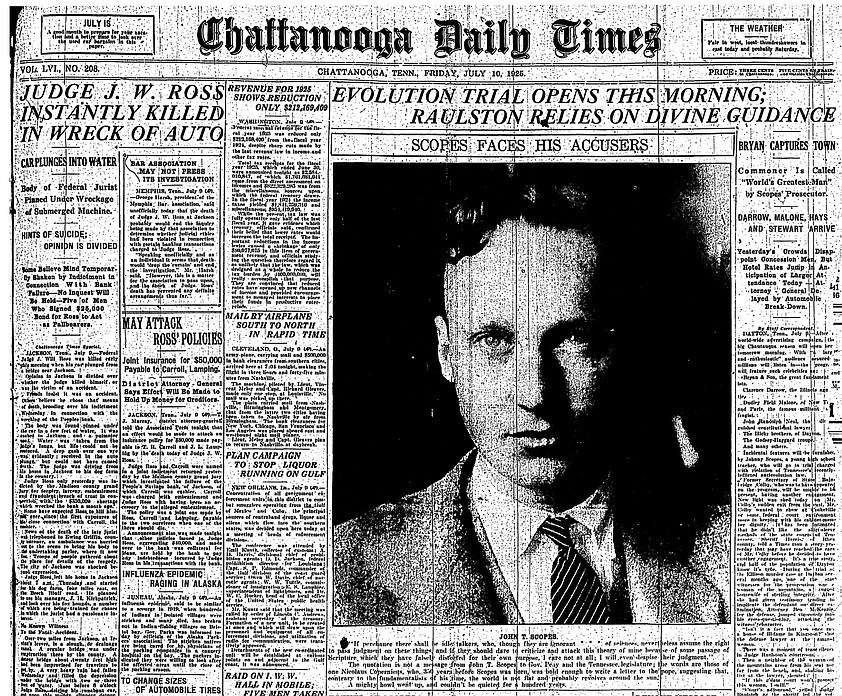
Over 100 years ago, one of America’s most sensationalist trials began on July 10, 1925 — just up the road in Dayton, Tennessee. The case, known as the Scopes trial, pitted local high school biology teacher John T. Scopes against the state of Tennessee. At issue was the Butler Act, a state law which banned the public school teaching “that man has descended from a lower order of animals.”
What resulted was largely a media spectacle, “a concocted trial,” Edward Larson, a professor of history and law at Pepperdine University, told NPR recently. “Scopes never really taught evolution,” Larson told the outlet. “The town decided they wanted to stage this test of the new state law.”
After an eight-day trial, the jury, after less than 10 minutes of deliberation, found Scopes guilty and fined him $100, though the verdict was later overturned by the Tennessee Supreme Court over a technicality.
In the decades since, the trial has left its mark in Dayton, the seat of Rhea County. Scopes is so ingrained in the culture there that the Rhea Heritage Preservation Foundation holds an annual stage production dramatizing the trial.
For the rest of the country, the impact of Scopes was immediate. Soon after the verdict, more than 20 anti-evolution bills, The Associated Press reported, were defeated in statehouses across the nation. Tennessee’s Butler Act, however, wasn’t repealed until the 1960s.