
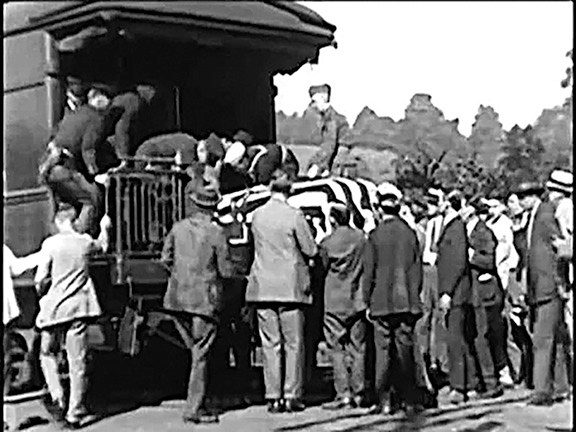
Only days after William Jennings Bryan and Clarence Darrow argued the “the teaching of evolution in the classroom” Scopes case before the judge, the national press and a packed courtroom, Chattanoogans woke to news on Monday, July 27, 1925, that Bryan had died the previous afternoon.
His friend Attorney General G.W. Chamlee eulogized: “Without doubt, he was one of the greatest private citizens the United States has ever produced … .” Chamlee speculated that his death was caused by “the fatigue of the Dayton trial, coupled with exertion and travel in the sun during the last few days.” Doctors confirmed that his peaceful passing on Sunday afternoon was due to apoplexy (stroke or heart attack).
Mary Baird Bryan, an invalid for more than a decade and yet always at her husband’s side, recounted his final words, “I think I am going to get a good sleep.” She explained that he had lain down to rest without “the slightest premonition that the sleep would be the dreamless sleep which does not end this side of the resurrection morn.” He had been “stilled forever without a final gesture of affection and farewell.”
On Wednesday morning, the train cortège, which included an observation Pullman car (designed for passenger viewing) and a companion carriage holding friends and press, left Dayton — the small town now “quieted and saddened” — on the first part of a journey that would see Bryan, “the protector of the faith of our fathers,” buried in the hills of Arlington National Cemetery. In an interesting twist of fate, Pete Gorman, the conductor of the funeral train, had also operated the Bryan for President campaign train in 1896. Gorman was again accompanied by H.J. Miller, who served as fireman on both trains, and admitted that he was “deeply touched” to be ferrying the “dead warrior” to his final resting place.
Railway officials accompanying Bryan included: J.L. Meek, assistant general ticket agent; L.H. Woodall, superintendent of the Cincinnati, New Orleans and Texas Pacific Railway; W.C. Spencer, general ticket agent; J.H. Deering, trainmaster; and J.T. Green, Pullman’s Chattanooga superintendent.