
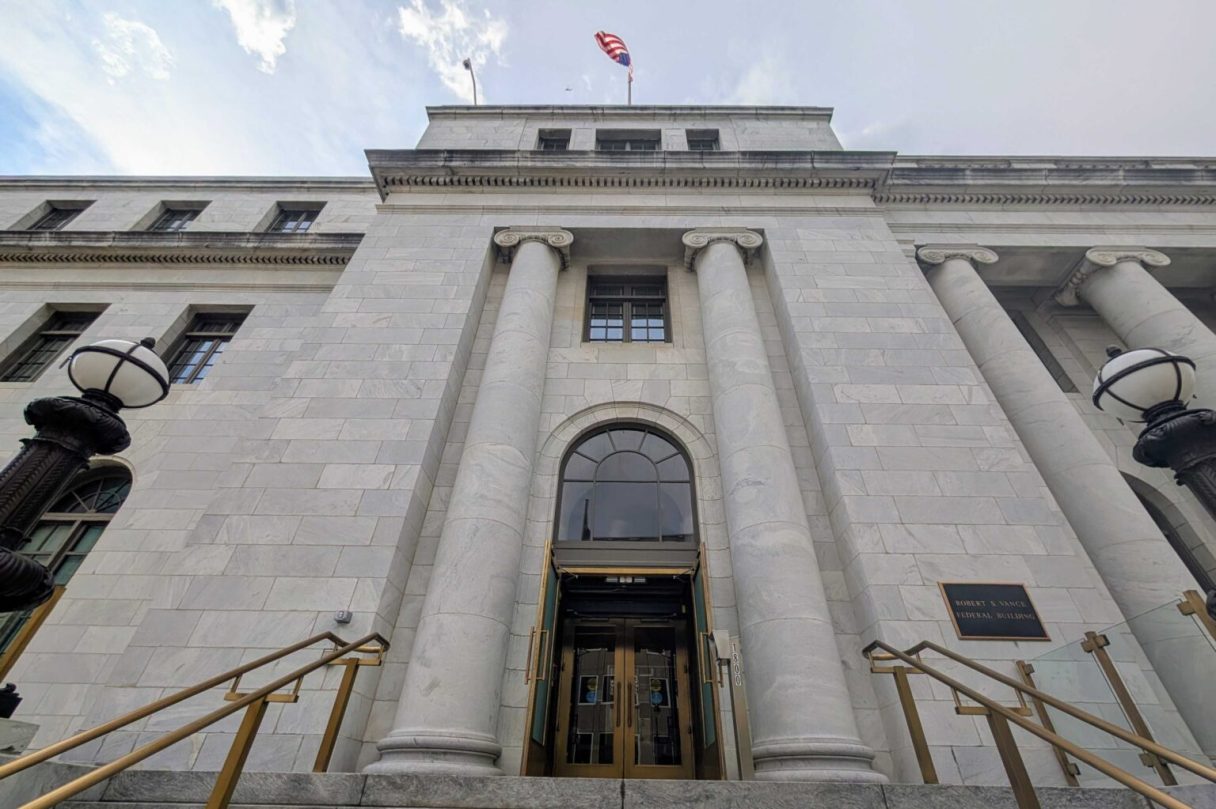
A panel of federal judges seemed split Tuesday on whether Alabama’s past resistance to a congressional map giving Black voters a better chance of electing their preferred leaders should subject the state to judicial review of future maps.
The three-judge panel — U.S. Circuit Judge Stanley Marcus, appointed by former President Bill Clinton, and U.S. District Judges Anna M. Manasco and Terry F. Moorer, appointees of President Donald Trump — heard arguments Tuesday over the request from plaintiffs in a lawsuit to put Alabama back under “preclearance,” which would subject any future congressional maps for approval by the court.
Alabama was under preclearance under the Voting Rights Act from 1965 to 2013, when the U.S. Supreme Court struck down the part of the law that required preclearance for states with histories of voting discrimination like Alabama. Another option floated by lawyers for plaintiffs was to give the federal court jurisdiction for at least 60 days after new congressional maps are drawn in 2030, which would allow plaintiffs to challenge new maps drawn after the 2030 census based on the claims they already argued and won.
The court ordered the state to draw a new congressional map in 2023 after nearly two years of litigation with two appeals to the U.S. Supreme Court. The panel ruled that the Legislature-approved map did not give Black voters the ability to choose their preferred leaders, and ordered a majority-minority congressional district and a district with a near-majority of Black voters to be drawn. After a trial earlier this year, the court ruled in May that Alabama had intentionally discriminated against Black voters by approving a map in 2023 that initially only had one majority-Black district.
Deuel Ross of the NAACP Legal Defense Fund, representing plaintiffs who originally challenged an Alabama congressional map approved in 2021, said Tuesday that federal oversight, or at least giving the court jurisdiction for some time after 2030 — which would allow plaintiffs to ask the court to review any map passed by the Legislature based on claims previously made — is necessary to keep Alabama from “backsliding” on voting rights.
“We have the Legislature engaging in intentional discrimination when given the option to remedy the map, and that is, again, from our perspective, exactly why we need preclearance. It’s exactly the kind of concern that we want to prevent the state from doing, again, that kind of backsliding,” Ross said to the three-judge panel.
Preclearance would shift the burden of proof to the state and require it to demonstrate that any new map does not diminish the ability of Black voters to elect their chosen representatives. Ross said that the state’s past actions, including its initial resistance to drawing a second majority-Black or Black-opportunity district, were evidence of a pattern of “intentional discrimination.”
Alabama Solicitor General Edmund LaCour argued against any oversight, referring to it as a “preclearance regime.” LaCour suggested that a mandatory injunction, legally binding the state to use the court-ordered special master’s map through the 2030 census, would be sufficient. He argued that an injunction would be enforceable and that the case could be reopened if the state were found to be in violation.
“I think again, the question is, is an injunction going to get the job done? Injunction has got the job done up to this point, and would it in the future as well,” LaCour said to the judges.
LaCour argued that federal oversight would be appropriate if Alabama committed several constitutional violations, saying that preclearance is an “extraordinary remedy warranted only upon a finding of multiple violations of 14th or 15th Amendment,” and that the current situation is unlike historical “unremitting and ingenious defiance that made it nearly impossible for Black voters in the South to register to vote.”
“One violation alone is not a pattern,” LaCour said.
LaCour declined to comment after the court hearing.
Marcus did not seem convinced by LaCour’s argument, and asked LaCour if he was “trying to make an argument that Alabama should be completely divorced from its history?”
“You stood in front of us and essentially asked us for time, which we gave you, and then your clients chose not to enact a remedy in compliance with our work. So, I hear you that to a certain extent, states should be given some ability to be viewed as actors with clean hands, but the state of Alabama shouldn’t be divorced from its history, should it?” Marcus asked.
LaCour said that there’s “a lot of history yet to be written,” again arguing that it would be hard to predict what a new elected state government would do after 2030.
Moorer indicated that he believed the injunction is sufficient to provide relief at least through 2030. Should the state try to pass new maps before the 2030 redistricting cycle, plaintiffs could ask the court to intervene again.
“So you would agree that through the remainder of the cycle, it’s a matter of no moment in terms of the relief the plaintiffs have sought and obtained,” Moorer asked Abha Khanna, an Elias Law Group attorney representing plaintiff Marcus Caster.
Khanna said that “it makes a theoretical difference in a world in which, for instance, in 2027 there is an attempt to redistrict again, notwithstanding the state’s assurances before this court.”
Manasco seemed more neutral and focused more on the procedural implications, though she was still focused on the “least intrusive way” of providing relief to plaintiffs.
“What if you had in hand a final judgment ordering the Secretary of State to administer all Alabama congressional elections through until the Alabama Legislature enacts a map after the 2030 census, according to special master map three and something happened,” Manasco asked Ross. “Circumstances unfolded such that the Legislature redistricted in ’27 or anything like that. Why, in that case, do you need bail in instead of a retention of jurisdiction?”
Ross said that without court oversight, specifically under a process like preclearance, Alabama could engage in “gamesmanship,” potentially question and continue to challenge the special master’s map.
“I think that the retention of jurisdiction, the clarity of what (preclearance) does and doesn’t require, is really important, even if the court only wants to retain jurisdiction through the 2030 election,” Ross said.
Leticia Jackson, one of the plaintiffs present at the hearing, said she strongly supports preclearance and is cautiously optimistic Alabama may be placed under oversight, pointing to Alabama’s history of resistance to voting rights.
“The state has a history of this. They actually stood in court and told the court they did not have to abide by their order,” Jackson said in an interview after the hearing. “Preclearance is important for that very reason.”
Read more at AlabamaReflector.com.