
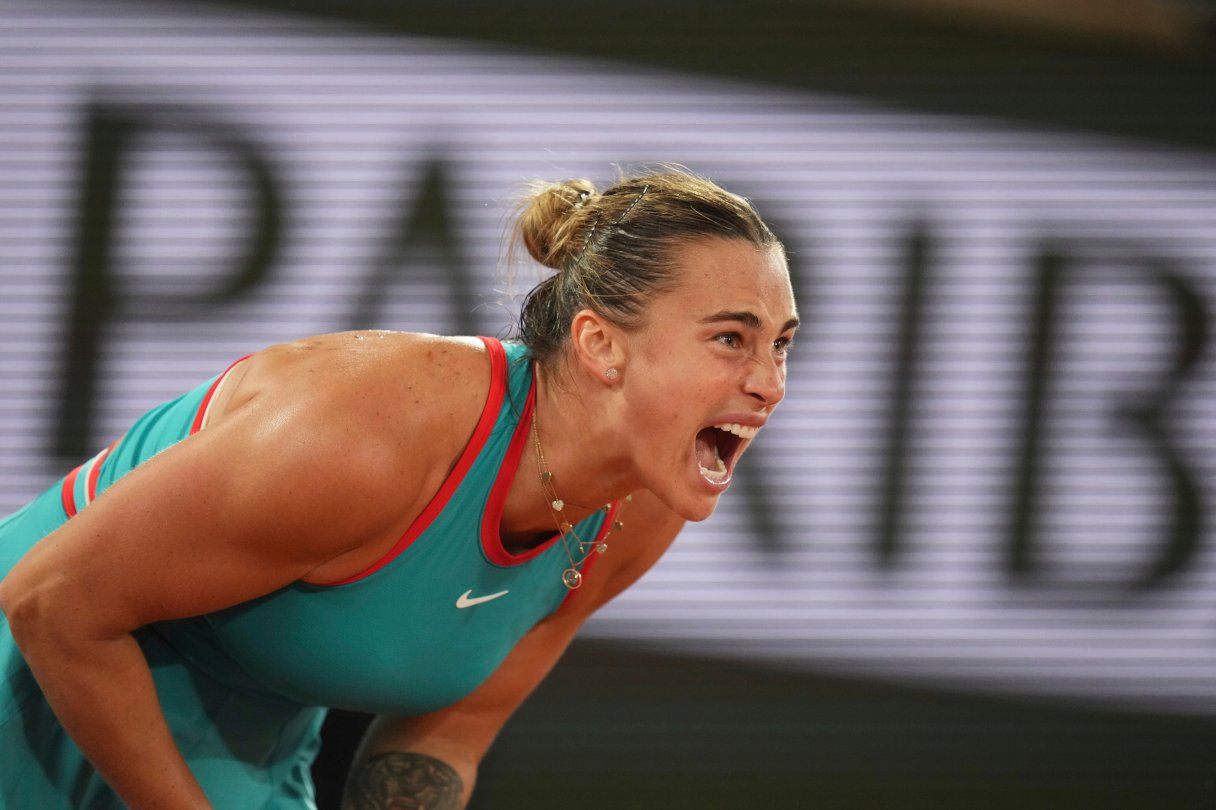
PARIS — Rust-colored flecks of dirt dotted Aryna Sabalenka’s back and caked her white tennis shoes as she ripped big shot after big shot against Iga Swiatek on Thursday, the thud of racket-on-string reverberating off the closed roof of the main stadium at Roland-Garros.
So used to hearing — and believing — she was a fast-court specialist who couldn’t succeed on the slower red clay used by this Grand Slam tournament, the top-ranked player on the WTA Tour showed just how good she can be on the surface by ending Swiatek’s 26-match unbeaten streak at the French Open and bid for a record fourth consecutive women’s singles trophy at the event with a 7-6 (1), 4-6, 6-0 win in Thursday’s semifinals.
Now the 27-year-old Sabalenka will try to win her fourth major title overall — and first not on a hard court — when she takes on second-seeded Coco Gauff in Saturday’s final. It will be the first title match in Paris between the top two women in the draw since 2013 and just the second in the past 30 years.
“It’s going to mean everything to me and my team, because I have to say that almost (my) whole life, I’ve been told (clay) is not my thing, and then I didn’t have any confidence,” said Sabalenka, who has won three major titles, all on hard courts, taking the Australian Open in 2023 and 2024 and the U.S. Open last September. “In the past — I don’t know how many years — we’ve been able to develop my game so much, so I feel really comfortable on this surface and actually enjoy playing on clay.”
Gauff, a 21-year-old American who was the runner-up at Roland-Garros in 2022 to Swiatek, reached her second French Open final by beating 361st-ranked French wild-card entry Loïs Boisson, 6-1, 6-2, in a far less interesting, far less competitive semifinal that ended the home favorite’s storybook run.
“My first final here, I was super nervous, and I kind of wrote myself off before the match even happened,” said Gauff, who is 5-5 against Sabalenka and beat her for the 2023 U.S. Open title at age 19. “Obviously here, I have a lot more confidence just from playing a Grand Slam final before and doing well in one.”
Much to the chagrin of the 15,000 or so locals pulling for their countrywoman at Court Philippe-Chatrier, Boisson versus Gauff wasn’t much of a contest, as might be expected from their rankings and relative experience. Then again, that hadn’t stopped Boisson — who was No. 367 in the most recent WTA rankings but will make a big jump next week — from eliminating both No. 3 Jessica Pegula of the United States and No. 6 Mirra Andreeva of Russia en route to becoming the first woman since 1989 to get to the semifinals in her Grand Slam debut.
“I couldn’t play my game today,” Boisson said after facing Gauff, “because she was just too good.”
It’s been a quarter-century since a woman representing France won the singles title at Roland-Garros, and Mary Pierce’s 2000 victory will remain the most recent for at least another year.
Loud as the crowd was, repeatedly singing Boisson’s first name, Gauff’s play spoke volumes, too, as she took 20 of the first 30 points for a 4-0 lead. That pattern held, and by the end, Gauff had won 34 of the 51 points that lasted at least five strokes.
“I was mentally prepared before the match that it was going to be 99% for her. But I just tried to block it out,” Gauff told the spectators during her on-court interview, laughing as she explained her thought process. “And actually, when you guys were chanting her name, I was saying to myself my name, just to kind of psych myself out. You have to do that.”
Then she added: “I know you guys would usually root for me if I’m not playing a French (opponent).”
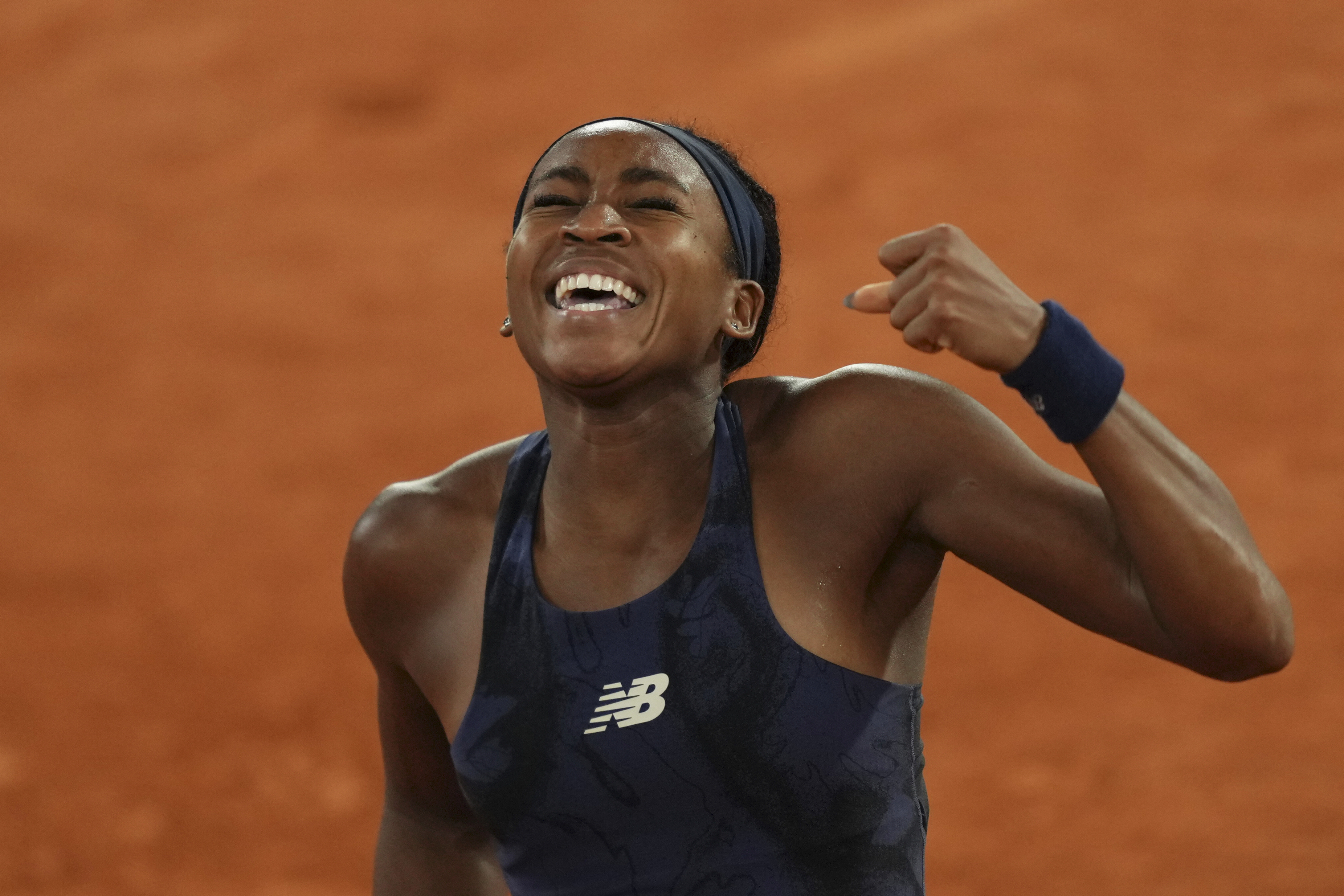
As for Sabalenka, the most remarkable thing about her win was the way she dominated in crunch time, racing through the last set.
“I mean, 6-love,” she said. “What can I say? Couldn’t be more perfect than that.”
Swiatek’s explanation?
“I lost my intensity a bit,” she said. “Just couldn’t push back.”
This stat says it all: The third set included 12 unforced errors off Swiatek’s racket, and zero off Sabalenka’s.
Its extends a rough stretch for Swiatek, at least compared to what she has achieved in recent years. The 24-year-old from Poland hasn’t reached a final at any tournament since walking away with her third trophy in a row in Paris — and fifth Grand Slam title overall — 12 months ago, and she recently slid to No. 5 in the rankings.
Her rut includes a loss in the semifinals at the 2024 Paris Olympics, which also used the red clay of Roland-Garros. Later in the WTA’s 2024 season, she was suspended for a month after testing positive for a banned substance; her explanation was accepted that the result was caused by a contaminated medicine.
Sabelanka is, unquestionably, as good as it gets in women’s tennis right now.
“She didn’t doubt,” Swiatek said. “She just went for it.”
Even though Sabalenka broke in the first game and soon led 4-1 — at which point Swiatek was glancing up at her coach, Wim Fissette, in the stands, hoping for some sort of insight that could change things — this was not one-way traffic. Swiatek ended up leading 5-4 in that set, but when they got to the tiebreaker, Sabalenka asserted herself.
And then she did the same in the last set.
“It was a big match, and it felt like a final,” Sabalenka said. “But I know that the job is not done yet.”
Sabalenka won her most recent encounter with Gauff, which happened a month ago on a clay court at the Madrid Open.
“Anything can happen on Saturday,” Gauff said. “But I’m looking forward to it, and glad to be going up against a world No. 1, too.