
OAKMONT, Pa. — Never mind that Rory McIlroy is finally a Masters champion and the first player in 25 years to join the exclusive list of players with the career Grand Slam. Or that Scottie Scheffler won the PGA Championship last month and reasserted himself as golf’s best player.
They are the biggest stars in the game heading into the third men’s major championship tournament of the year, but they might not be the main attraction. The one name that gets everyone’s attention at this U.S. Open: Oakmont Country Club.
The course that Henry Fownes built in 1903 is as tough as the steel nearby Pittsburgh is so well known for. Geoff Ogilvy, who won the 2006 U.S. Open at Winged Foot in Mamaroneck, New York, once said playing Oakmont “was like the hardest hole you’ve ever played on every hole.”
The United States Golf Association doesn’t have to do much to achieve what it always wants at its biggest show: the toughest test in golf.
Oakmont hosts the U.S. Open for the 10th time on June 12-15, more than any other course in the tournament’s 130-year history. There’s a reason the USGA keeps going back.
“There are certain places in our game where you stand on the first tee and you look out over the landscape, and it’s just meant to play the U.S. Open. Oakmont is that place,” John Bodenhamer, the USGA’s chief championships officer, said in an interview with Golf Channel. “It was built for a U.S. Open.”
Adding to the hype are players who have gone to Oakmont in the weeks leading up to the U.S. Open sharing tales of deep rough and greens that make it feel like they are putting on linoleum. There have been videos of golf balls in the thick grass with only a few dimples visible.
“I would say all of the rumors and everything are pretty on point,” said two-time PGA Championship winner Justin Thomas, who toured Oakmont before heading to the Memorial Tournament last week.
Xander Schauffele has finished out of the top 10 only once in his eight U.S. Opens. He has yet to see Oakmont, but its reputation is enough for him to realize what to expect.
“It’s just a battle. It really is,” Schauffele said. “It can be extremely rewarding if you are able to stay disciplined for 72 holes. The cliché statement of golf is a marathon — it seems to be the most true feeling when you play at U.S. Opens. You just feel like you’re going to war every day.”
Bryson DeChambeau is the reigning champion, one of eight players who broke par last year as the tournament returned to the famed No. 2 Course at North Carolina’s Pinehurst Resort. That was a stern test of a different variety, more about domed Donald Ross greens and fairways framed by sand dunes.
Before that was the experiment at Los Angeles Country Club, where Schauffele and Rickie Fowler made U.S. Open history, each with a record 62 about 10 minutes apart in the first round.
In the eyes of Jordan Spieth, the 2015 U.S. Open winner at Chambers Bay near Seattle, what Oakmont provides is a chance to reset what this event is all about: narrow fairways, deep rough, tough greens. And at Oakmont, the famous “Church Pew” bunkers that separate the third and fourth fairways.
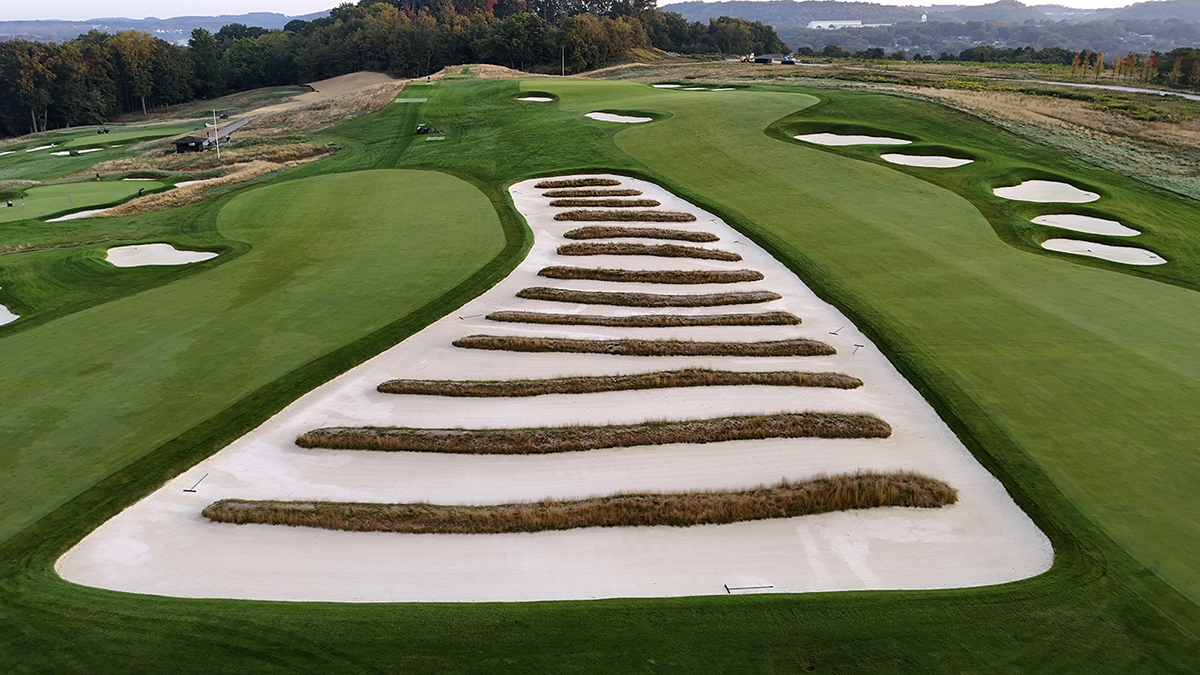
“If you miss the fairway, it’s really hard to make par. And if you hit the fairway, the job’s not done,” Spieth said. “I think it’s a good test. The way I’ve always talked about Oakmont is the USGA needs one year to be able for people to forget about something they did in a different one. It sets the slate straight.
“It’s the easiest Open for the USGA. They don’t have to do a lot to it, and it makes it really good for the tournament.”
Scheffler made his U.S. Open debut nine years ago at age 19, when he was still at the University of Texas. He shot a 69 in the first round at Oakmont, then missed the cut. Now he is a three-time major champion, fresh off his five-shot victory in the PGA Championship at Quail Hollow Club in Charlotte, North Carolina. Perhaps more telling was a four-shot victory last weekend at the Memorial in Dublin, Ohio, where players felt they were getting a preview of the U.S. Open with rough so thick at Muirfield Village that just getting back to the fairway could be a challenge.
The freak injury Scheffler suffered in late December — he tried cutting ravioli with a wine glass on Christmas and punctured his right hand — might have set him back at the start of the year, at least by the high standards he has established over the past three years. He is in full stride now, winning three of his past four tournaments.
Not to be overlooked is DeChambeau, who left the PGA Tour for LIV Golf when the rival circuit launched three years ago. For all the talk about Oakmont’s toughness, Winged Foot is another brute of a U.S. Open test. That’s where DeChambeau blasted away off the tee, powered wedges out of the rough, set the 72-hole scoring record at the course (274) and won by six shots.
Now he is the reigning champion again and ready to match muscles with Oakmont. Only five players in the past 100 years have won back-to-back editions of the U.S. Open.
“I think I’m always chasing history. Everybody is. We’re all trying to accomplish feats that haven’t been done in a long time, and going back to back would be great. Three in a row would be an even better accomplishment,” DeChambeau said. “So it is in the back of my head.
“How am I preparing for it? Just like I would any other tournament. Just like I did last year with Pinehurst, focusing on executing the right shots, hitting the fairways, not three-putting — that’s going to be a big deal — and keeping it out of the rough. I try to keep it simple.”
That’s a recipe for a traditional U.S. Open. Avoiding three-putts is always mentioned at Augusta National, where McIlroy’s playoff victory over Justin Rose settled the Masters in April. That comes into focus at Oakmont because of its reputation for fast greens. Sam Snead once famously (and jokingly) said of Oakmont: “I put a dime down to mark my ball, and the dime slid away.”
One only has to look back at the last U.S. Open at Oakmont, in 2016, when Dustin Johnson’s ball moved ever so slightly as he was stepping in for a par putt on the fifth hole. He didn’t think he caused it to move. The USGA didn’t tell him until the 12th tee that it was being reviewed, and he was penalized after the fourth round was over.
By then, he didn’t care; he won by three shots instead of four.
Johnson has the qualifications for the World Golf Hall of Fame, and so does practically every U.S. Open champion at Oakmont, a testament to its stature.
Missing is Phil Mickelson, who takes on Oakmont for the fourth time. He missed the cut the past two times at the course, and shot 297 — 18 shots behind — in 1994. The U.S. Open remains the only major keeping him from the career Grand Slam, and this likely will be his last one.
Mickelson won the 2021 PGA Championship at age 50. His five-year exemption to the U.S. Open runs out this year, and he already accepted one special exemption (which he didn’t need after he won the PGA Championship). Only once has the USGA awarded a second exemption to a player who had not won the U.S. Open (Seve Ballesteros).