
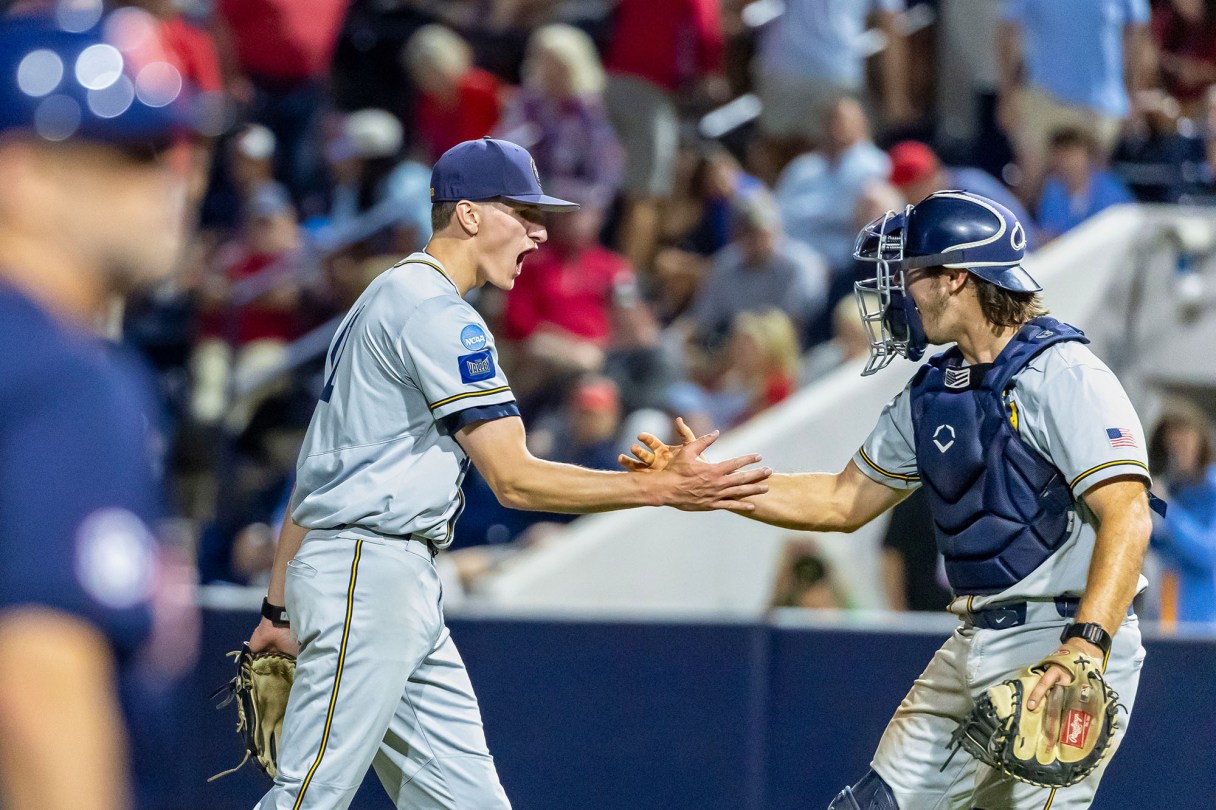
OMAHA, Neb. — Six conferences and an independent (temporarily) program will be represented at the 2025 College World Series, and none of the teams were among the final eight in Omaha a year ago.
In 2024, the Atlantic Coast Conference and the Southeastern Conference had four teams apiece in the CWS, and all the talk was that college baseball would forevermore be dominated by programs from the powerful leagues that invest the most in the sport via scholarships, deals for name, image and likeness compensation, and — starting July 1 as the House v. NCAA settlement kicks in — direct payments to players.
Someone forgot to tell that to Murray State, among others.
The CWS opens Friday afternoon at Charles Schwab Stadium Omaha with Sun Belt Conference champion Coastal Carolina (53-11) — the No. 13 national seed when the NCAA Division I tournament’s 64-team bracket was revealed on Memorial Day — playing unseeded Arizona (44-19), which won the Big 12 in its first year of league membership. It’s a rematch of the 2016 CWS finals, which Coastal Carolina won in what had been the Chanticleers’ lone appearance in Omaha until this year.
No. 8 national seed Oregon State (47-14-1), an independent until the Pac-12 ramps up again in 2026-27, meets the ACC’s unseeded Louisville Cardinals (40-22) in the second game.
Saturday’s first game matches No. 15 UCLA (47-16) of the Big Ten — like Arizona, the Bruins left the Pac-12 after last season — and Missouri Valley Conference upstart Murray State (44-15). The final first-round pairing that night will be an all-SEC battle between No. 3 Arkansas (48-13) and No. 6 LSU (48-15), which won its seventh national championship in 2023.
Double-elimination play will leave two teams standing for the best-of-three CWS title series that starts June 21.
(READ MORE: A look at the eight teams in the 2025 College World Series)
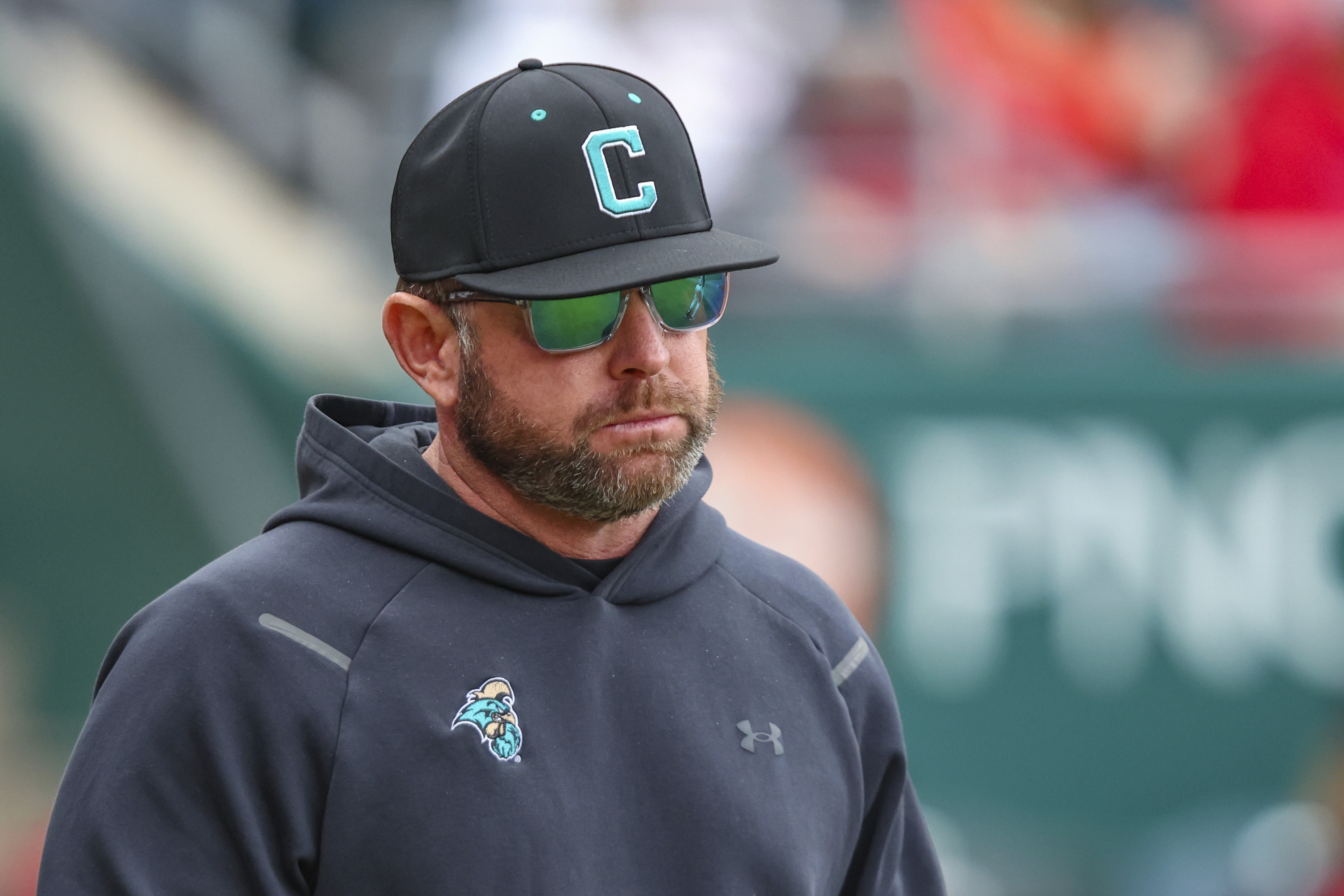
Chanticleers coach Kevin Schnall was Gary Gilmore’s assistant in 2016, and he said he never believed a takeover by the Power Four conferences — the ACC, Big 12, Big Ten and SEC — was inevitable in college baseball. His team’s 23-game winning streak is the longest in history by a team entering a CWS.
“Why has Coastal been so successful for 25 years? Well, Gary Gilmore was able to teach us how to assemble a roster,” Schnall said. “It’s not about putting together just the best players. You have to put together the best team. Sometimes money doesn’t always buy that.”
The money is about to get bigger. The House v. NCAA settlement will mandate roster limits, likely 34 players in baseball, but also allow schools to award as many scholarships as there are roster spots. Most programs are not expected to max out scholarships in baseball, but many will at least double the longtime limit of 11.7.
Jay Artigues, the athletic director at Southeastern Louisiana who also chairs the Division I Baseball Committee, said high-performing programs from mid-major conferences aren’t necessarily at a disadvantage because of how they tend to build their rosters. The outlook for them is not doom and gloom, he said.
“The Arkansases, the LSUs and the Georgias of the world, they’re going to have the premier 18-, 19-year-olds in the country, no question about it,” Artigues said. “They can’t get old because their 18- and 19-year-olds are signing (pro contracts) after that third year. Now where a mid-major can compete against them is having a good 22- or 23-year-old. You put a good 22-, 23-year-old against a really good 18-year-old, it evens the field.
“I think the mid-majors that are having success are all older. You look at what Southern Miss did this year, they’re a fourth-, fifth-year team. That’s why they’re kicking the crap out of some P4 teams.”
Four players projected by MLB.com as first-round picks in this year’s draft will be playing in Omaha: LSU left-handed pitcher Kade Anderson (projected at No. 1 overall), Oregon State shortstop Aiva Arquette (No. 3), Arizona outfielder Brendan Summerhill (No. 16) and Arkansas shortstop Wehiwa Aloy (No. 23).
Craig Keilitz, the executive director of the American Baseball Coaches Association, said the diversity of this year’s CWS field is good for the sport.
“I’m probably surprised as a lot of people as this proliferation of money has followed its way down, to say it might not be possible,” he said. “But I think it’s absolutely remarkable. I think it’s going to be interesting. I think it’s going to be highly watched and followed. I don’t think we could have scripted it any better.”
Louisville coach Dan McDonnell said he thought at least one more ACC team would join his in Omaha, but he can’t help but be happy for Murray State to make it considering he played second base for The Citadel in 1990, when the Southern Conference’s Bulldogs made it all the way to the CWS. It was his greatest baseball experience, he said, and as far as he’s concerned, the more players who can experience the CWS, the better.
The CWS is celebrating its 75th anniversary in Omaha, which landed what then was a lightly attended tournament in 1950 partly because city leaders promised to cover any cost overruns. The CWS blossomed in the 1980s with the start of ESPN’s national coverage, and in 2011, it moved from a dilapidated Rosenblatt Stadium to the 24,000-seat Charles Schwab Field Omaha in 2011.
“Omaha!” long has been a rallying cry for baseball teams hoping to play for the national championship, and the city and the NCAA have a contract that keeps the CWS in Omaha at least through 2035.