
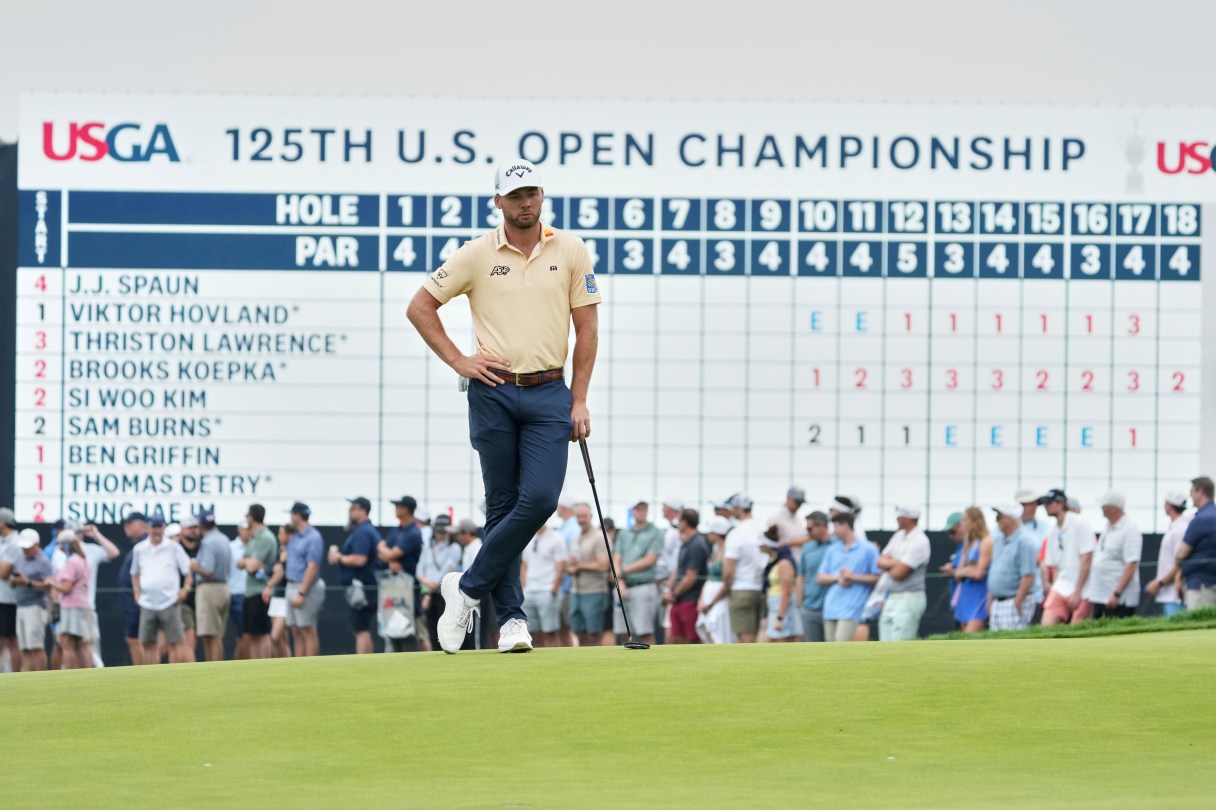
OAKMONT, Pa. — The pounding rain arrived far too late to douse so many of the meltdowns across Oakmont Country Club on Friday in a U.S. Open that produced a brilliant round by Sam Burns and a litany of collapses and tantrums typical in a major that prides itself on being the toughest test in golf.
Only three players remained under par.
Still to come are two more rounds on a course that ruined good scores with remarkable swiftness on a day when rounds took nearly six hours to complete and not everyone got to the tournament’s 36-hole mark.
“There’s no hole where you can get up there and just hit it and not really pay attention to what you’re trying to do,” Burns said after a 5-under-par 65 that moved him to the top of the leaderboard, one shot ahead of first-round leader J.J. Spaun, who fell out of a share of the lead with a bogey on the 18th, his sixth in a round of 72.
“I think it requires a lot of focus on every shot,” Burns added, “and even when you’re in the rough and you’re trying to get it back in the fairway, it’s just, every shot is difficult. I think over time that’s just pretty taxing.”
Scottie Scheffler battled just to salvage a 71 — the sixth straight round over par in a U.S. Open for the same player who has been No. 1 in the Official World Golf Ranking for two-plus years — and then headed to the practice range with arms flailing while venting frustration on why the ball wasn’t going where he wanted. He was seven shots behind but felt he was still very much in the hunt for a second straight major title and fourth overall after adding a PGA Championship victory last month to his pair of Masters triumphs from 2022 and 2024.
Second-ranked Rory McIlroy flung a club on No. 12 and smashed a tee marker on No. 17, made a birdie on his last hole and then declined to share thoughts on his round — or anything else — for the sixth straight round in a major. The star from Northern Ireland hasn’t spoken at one since winning the Masters via playoff in April to complete the career Grand Slam.
Shane Lowry, McIlroy’s good friend from Ireland, was having such a tough time that he blanked and picked up his ball on the 14th green without marking it, a one-shot penalty that turned his 77 into a 78, not that it mattered.
That was the mental side. The physical part of golf looked even worse.
Thriston Lawrence became the first (and only) player to reach 6 under so far at this 125th U.S. Open. He promptly made six bogeys and a double bogey over his next nine holes. He was still 1 over — four shots behind — and was ready to hit a four-foot par putt when the round was halted because of weather.
He would have to return Saturday morning. Have a nice night.
“A bit frustrating in that sense, but those are the rules,” said Lawrence, one of 13 players whose second round was in limbo. “It’s an important putt. Each shot means a lot in a championship like this.”
Thomas Detry can appreciate the suffering. He was challenging for the lead until three double bogeys in a four-hole stretch.
“If I can avoid making a double bogey on those next two days, I will have achieved what I wanted to achieve,” Detry said.
And then there was Phil Mickelson, in what likely is his 34th and final U.S. Open. He was just outside the top 20 until two double bogeys in his last four holes for a 74, moving to 8 over. The projected cut line was at 7 over, and Bryson DeChambeau’s to repeat as champion and add a third U.S. Open title was over as he reached 10 over with a 77.
He’s the first reigning U.S. Open champion to miss the cut since Gary Woodland in 2020 at Winged Foot Golf Club in Mamaroneck, New York — where a bulked-up DeChambeau overpowered the course to win by six shots.
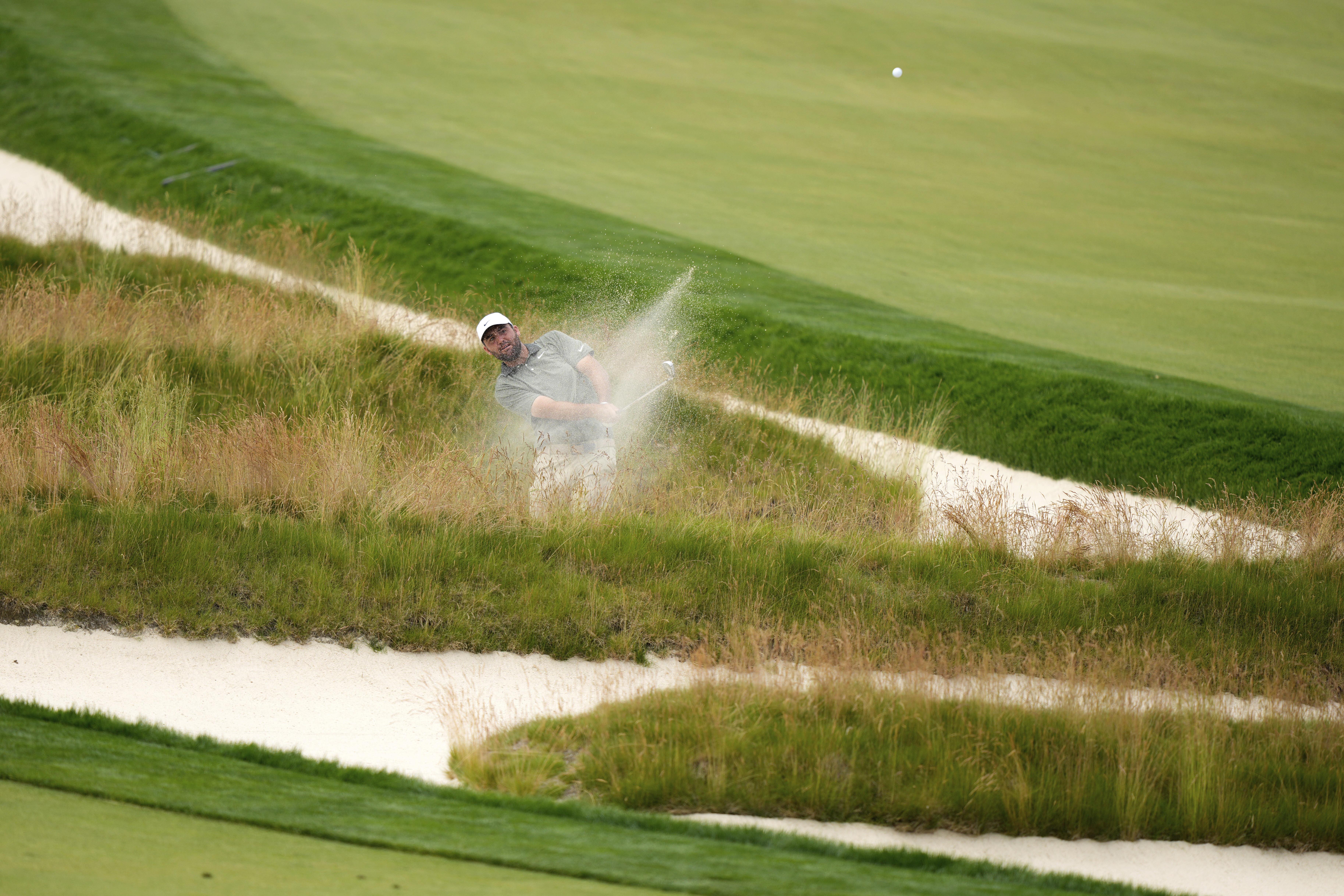
Those on the number for advancing beyond the first 36 holes included Baylor School graduate Harris English, who followed his opening 73 with a one-birdie 74. This is his 10th U.S. Open, and he has never missed the cut, with his best results coming in a four-year stretch from 2020 to 2023 as he finished tied for eighth or better three times.
Fellow former Red Raiders standout Stephan Jaeger also opened with a 73 but chased it with a 76; after making the cut on the number at the Masters in April and at the PGA Championship last month with a shot to spare, he couldn’t find his way to the weekend at Oakmont.
Burns played in the morning and missed all this chaos, getting to 3-under 137 through 36 holes for a number that no one could match the rest of the day.
Burns and Viktor Hovland (68) each have 11 sub-par holes through 36, the most to that point in three U.S. Opens at Oakmont since it switched to par at the course being 70 in 2007. Hovland was two shots behind, alone in third.
Burns can only imagine where he would be if not for a shocker of a finish Thursday, when he was one shot out of the lead and then played his last four holes at 5 over.
“I played really well yesterday other than the finishing holes. So I think today was just kind of getting mentally ready to come out and try to put a good round together,” said the 28-year-old from Louisiana who tied for ninth at last year’s U.S. Open for his lone top-1o finish in any major. “It was unfortunate, but there was too much good to focus on the little bit of bad.”
Hovland twice holed 50-foot shots from off the green: a putter from the collar on No. 10 when he started his round, and chipping in for eagle on the reachable par-4 17th. He also chopped up the second hole for a double bogey, but he was happy to be done.
“Definitely tired, exhausted because you’re just focusing so much on every single shot,” he said. “I’m very pleased with 2 under par, but also I know that I was 4 under at some point. So it’s like very pleased, but also, ‘Man, that could have been a little bit lower.’ But we’re in a really nice spot after two days, so I’m just kind of happy.”
Adam Scott, playing in his 96th consecutive major, had another 70 and joined Ben Griffin (71) at par 140.
Scheffler was among those who had little room left for mistakes. He opened with a birdie on No. 10, but then didn’t find another fairway until he came up just short of the green on the 17th, 50 feet away for eagle. Four putts later, he had a bogey.
It was a grind all the way, battling his swing and the rough, making a number of key par putts that kept the round from getting worse.
“Today was, I think with the way I was hitting it, easily a day I could have been going home,” Scheffler said. “And battled pretty hard to stay in there. I’m 4 over. We’ll see what the lead is after today, but around this golf course, I don’t think by any means I’m out of the tournament.”
Neither is five-time major winner Brooks Koepka, who had a 74 but was only five behind.
Jon Rahm went from red numbers to red in the face with a 75, leaving him in the same spot as Scheffler. Rahm, who took 35 putts, was asked if his score could illustrate how tough Oakmont was playing.
“Honestly, too annoyed and too mad right now to think about any perspective,” he said. “Very frustrated. Very few rounds of golf I played in my life where I think I hit good putts and they didn’t sniff the hole. So it’s frustrating.”
That’s not just Oakmont. That’s most U.S. Opens. In that respect, Hovland was a curious contender. He has been all over the place with his swing, his expectations, his confidence. He won during the PGA Tour’s Florida swing and is making progress. Perhaps the lack of expectations helped him.
“For some reason I’ve just been in a really nice mental state this week,” Hovland said. “Both my rounds have been very up and down. I feel like a couple times if it would have happened at another tournament, for example, I could have potentially lost my mind there a little bit. But I felt like I kept things together very well.”