
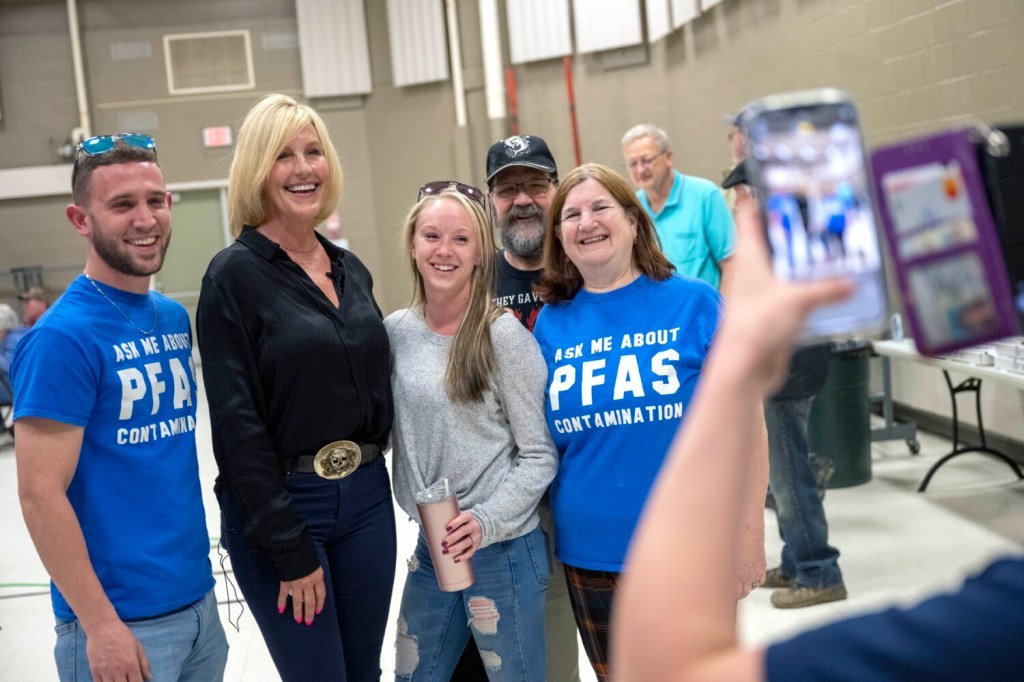
“Forever chemicals,” a class of long-lasting compounds prevalent in commercial products, have been on Erin Brockovich’s radar for at least a decade.
Brockovich, a consumer advocate, first rose to national prominence about 30 years ago when she helped build a case against a California utility company, Pacific Gas & Electric, alleging the corporation had contaminated the town of Hinkley’s water supply. A lawsuit was settled for $333 million in 1996, and Brockovich’s role in the fight was later adapted into an Oscar-winning movie.
Brockovich has since set her sights on per- and polyfluoroalkyl substances, or PFAS. Companies have used those so-called “forever chemicals” for decades because of their stain- and heat-resistant properties. However, they don’t break down naturally in the environment, meaning they can accumulate in animals through food or water.
According to the Environmental Protection Agency, peer-reviewed studies indicate exposure to certain levels of PFAS could lead to developmental delays in children, increased risk of some cancers and other health effects.
Consumer advocate Erin Brockovich talks PFAS, building trust



In 2024, the EPA announced new drinking water limits for forever chemicals, setting a maximum of 4 parts per trillion for the two most common types — PFOS and PFOA. The Trump administration has decided to maintain the Biden-era drinking water standards for those two types of PFAS, but it will rescind and review the guidelines for a few other compounds. Federal officials have given public drinking water systems more time to comply with those requirements, extending the deadline from 2029 to 2031.