
Five years ago this month, just before 6 a.m. on March 2, 2020, the Nashville office of the National Weather Service posted a message on social media about changes in the forecast.
“Yes, just 3 days ago, we were advertising lots of rain this week,” the message read. “Model changes happen. Heavy rain isn’t huge threat anymore … HOWEVER, there is a growing strong to severe threat this evening. Large hail, damaging winds and even a tornado can’t be ruled out.”
The message said the main time frame for the severe weather threat was between 6 p.m. and 2 a.m.
Around 12 hours later, another message came.
“Severe storms are possible overnight tonight for all of Middle Tennessee,” it read. “Be sure to keep your phones on and have a way to get warnings while you sleep. This entire event will take place overnight tonight.”
Then, just after midnight, another.
“Confirmed tornado northwest of Downtown Nashville. TAKE COVER NOW IF YOU ARE IN DAVIDSON, WILSON, OR SUMNER COUNTIES!”
The tornado brushed NewsChannel 5’s studios, and meteorologist Bree Smith, who was on air at the time, said the station was flying blind. She was able to convey to the public information about the tornado because of the weather service.
“I lost all monitors in the studio. I did not know if we were even still on TV. All I had was one computer that was still getting radar data from the National Weather Service, and I had one computer that was working with an active chat with the National Weather Service in a completely dark studio,” Smith told the Nashville Banner.
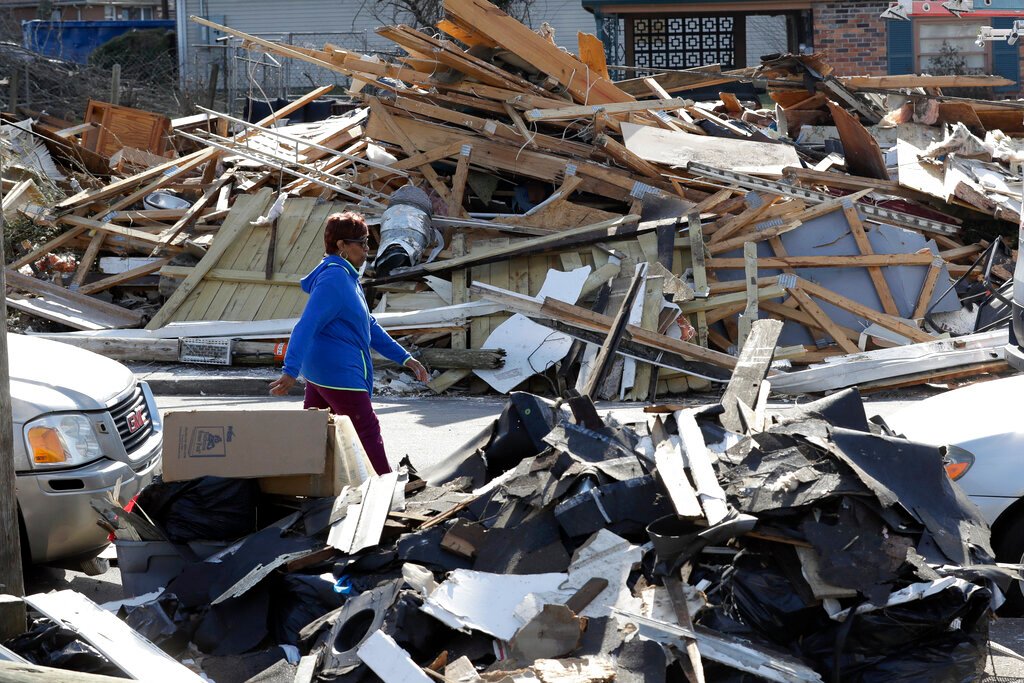
By the night’s end, seven tornadoes had touched down in Middle Tennessee, including one that tore through Nashville and blew east for more than 50 miles. Twenty-five people, including five children, were killed.
The forecasts that warned people across the region about the coming storms and urged them to take cover as tornadoes touched down were enabled by data, radar images and models made possible by the agency which has recently found itself under the axe of President Donald Trump’s administration and billionaire Elon Musk’s Department of Government Efficiency. Hundreds of federal workers have been fired from jobs at the National Weather Service and its parent organization, the National Oceanic and Atmospheric Administration, and hundreds more have reportedly accepted the administration’s invitation to retire.
Current and former weather officials have warned that the cuts — including the firing of people focused on hurricanes, tornadoes and floods — could hamper forecasts and severe weather warning efforts. The cuts come just as the U.S. is entering tornado season.
The mass firings, uncertainty about what could come next, and the intense political polarization of this moment seem to have had a chilling effect. People in the local weather community either declined to comment or did not respond to requests. Officials at Nashville’s weather service office referred the Banner to the agency’s federal public affairs office, which has not responded. Sources told the Banner that no one at Nashville’s weather service office was fired but that the office was already short-staffed and that hiring in such an uncertain time would likely be difficult.
“They are a tiny but mighty group that watch over Middle Tennessee, 365 days a year, 24/7,” Smith said. “Currently the Nashville National Weather Service office covers 38 counties — it’s over 2.7 million people — with a staff of 16. And they have to be two people on at all times, so 16 people are somehow covering 38 counties every single hour of the day, all year, and they’re not just monitoring it as far as issuing watches and issuing warnings, but also working with the storm prediction center.”
They don’t just sit behind desks, either, Smith said.
“They collect data. Weather balloons are released at every National Weather Service location twice a day, across the country, across the globe,” she said. “And that data is critical because if we don’t know what’s happening at the surface and at every layer of atmosphere, we don’t know what these storms are gonna do. And the computer models, and even the weather apps on people’s phone, they’re all pulling from the data that these National Weather Service offices are creating.”
James Spann, a long-respected Alabama-based meteorologist who has been working since the 1970s, spoke to the Banner by phone on Wednesday between television segments.
“I don’t think people really understand what is provided from the National Weather Service,” he said.
The service is headquartered in Maryland, where officials oversee a network of six regional offices and 122 local weather forecast offices. Weather data is fed through this network, which is staffed throughout with meteorologists and forecasters who issue the updated predictions and warnings that make their way to local television news stations or severe weather outlets.
Spann said the service is the source of the most essential tools people in his position rely on for everything from severe weather warnings to more mundane daily forecasts.
“The weather service operates the radar that we use,” he said. “They operate the satellites that we use. These beautiful satellite images you see when you open up your app? Where does that come from? It comes from the National Weather Service. Goodness, my core tool when it comes to telling people what the weather is going to do over the next seven days is computer models. Who runs the computer models? The National Weather Service.”
Weather forecasters are not only concerned about staff reductions. Various outlets have reported that Musk’s DOGE plans to cancel the leases for buildings housing critical weather operations, including the National Centers for Environmental Prediction, which includes the Environmental Modeling Center and the Radar Operations Center in Oklahoma. Trump administration officials have disputed some of that reporting without clarifying their long-term plans for the buildings or the work that goes on inside them.
“I’m all for better efficiency in government,” Spann told the Banner. “I’m all for it. But you can’t do it at the expense of setting up a dangerous situation where a tornado might go unwarned.”
Smith put the service, and potential cuts to it, in blunt terms.
“The National Weather Service are the weather heroes of this community,” she said.
This article first appeared on Nashville Banner and is republished here under a Creative Commons license.