
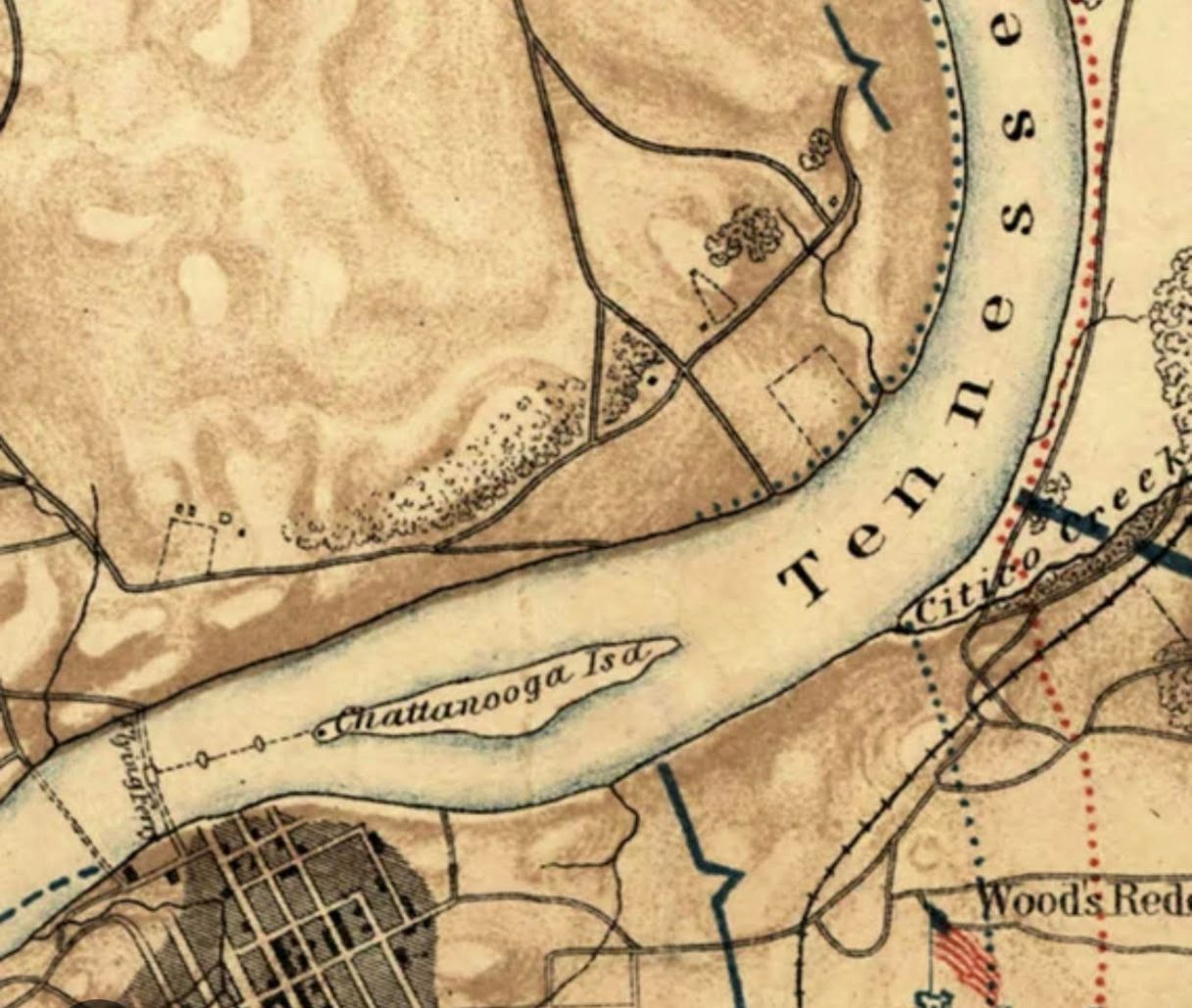
(Editor’s note: Second of two parts)
As work began on Chattanooga’s Riverside Drive in 1915, it became obvious that Citico Mound needed to be leveled. Within the first week of excavation, the steam shovel had uncovered the partial remains of a “long-buried” individual, increasing speculation about the nature of the mound and its hidden history (formerly the center of the Mississippian/Muscogee Citico town.)
Two days after the discovery of a human skull and other bodily remains, the “finds” were on display in the window of the Chattanooga Daily Times, and as the newspaper reported, “thousands” wandered outside the Georgia Avenue exhibit. Random comments from viewers were recorded in an article. A “bright-faced girl” filed by the window several times before remarking, “I’m satisfied it is no one I knew.” A prominent local minister stopped among the crowd, turned to the Times reporter, and said, “Right in that window is what we are all coming to some time. What a subject for a sermon!”
As the story spread across The Associated Press wires, others from near and far weighed in on the discoveries. W.E. McElwee, a Rockwood archeologist, sent a list of questions in a letter to the Times and stated the answers would help him identify the approximate age of the artifacts. He was especially interested in the pottery shards and asked if they bore “undulating lines.” The answer was “Yes” — the decorative lines, usually in groups of four or six, were interwoven in a pattern reminiscent of a chain. He also inquired if the pottery was composed of “sedimentary or plutonic work” and was told by a local mining engineer that “plain river bottom soil” was the primary ingredient.
Experts from the Academy of Natural Sciences of Philadelphia, who had earlier visited and retrieved a number of artifacts, asserted that the “mound had been built more than five centuries earlier.” Their research uncovered a female skeleton buried in a sitting position with a large pot. The large handled container was partially filled with food and found between the woman’s knees. The team’s director suggested that the differences between the bones found in the field nearby and the graves nearest to the mound seemed to confirm “evidence of two races.”
George Gardenhire, who originally owned the Mound and much of the land nearby, visited the site on June 17, 1915, and was given “five or six pieces of cedar, each two feet in length,” taken from the center of the feature by the steam shovel. He reminisced about the Mound’s history. According to him, a small fort or blockhouse had been constructed at the summit around 1848. Recounting stories from ancestors, who had owned the land for five generations, Gardenhire recalled that the structure was two stories high and had rows of portholes around it and a “conning tower” on top. He mentioned that his family had once owned a copy of a Civil War photo which showed the blockhouse.
As excavation continued, another skeleton was uncovered. The bones, according to experts onsite, were those of a middle-aged female only five feet tall but with teeth wear indicating an adult. Interestingly, when exposed to the air, the finger bones disintegrated into dust with only the arm and leg bones along with a few vertebrae surviving. Uncovered also were a number of pots, shell beads, some stone “chisels and hatchets,” and various shell decorations used perhaps as necklaces.
By late summer, the fervor over the hill seemed to have evaporated. A Chattanooga Daily Times headline read that “Citico Mound Not All It Was Cracked Up to Be.” The story stated that while some had expected a “treasure chest” or a “tomb of Warrior Citico,” the truth was that other than some “bones and shells,” the Mound revealed few secrets.
The construction of Riverside Drive continued. The final days revealed that the interior soil was firm and compacted in contrast to the land around the base where the bone fragments were found. Scholars speculated that the “risen ground had most likely been used as an observation post by the early native peoples. Tragically, the final days of excavation also witnessed the only construction death; a Hamilton County Highway Commission employee, Buster Benton, was killed when a portion of the mound collapsed and trapped him in the avalanche.
Some Chattanoogans feared the accident was the result of disturbing a sacred burial ground.
Linda Moss Mines is the Chattanooga-Hamilton County historian. For more on local history, visit Chattahistoricalassoc.org.