
NEWARK, N.J. — When Alabama faces Duke for a trip to the men’s Final Four on Saturday, fans will witness what some say is the future of college basketball, what others call a byproduct of nobody putting up a good enough fight on defense, or some combination of both.
The meeting pitting All-America first-team selections Cooper Flagg (Duke) and Mark Sears (Alabama) against one another is also a showdown between teams that each hit the 100-point mark — a semi-rarity in college games that run eight minutes shorter than the pros — in the Thursday night contests that vaulted them into the East Region final of the NCAA Division I tournament.
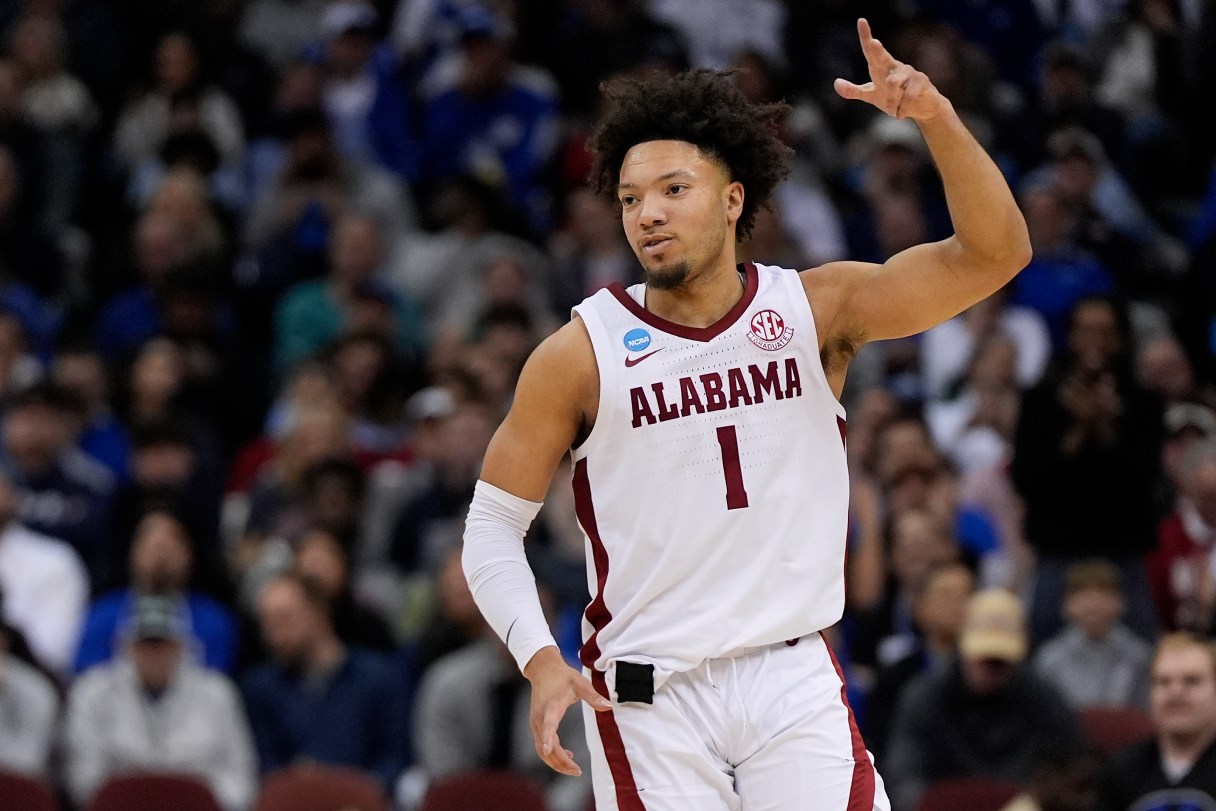
Second-seeded Alabama (28-8) set March Madness records by attempting 51 3-pointers and making 25 in a 113-88 win over sixth-seeded BYU in the Sweet 16. Had the Southeastern Conference’s Crimson Tide not taken any of their scant 15 shots from inside the arc, they still would have scored enough to win.
Top-seeded Duke (34-3), not as prolific a 3-point shooting team as Alabama but every bit as deadly with Flagg doing the scoring and passing, shot 60% from the floor and made 11 of 19 tries from 3-point range (57.9%). The Blue Devils, who swept the Atlantic Coast Conference regular-season and tournament titles, beat Arizona 100-93.
What conclusions to draw?
“At the end of the day,” Duke coach Jon Scheyer said, “it’s math.”
As the Tide illustrated with precision on Thursday, a team that shoots 33% from behind the arc can run a more free-flowing offense with a better chance of open shots and will score as many points as one that grinds its way for 2-point baskets and makes 50% on the same number of attempts.
This move to the 3-pointer is, in some minds, what’s currently ruining the NBA.
“It’s just who can run faster, who can hit more 3s; it’s no substance. I think it’s very boring,” Golden State Warriors forward Draymond Green — whose own team used long-range shooting to win multiple championships — said during the midseason break for the NBA All-Star Game.
That style of play has infiltrated the college game, and it figures to only grow as teams such as Alabama and Duke keep scoring and winning.
With Sears leading the way — his 10 3-pointers Thursday were one short of the NCAA tourney record — the Tide play that game as well as anyone.
They average a nation-leading 91.4 points a game. Coach Nate Oats, a former math teacher who understands the numbers, said his team will adjust if needed.
“When people ask me, ‘How many 3s do you want to get up?’ Well, it depends on how you want to guard us,” Oats said. “If you’re going to guard us and not let us in the paint, let’s get 51 up. … If you want to completely run us off the (3-point) line, we’ll try to go score 70, 75 points in the paint.”
Duke also shoots its share of 3s, though its roll through the tournament could be seen as much as a product of what happens, quite simply, when a team has all the best players. There are six Blue Devils who look like NBA draft picks.
The best of them is Flagg, who is 6-foot-9 and, according to retired Syracuse coaching legend Jim Boeheim and others, is also starting to look like a modern-day version of Larry Bird — with the potential to be even better than the Boston Celtics great.
The 18-year-old had 30 points, six rebounds, seven assists and three blocks against Arizona on Thursday. The actual performance — the no-look pass to Sion James in the corner for 3, the play where Flagg bobbled the ball but gathered and flipped it up to Khaman Maluach for an alley-oop dunk — looked even better than the numbers themselves.
“We’re going to have to do our best,” Oats said. “But he’s also one of those guys that, I mean, you’re not going to hold him down to 10 points.”
Duke has attempted 45.4% of its shots from 3-point range this year, compared to 46.2% for Alabama. The reason the Tide feel so much more prolific from behind the arc is because they lead the nation in possessions this season, while Duke, which plays slower, sits at 274th.
At any speed, both teams are following an unmistakable trend.
Six years ago, NCAA champion Virginia played deliberately but still attempted 39.5% of its shots from long range. When Duke won it all in 2015, none of the Final Four teams (including Kentucky, which came into the semifinals undefeated) took more than 39.8% of their shots from 3.
So that’s the future of college hoops. And the present.
The team that heads to San Antonio for next weekend’s Final Four will probably be the one that figures out how to stop all those 3s, or at least slow them down, or, if none of that works, simply make more of them.
“I just think it’s about the math,” Scheyer said. “I still think it’s an exciting game, and I’m sure the game will evolve somehow. I’m not sure why that is right now, but I don’t think it can change anytime soon.”