
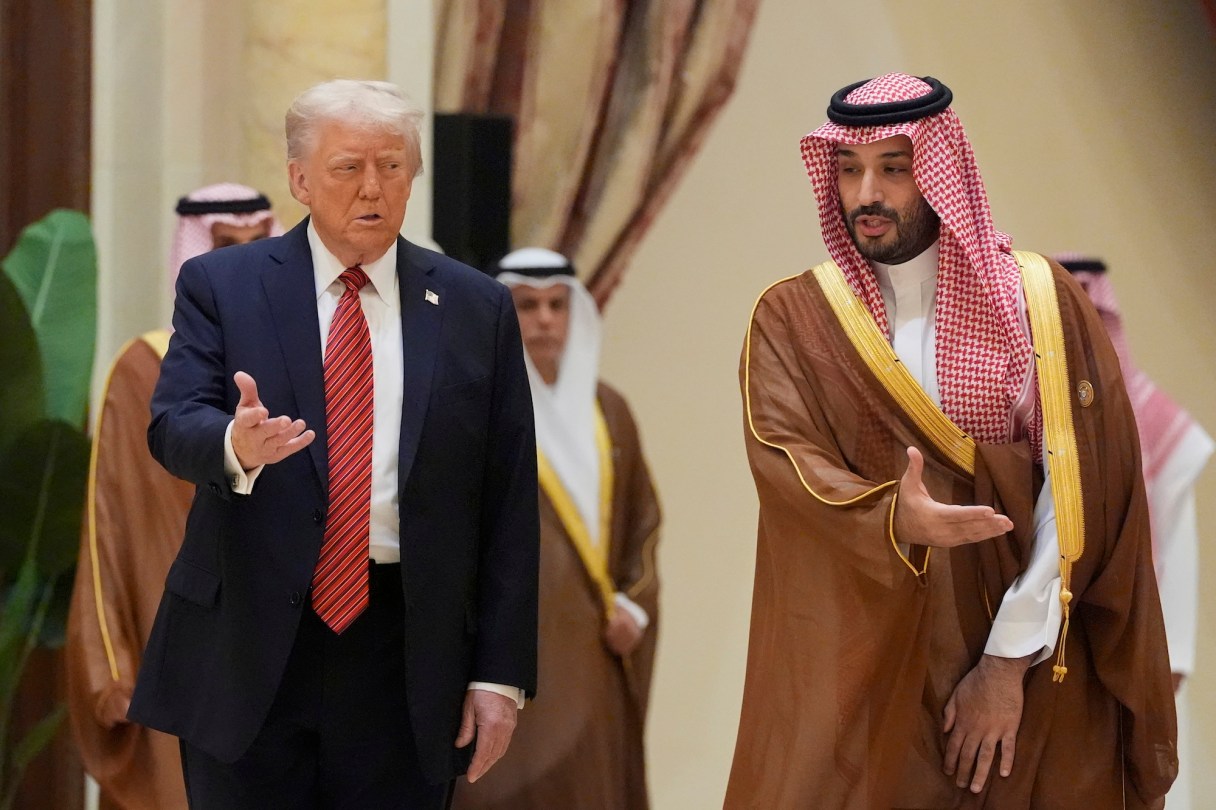
American presidents are supposed to have a grand theory of foreign policy — a proper doctrine, like Harry Truman and James Monroe and all their imitators — because how else would we categorize them?
Various doctrines have been attributed to Donald Trump over the years: Jacksonian, realist, nationalist, isolationist, unconventional dove, conventional hawk, anti-imperialist, neo-imperialist. Clearly he is no kind of idealist, no starry-eyed Wilsonian; those labels can be ruled out. But is there a definite idea at the heart of his approach to foreign policy?
Only if you consider dealmaking an idea. Because it’s the quest for the handshake that guides Trumpian foreign policy on almost every front.
Obviously “America First” nationalism is essential to his self-image. But it doesn’t necessarily predict his actual behavior. If our allies in the Middle East want to make a big, beautiful deal to build up their artificial intelligence capacities, Trump is ready to shake hands even if involves outsourcing some of the world’s most important emergent technology. If our rivals in Beijing want to come to the negotiating table on tariffs, the nationalist dream of a total decoupling from China can be set aside.
Likewise, Trump styles himself an anti-interventionist; he gave a big speech in Saudi Arabia on that theme. But any neo-isolationist impulse can dissolve quickly when there’s a big incentive for dealmaking — as in, most recently, the India-Pakistan conflict. And Trump is happy to be hawkish when it suits him, ordering a bombing campaign against the Houthis, threatening North Korea in his first term, even making vague threats against the territory of a NATO ally because he covets Greenland. He sees military force as a useful tool when a rival isn’t yet willing to be a dealmaker, but he switches from hawk to dove as soon as those conditions change.