
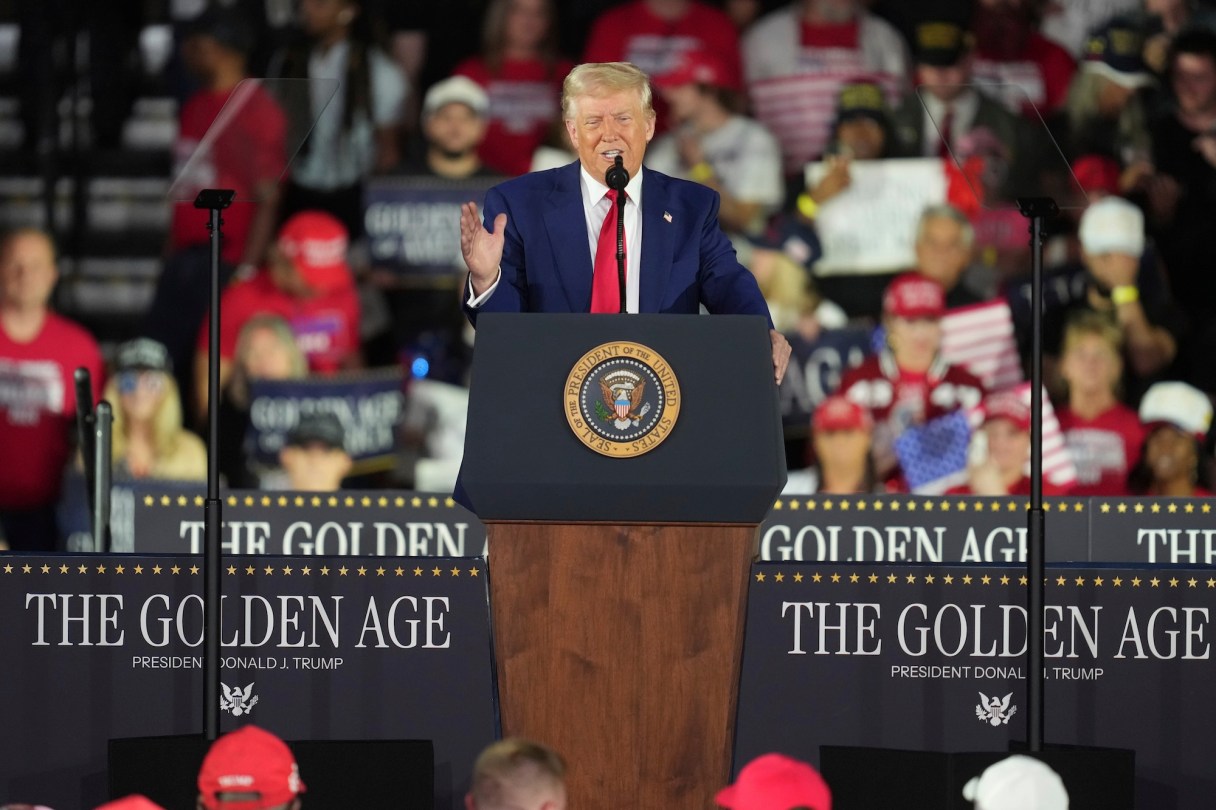
Pundits are confused about what to make of the first 100 days of the second Trump administration.
Supporters talk of “flooding the zone,” believing President Donald Trump is making so many changes so quickly that his opposition is reduced to deer-in-the-headlights infancy.
Opponents either claim that Trump’s first three months are directionless chaos or a Hitlerian nightmare or both.
But what is really happening?
One, Trump is finally addressing the problems that proverbially “cannot go on forever, and so they won’t go on.”
When, if ever, would the left have closed the Southern border? After 10, 30, 50 million illegal aliens?
How many more criminal illegal entrants was the Biden administration willing to allow into American neighborhoods – 500,000? 1 million? 3 million?
How long was the world simply going to ignore the human destruction on the doorstep of Europe?
Would former President Joe Biden or former Vice President Kamala Harris have sought a ceasefire? Or would it have taken another 1.5, 3, or even 5 million more dead, wounded, and missing Ukrainians and Russians?
All moaned that China was piling up huge trade surpluses while denying its own population the usual modern safety net. They knew Beijing’s aim was to use the trillions of dollars in trade surpluses to build a new massive military, a greater arsenal of nuclear bombs, and a new imperial Belt and Road overseas empire.
Yet no administration did anything but greenlight American outsourcing and offshoring while ignoring Chinese trade cheating and technology theft.
In sum, we just witnessed all at once a 100-day, 360-degree effort to address all the existential challenges that we knew were unsustainable but were either afraid or incompetent to address.
Second, the administration apparently wants to confront the source of these crises and believes it is the progressive project.
The left maintains real political power not by grassroots popularity, but rather by unelected institutional clout. The party of democracy uses anti-democratic means to achieve its ends of perpetual control.
It wages lawfare through the weaponization of the state, local and federal courts.
It exercises executive power through cherry-picked federal district and circuit judges and their state and local counterparts.
The permanent bureaucracies and huge federal workforce are mostly left-wing, unionized and weaponized by a progressive apparat.
Academia is the font of the progressive project. Ninety percent of the professoriate are left-wing and activist – explaining why campuses believe they are above the rules and laws of the Constitution, the Supreme Court and the U.S. Congress.
Add into the mix the blue-chip Accela corridor law firms and the globalized corporate and revolving-door political elite.
The net result is clear: Almost everything the vast majority of Americans and their elected representatives did not want – far-left higher education, a Pravda media, biological men destroying women’s sports, an open border, 30 million illegal aliens, massive debt, a weaponized legal system and a politicized Pentagon – became the new culture of America.
So, Trump is not just confronting unaddressed existential crises but also the root causes of why, when and how they become inevitable and nearly unsolvable.
His answer is a messy, knock-down-drag-out counterrevolution to reboot the country back to the middle where it once was and where the Founders believed it should remain.
His right and left opponents call such pushback chaotic, disruptive and out of control.
But the counterrevolution appears disorderly and upsetting, mostly to those who originally birthed the chaos; it certainly does not to the majority of Americans who finally wanted an end to the madness.
Victor Davis Hanson is a historian at the Hoover Institution, Stanford University.