
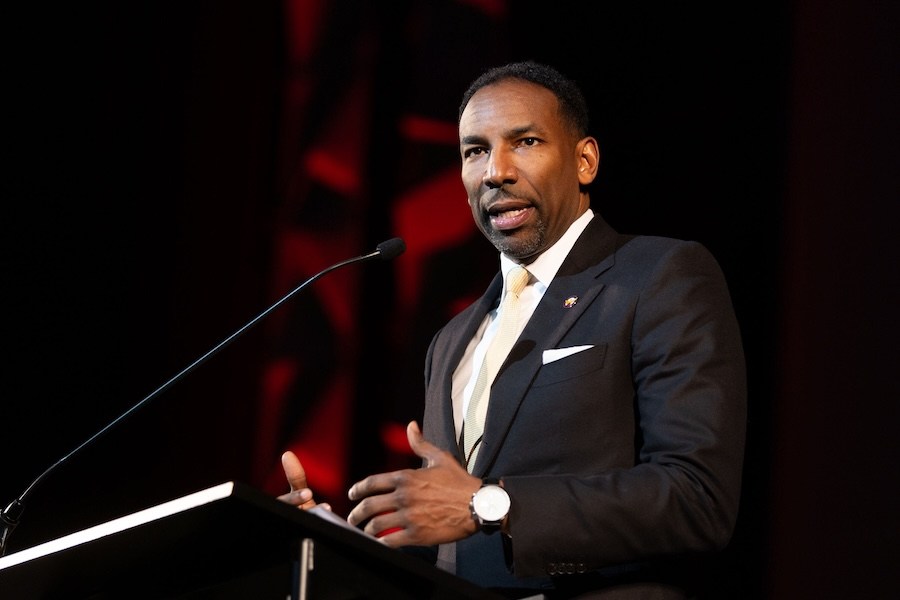
Four years ago, Andre Dickens was an ambitious Atlanta City Council member who surprised even the most veteran politicos when he went from single-digit polling to a runoff victory in one of the most lopsided mayoral elections in modern history.
On Tuesday night, Dickens’ reality could not be more different as he celebrated a blowout reelection win that secured him four more years in office. The Associated Press called the four-way race just 90 minutes after polls closed.
The Adamsville native has always envisioned the city’s top job as an eight-year commitment. After taking office in 2022 on the heels of the pandemic, Dickens worked quickly to mend the city’s fractured relationship with state leadership and reduce Atlanta’s high violent crime rates — which have dropped significantly since he took office.
He’s been praised throughout his first term for successfully thwarting an effort by some Buckhead residents to secede from the city, pouring millions of dollars toward affordable housing initiatives and fighting gun violence by focusing on Atlanta youth.
Dickens has few critics inside City Hall and boasts a strong alliance with Atlanta City Council, which rarely pushes back publicly against the administration’s agenda. Going into a second term, the mayor hopes to leverage his relationships to pass an ambitious extension of all of Atlanta’s tax allocation districts — a controversial proposal that he says is needed to fight racial disparities across neighborhoods.
But he also faces headwinds.
Throughout the first year of President Donald Trump’s second term, Atlanta has lost millions in federal dollars for high-stakes infrastructure projects and faces even greater losses if the city challenges a Trump administration order looking to do away with diversity, equity and inclusion initiatives — a hallmark of Atlanta history.
Atlanta has so far also avoided federal military intervention, even though Georgia’s capital city has been a prime target of Trump in the past.
Some missteps
Dickens’ first term wasn’t without controversy.
When a series of severe water breaks in May 2024 halted water service to thousands of residents for days, Dickens was slammed for initially being out of town at a reelection fundraiser in Memphis while residents struggled to get information on what was going on.
More recently, the mayor was locked in a bitter feud with the city’s Office of the Inspector General — an independent government watchdog arm created to root out corruption and misconduct.
After former Inspector General Shannon Manigault accused top city officials of blocking investigations, the Dickens administration spearheaded a massive overhaul of the office’s operations — a move many said weakened its independence and led to the resignation of Manigault and a majority of the OIG governing board.
And when he first took office, the city was in the middle of a heated debate over the controversial public safety training center and response to a citizen-led referendum effort against it.
Opposition to the $117 million project led to heated Atlanta City Council meetings and sometimes violent confrontations betweenpolice and protesters, along with the city’s first-ever citizen led ballot initiative to put the project’s fate in the hands of voters.
More extreme opponents caused millions of dollars’ worth of damage to construction equipment and police vehicles, and dozens were criminally indicted on RICO charges that were ultimately dropped. An environmental activist was also shot and killed by law enforcement on the property during a “clearing operation” — a state trooper was also shot during the exchange of gunfire.
At the time, some speculated that the training center controversy would mar Dickens’ first term in office and draw a slew of competitors to challenge his reelection bid. But he drew only three, lesser-known opponents this election cycle after major players in Atlanta politics opted against launching campaigns.
Looking forward
The mayor is hoping to utilize an estimated $5.5 billion generated by the proposed citywide tax allocation district extension to fund major projects that have the potential to shape the city for decades to come.
That list includes $130 million toward the ambitious Stitch project that would cap Atlanta’s downtown connector. And $100 million for a new hospital campus that, The Atlanta Journal-Constitution first reported, is quietly going through negotiations.
He pitches the extension as a necessary step to fighting “unbalanced growth” across the city that, despite its successes, still faces stark economic, education and health disparities between its wealthy northern neighborhoods and the southwest side.
But the plan requires buy in from Atlanta City Council, Fulton County and the Atlanta school board.
Atlanta is also selected to host eight FIFA World Cup matches this summer — a massive international event that will test the city’s ability to host thousands of visitors.
It’s arguably the city’s biggest test since the 1996 Olympics and has the potential to draw court future events and drag big businesses. But some are skeptical if the city’s infrastructure — particularly its dilapidated water system — can survive the crowd crush downtown.