
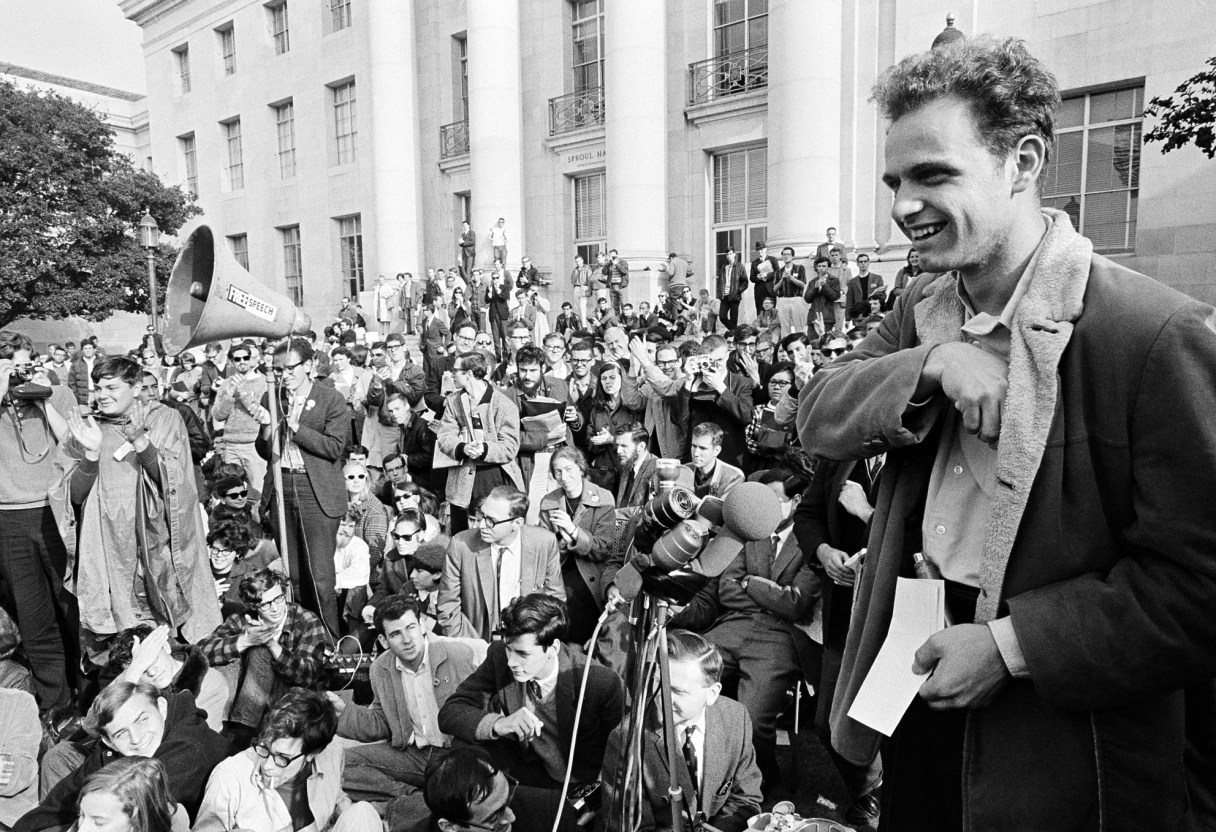
Bettina Aptheker was a 20-year-old sophomore at UC Berkeley when she climbed on top of a police car, barefoot so she wouldn’t damage it, and helped start the Free Speech Movement.
“Power concedes nothing without a demand,” she told a crowd gathered in Sproul Plaza on that October Thursday in 1964, quoting abolitionist Frederick Douglass.
Berkeley, as Aptheker describes it, was still caught in the tail end of the McCarthyism of the 1950s, when the 1st Amendment was almost felled by fear of government reprisals. Days earlier, administrators had passed rules that cracked down on political speech on campus.
Aptheker and other students had planned a peaceful protest, only to have police roll up and arrest a graduate student named Jack Weinberg, who had spent the summer working for the civil rights movement.
Well-versed in those non-violent methods that were finally winning a bit of equality for Black Americans, hundreds of students sat down around the cruiser, remaining there more than 30 hours before the protesters successfully negotiated with the university to restore free speech on campus.
History was made, and the Free Speech Movement born through the most American of traits — courage, passion and the invincibility of youth.
“You can’t imagine something like that happening today,” Aptheker said of their success. “It was a different time period, but it feels very similar to the kind of repression that’s going on now.”
Under the standards President Trump is pushing on the University of Southern California and eight other institutions, Aptheker would likely be arrested, using “lawful force if necessary,” as his 10-page ” compact for academic excellence ” requires.
If you somehow missed his latest attack on higher education, the Trump administration sent this compact to USC and eight other institutions last week, asking them to acquiesce to a list of demands in return for the carrot of front-of-the-line access to federal grants and benefits.
While voluntary, the agreement threatens strongman-style, that institutions of higher education are “free to develop models and values other than those below, if the institution elects to forgo federal benefits.”
That’s the stick, the loss of federal funding.
The greatest problem with this nefarious pact is that much of it sounds on the surface to be reasonable, if not desirable. My favorite part: A demand that the sky-high tuition of signatory universities be frozen for five years.
USC tuition currently comes in at close to $70,000 a year without housing. What normal parent thinks that sounds doable?
As with all things Trump, though, the devil isn’t even in the details. It’s right there in black and white.
Any university that signs on also would be agreeing to “transforming or abolishing institutional units that purposefully punish, belittle, and even spark violence against conservative ideas.”
So no more talking bad about far-right ideas, folks. That’s belittling to our racists, misogynists, Christian nationalists and conservative snowflakes of all persuasions.
Even more than silencing students or smashing protests, Trump’s compact seeks to purge this truth, and those who hold it, from the system.
Gov. Gavin Newsom has rightfully threatened to withhold state funding from any California university that signs.
Of course, some universities will sign it willingly. University of Texas called it an “honor” to be asked. There will always be those who collaborate in their own demise.
But authoritarians live with the constant fear that people like Aptheker will teach a new generation their hard-won lessons, will open their minds to bold ideas and will question old realities that are not as unbreakable as they might appear. Universities, far from assuaging that constant fear, should fight to make it a reality.
Anything less belittles the very point of a university education.