
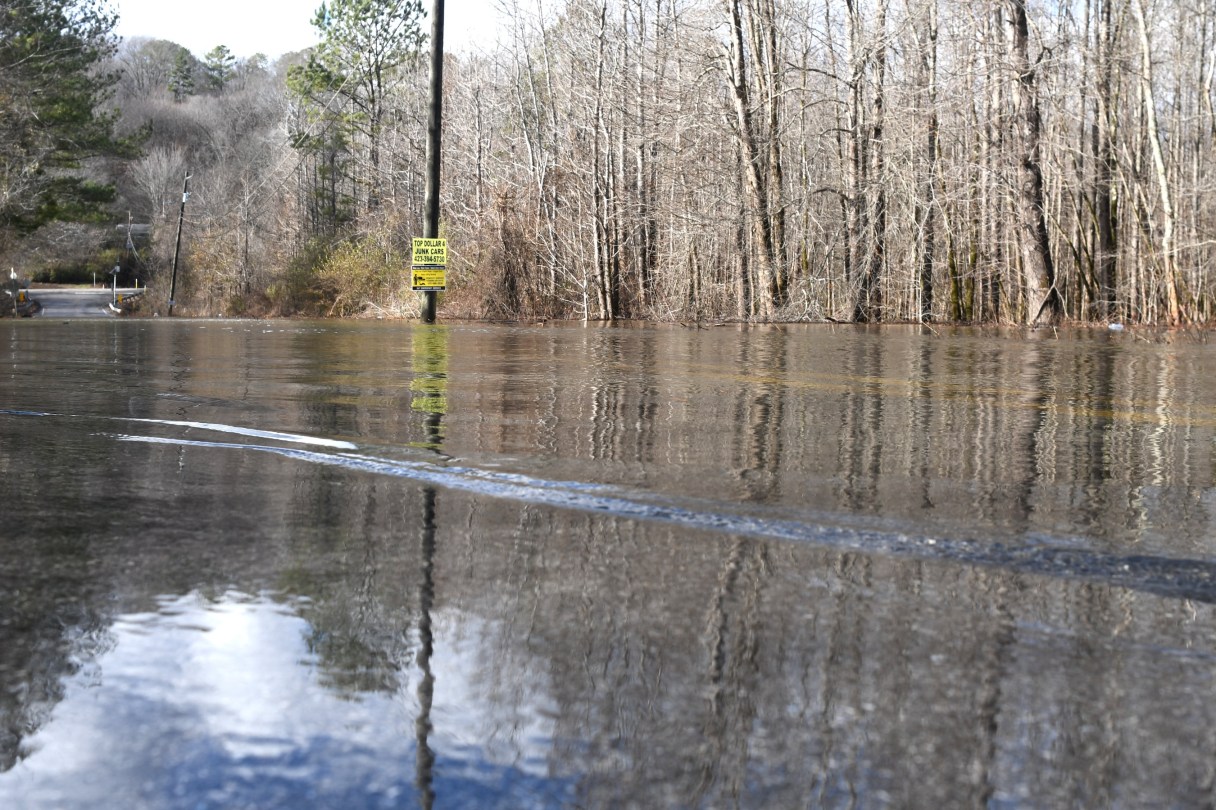

How and where developers can build in Chattanooga’s floodplains could be changing soon, following severe flooding in August.
Planning commissioners said Monday they need more time and information before voting on a pair of recommended changes, which city staff said could eventually give more people discounts on flood insurance.
Commissioner Nathan Bird, a civil engineer, said he looked at rain gauge data from the last 50 years and found the depth and intensity of storms in Chattanooga has been increasing.
(READ MORE: Hamilton County changes disaster plan after floods)
“I’ve become increasingly concerned about floodplain management over the past few years, pretty much since Hurricane Helene started setting off alarm bells in my head,” Bird said at Monday’s meeting.
IF YOU GO
What: Public meeting on new federal flood insurance rate changes
When: 5 to 8 p.m. Nov. 3
Where: Development Resource Center, 1250 Market St., Chattanooga
For more information: Contact the land development office at (423) 643-5848
One change would require developers filling in a portion of a floodplain to remove slightly more than that amount from another part of the property. That would help maintain the land’s ability to store and drain stormwater.
Another would standardize how high above the base flooding level new buildings in the floodplain must be built.
Those recommendations came from best practices and examples in other cities, said Darien Gilkenson, with the city’s Land Development Office.
“We have just had a lot of development that has brought in a lot of fill, that has created displacement, that is beginning to flood our neighbors’ and others’ properties,” Gilkenson said, “so we were looking for some mitigation from that.”
Stricter flood regulations would give the city a higher rating in its bid to join a federal flood insurance program, Chattanooga Floodplain Coordinator Ken Martin said. That could bring discounts from 4% to 45% to city residents who qualify, Martin said.
Commissioners did approve a set of updates required by the Federal Emergency Management Agency. Those have to be passed by the Chattanooga City Council before a late November deadline, when new insurance rate maps for Tennessee are set to take effect. Less than 2% of Hamilton County residents had flood insurance policies when floods hit in August.
The commission also approved a staff proposal to allow some recreational development and stabilization in floodways, or the areas around rivers and streams that flood first and worst.
“Currently, our ordinance states nothing can be done whatsoever,” Gilkenson said.
OFFSETTING
Staff recommended a ratio for developers to remove dirt after filling a floodplain while grading a site in the floodway or in the 100-year floodplain.
Their suggested ratio was 1.25 to 1 — meaning for every cubic yard filled in a floodplain, 1.25 cubic yards must be removed somewhere else on the property.
Bird and other commissioners said they wanted to see more information and hear the reasons behind regulations in other cities before approving that ratio. Information on the proposed changes wasn’t initially included in meeting materials given to commissioners, Commissioner Chris Mabee said.
“I do have some hesitancy to make such a massive change when we don’t even have the writing in front of us here to look at,” Mabee said at the meeting.
Not all floodplain is equal, builder and commission Chair Ethan Collier said at the meeting. Rigid rules don’t let developers and engineers be creative or to respond to different needs at different sites, he said.
“Our rules should be built around real information,” Collier said, “Not just like a blanket, ‘This 100% will protect everybody,'” Collier said.
(READ MORE: Chattanooga flood event took place with no watch in effect)
ABOVE THE BASE
Now, city code has different standards for how much above base flooding elevation a new building in the floodplain has to be — 1 foot for buildings on a slab and 2 feet on a crawlspace.
City staff recommended making the requirement 2 feet across the board.
“For clarity, for consistency, to provide stability and still be able to not have a huge impact on cost of construction based on what we already allow,” Martin said.
Nashville requires 4 feet above the base elevation, Martin said. Charlotte, North Carolina, requires 2 feet, and Knoxville requires 1 foot.
Collier suggested that 4-foot requirement in Nashville was done to stop development. Martin said that rule came in response to severe flooding in 2010, adding Chattanooga should be proactive.
The final decision on new rules should balance a likely increase in construction costs with a need for more resilient development, Collier said.
“There’s risk associated with being alive,” Collier said. “We can’t remove it all … we do have lots and lots of our city that is in a floodplain.”
Contact growth reporter Ellen Gerst at egerst@timesfreepress.com or 423-757-6319.
Note: This story was updated Oct. 16 to correct the fill requirements and the meeting date.