
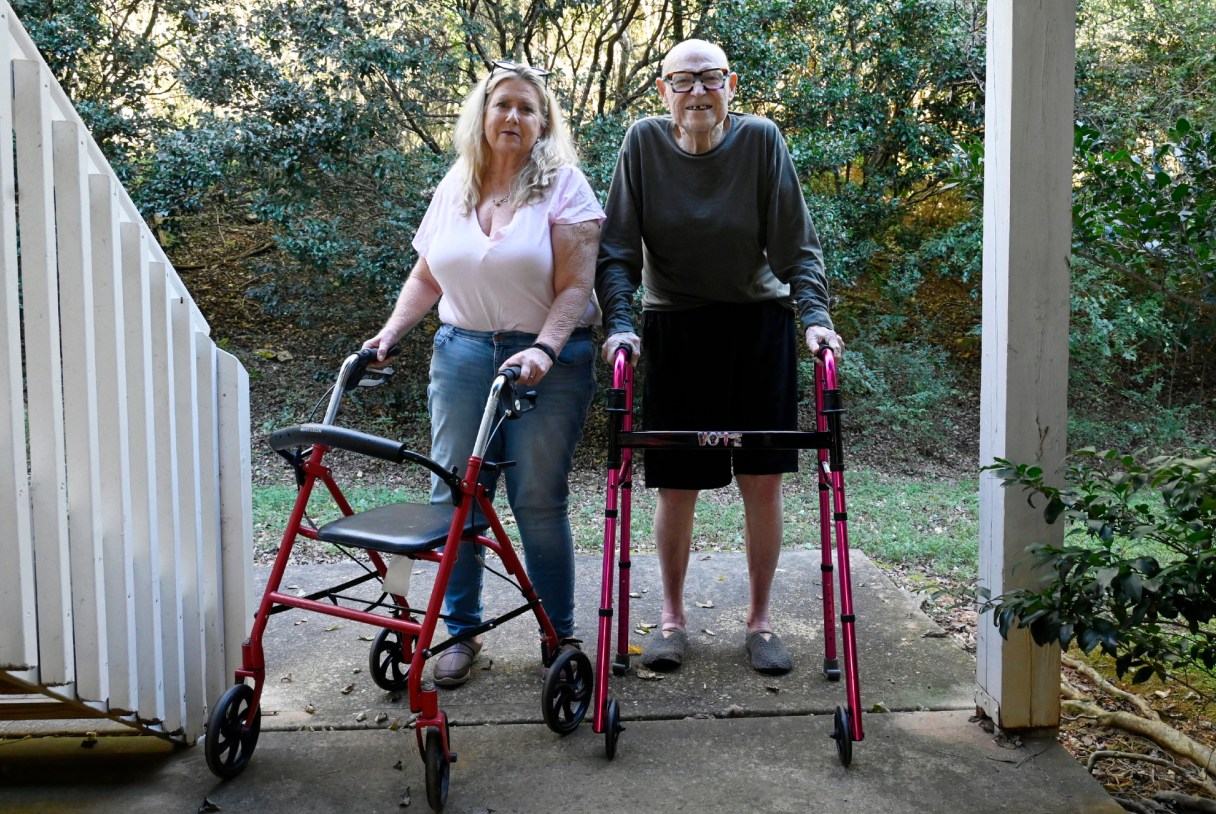
Chattanooga resident Cheri Roberts, 62, said on Wednesday that if the shutdown of the federal government continues, she worries her very health could hang in the balance.
“I see eight specialists and am looking at upcoming surgeries. I couldn’t afford (health insurance) premiums without (federal subsidies),” she said by phone. “You know, I’m not trying to exaggerate, but I might die if I stop going to the doctor.”
More than half a million Tennesseans pay lower health insurance premiums because they receive federal health care subsidies. Those subsidies are set to expire at the end of the year.
Currently, with subsidies, Roberts pays $10 a month for her insurance premium. Without subsidies, she said her premium will cost $1,140 a month — which she cannot possibly afford.
“I just had no idea,” Roberts said about the expiring tax credits.
It wasn’t until her daughter, Jessica Roberts, told her about the pending expiration of the subsidies that she learned her health insurance could be in jeopardy, she said.
Democrats have leveraged the ongoing federal government shutdown in an attempt to permanently extend federal health care subsidies like those Roberts uses, rather than let the program expire.
Senate Minority Leader Chuck Schumer has said that without a permanent extension of subsidies, Senate Democrats will not vote to pass a temporary budget to reopen the government. More than two weeks into the shutdown, an agreement with Republicans on a permanent extension has not been reached.
U.S. Sen. Bill Hagerty, R-Tenn., said the proposal for a permanent extension is costly.
“What we asked them to do is to continue the government under the budget that they all voted for under President (Joe) Biden,” Hagerty previously said by phone. “They’ve refused to do it. They proposed another trillion dollars of expenditures.”
‘STICKER SHOCK’
Roberts requires periodic knee injections to walk and is trying to schedule a knee replacement. She also cares for her father, who is in his 90s.
“Knowing that this is on the line, I mean, it’s just hard for me to look into the next year and see any kind of quality of life, because I could not get my issues treated,” Roberts said. “I don’t want to sound like I’m over-exaggerating or dramatizing, but it will completely affect my life, my way of life, how I take care of my dad.”
Jessica Roberts said her mom will have to move in with her in Virginia to save money for medical costs if her subsidies expire.
About 200,000 Tennesseans could lose their health insurance if they lose their subsidies, according to KFF, an independent health policy research non-profit.
“A lot of people, I don’t think they’re watching and looking at what’s going on, so they don’t know this is coming,” said Silvia Calzadilla, who works as the statewide director of Enrollment Services for Tennessee Health Care Campaign, where she helps Tennesseans purchase subsidy-qualified health care plans. “We have close to 400 clients. I haven’t had any calls, no people asking me anything, which is weird.”
For a 60-year-old couple making $82,000 in the congressional district represented by U.S. Rep. Chuck Fleischmann, R-Ooltewah, which includes Hamilton and Bradley counties, along with eight others, premiums will increase 261%, from $581 a month to $2,099, according to KFF.
“If they don’t have subsidies, I don’t think many people are going to be able to afford the insurance, because it’s really expensive,” said Calzadilla by phone. “I have people say to me, if you don’t help me, I’m going to die, because the hospital said they are not going to treat me anymore if I don’t have insurance.”
Subsidy amounts vary from person to person based on income level, household size, age and health care plan.
“It’s not a flat $100 off for everybody, and I think that also makes it very complicated for people to understand it in a real way,” said Mandy Spears, executive vice president of the Sycamore Institute, an independent, nonpartisan public policy research center for Tennessee. “I think that’s probably going to be a very real … sticker shock situation when people go to renew.”
‘SERIOUS CONCERN’
BlueCross BlueShield of Tennessee provides subsidy-qualifying health insurance plans and began to raise awareness about the potential expiration months ago through outreach on social media and an opinion article.
“This is a serious concern for families across the state, and that’s why we’ve taken proactive steps to raise awareness,” said Dalya Qualls White, senior vice president and chief communications officer of BlueCross BlueShield of Tennessee, in an email to the Chattanooga Times Free Press. “Since early summer, we’ve worked to inform our members, community leaders and elected officials about the potential impact of the expiration.”
More people in Tennessee have health insurance since the marketplace premium subsidies became available, according to a Health and Human Services report. Since the implementation of premium subsidies, the total uninsured rate in Tennessee decreased 4.6 percentage points, from 13.9% in 2013 to 9.3% in 2022.
Even for people who are not directly affected by the subsidy expiration, health care experts say there will be wider impacts on Tennessee’s health care ecosystem.
A greater burden could be placed on hospitals and drive up uncompensated care costs if more Tennesseans become uninsured with the loss of subsidies.
“It’s going to drive up costs and burden on the hospital systems,” said Lacey Lyons, communications coordinator at the Tennessee Health Care Campaign. “Because people might postpone care, and it’s more costly to care for someone who has been putting off care and comes to the emergency room and is in critical condition.”
People end up using hospitals and emergency rooms as doctors, Calzadilla said. People can’t pay those bills, and then those hospitals close.
“It’s a chain; if you don’t do one thing, another thing will happen,” Calzadilla said.
Hospitals are required to provide certain services regardless of insurance and absorb the cost.
HOSPITAL CLOSURES
Tennessee has experienced the second-most hospital closures of any state, particularly in rural areas, with 15 closures since 2010, according to KFF.
In Tennessee, the demand for uncompensated care could increase by 29.2% or $378 million if subsidies expired, according to a study by the Robert Wood Johnson Foundation and the Urban Institute.
Two local clinics that provide health care to people without insurance in Chattanooga, Volunteers in Medicine Chattanooga and Purpose Point, expect more patients if premium subsidies expire.
Therma Beaman works as a community health specialist at Purpose Point in Chattanooga, said they are looking to bring on another practitioner in preparation for health care subsidies expiring.
“We are not going to turn anyone away because of the ZIP code that they live in. We’re not going to turn them away because of their financial situation,” Beaman said by phone. “We’re not going to turn them away.”
U.S. Sen. Marsha Blackburn characterized a permanent subsidy extension as unnecessary.
“Senate Democrats deliberately forced a shutdown and blocked a clean extension of current spending levels in favor of a nearly $1.5 trillion package of far-left priorities,” Blackburn said in a statement.
Contact politics reporter Ruby Rayner at rrayner@timesfreepress.com or 423-757-6556.