
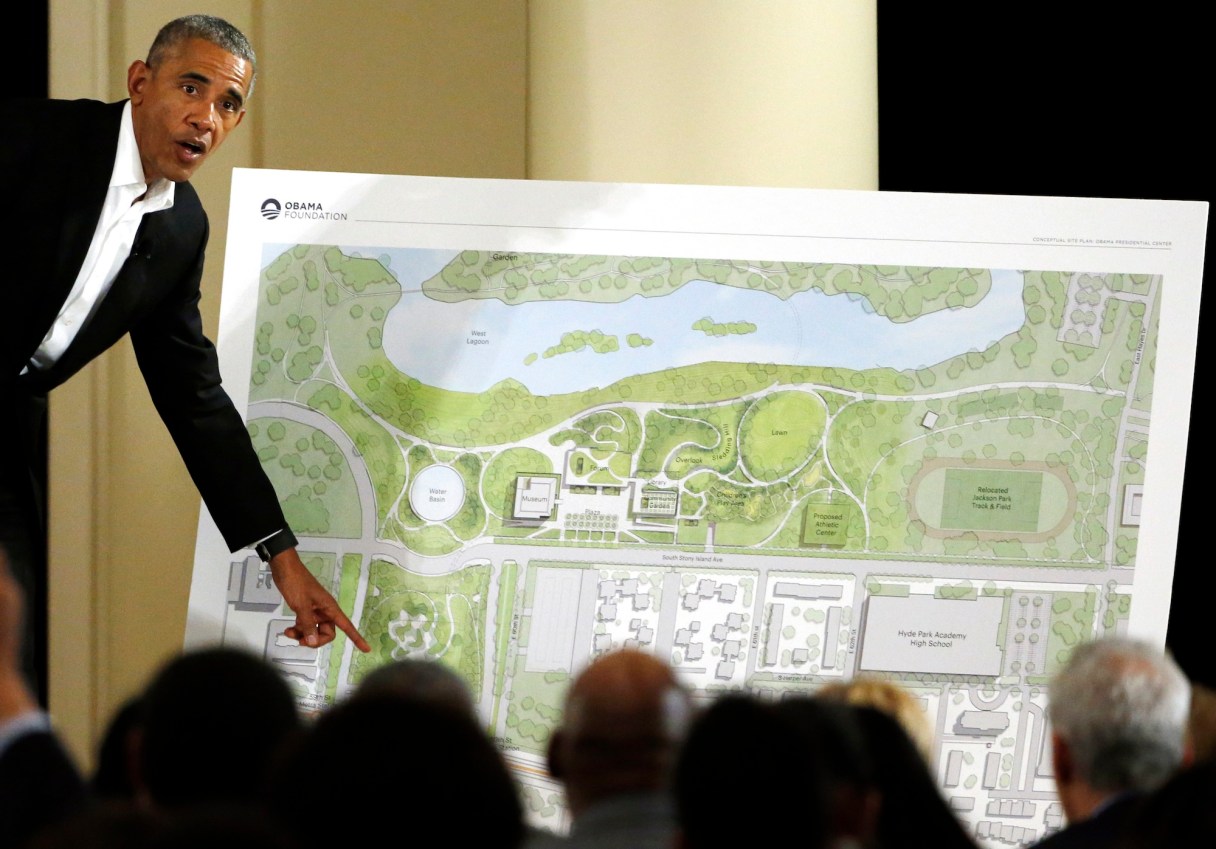
The controversial public building is ugly and intimidating, architectural vainglory battening on presidential ego, inappropriate to its setting, unmoored from memory and tradition.
I’m talking, naturally, about former President Barack Obama’s unfinished presidential center, currently looming like a Star Wars barracks over the residents of Chicago’s South Side.
Admittedly, it’s not the most important architectural controversy involving an American president at the moment. But how you think about President Donald Trump’s demolition of the White House’s East Wing to make way for a large neoclassical ballroom should be connected to how you feel about the Obama megalith and the larger urban-progressive approach to public building.
Trump being Trump, the ballroom project is proceeding without much external consultation and with a whiff of private-donor corruption. But many of the complaints from outraged liberals are more historical and aesthetic, accusing Trump of bulldozing American heritage to build something crass and gaudy in its place.
And those arguments illustrate a consistent problem with progressive stewardship of American cities, which mixes admirable impulses toward aesthetic preservation with two related failures: a failure to make room for the necessity of substantial development and change and a failure to apply the same aesthetic sensibility to new developments that it applies to older ones.
Put more simply, progressives and urban institutions are good at protecting architectural beauty where it exists, lousy at making sure new development happens on a reasonable timeline and consistently terrible at encouraging loveliness in the developments that do get built.
The case for Trump’s ballroom is connected to these failures. First, it is simply good to build a White House ballroom, the presidency has needed one for a long time, and it’s absurd the leader of a superpower has to host state dinners in temporary tents.
No doubt there was a more careful and sensitive way to pursue the project. But care and sensitivity are part of the reason that, in so many liberal-leaning jurisdictions, apartment towers, power plants and high-speed rail lines vanish into developmental limbo. It’s a small example of why Trump’s bull-in-a-china-shop approach appeals.
There is another issue besides bureaucratic sclerosis that makes it hard for left-leaning jurisdictions to overcome opposition to new building: namely, the widely shared awareness that when development happens under progressives auspices, it is often soul-crushingly unattractive.
The general design of the Trump ballroom — if you look at the actual sketches, not the social-media caricatures — is in keeping with the character of the White House, and if there’s any place where a cautious classicalism is appropriate, it’s at 1600 Pennsylvania Ave. So in the end Trump’s architectural legacy will probably be useful, if not dazzling, at least appropriate, pleasing, fine.
But like the restaurant that disappoints people with terrible food and small portions, our progressive urbanism doesn’t build enough buildings and makes the ones it does build ugly.
Like, say, the new Obama tower. To read the localist and antigentrification arguments against its construction is to encounter the kind of NIMBY special pleading that so often derails necessary development. But it’s also to encounter an important reason NIMBYism has so many partisans.
It’s not just an aversion to crowding or extra foot traffic or rising rents. It’s also because no matter how tight the link between progress and development, it doesn’t feel like progress to live under a baleful shadow like the one Obama’s presidential monument will cast.
The New York Times