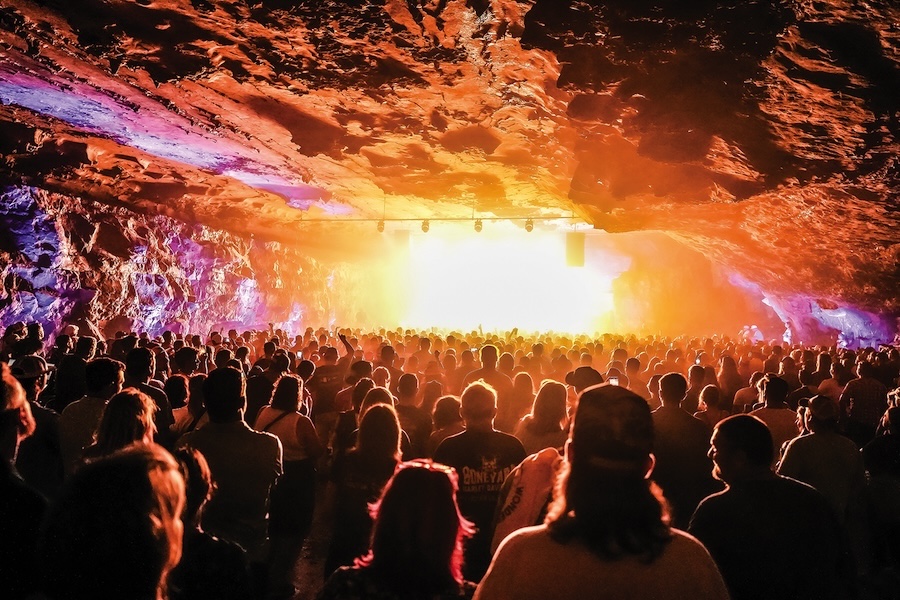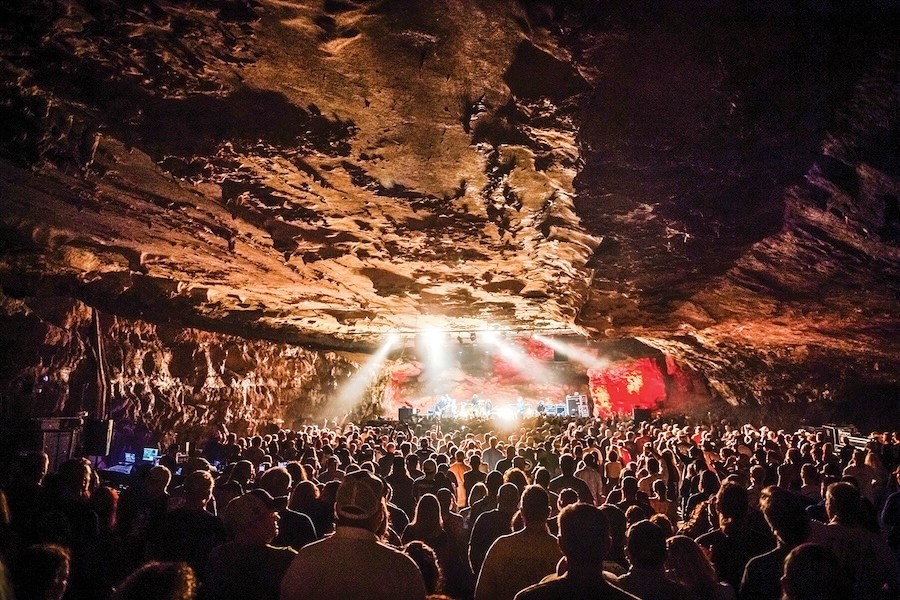
About 20 minutes into a set of revved-up honky tonk, Ketch Secor, lead singer of Old Crow Medicine Show, tells the crowd:
“We love playing here. There’s no better place to be on a hot summer night.”
He has a point. Inside The Caverns concert venue, it’s always 59 degrees. But outside at 5 p.m. on the Sunday evening when the band is performing, it’s a sweaty and humid 90 degrees, feeling somewhat like a pizza oven.
Escape from heat is one of the calling cards for The Caverns in Pelham, Tennessee, a little over an hour west of Chattanooga. And yes, it’s an actual underground space. (For those who want to get technical, a cavern is an opening in a rock face that lets in natural light, while a cave is an opening in a rock face with no natural light coming in. Either way, The Caverns is actually part of an 8,000-foot-long cave system.)
But The Caverns, which opened in 2018, has much more to offer than just cool temperatures. Its attributes have been noticed by many, including the Academy of Country Music, which voted The Caverns as the 2025 Theatre of the Year, beating out venues in Boston, Philadelphia, Knoxville and Milwaukee.
“We were definitely surprised — in the best way,” says Caverns Marketing Director Jeff Meltesen. “It was our first nomination, so winning right out of the gate felt pretty special.”
The venue, with a capacity of 1,200 people when standing and 850 when seats are brought in, doesn’t just focus on country acts, spreading its musical net much further. Bluegrass, folk, Americana, roots-rock and jam bands (think groups like the Grateful Dead) are its primary acts, but it also has featured the “cosmic metal” of Blood Incantation, alternative rockers Jimmy Eat World, soulful St. Paul and the Broken Bones and electronica DJ Hamdi.
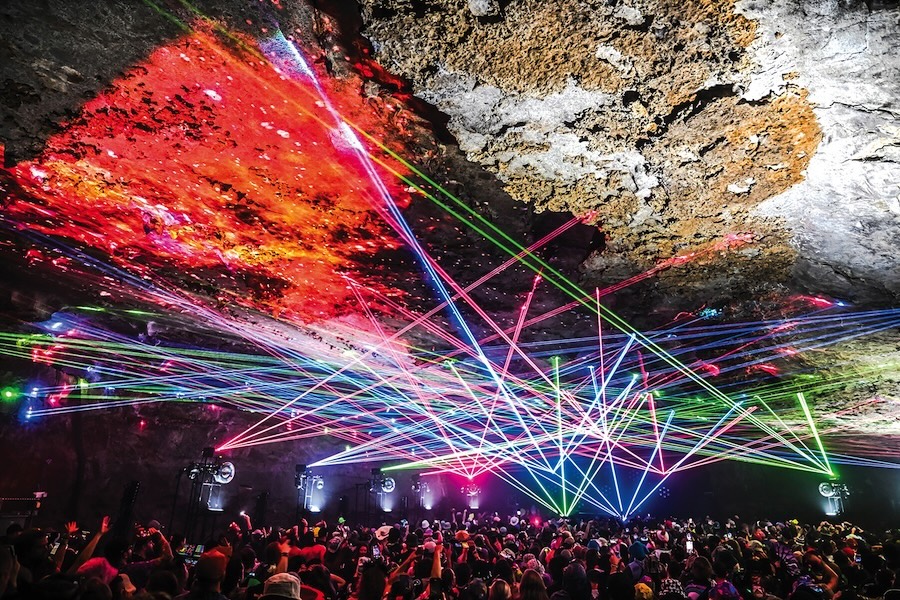
“You name it, we’ve hosted it. We’ve even had comedy shows down in the cave,” Meltesen says.
After performing in The Caverns in 2018, singer/songwriter Brandi Carlisle told Rolling Stone magazine that it provides an important connection with the natural world.
“One thing we know is that in nature, music is naturally occurring,” she said. “We’ve only learned to mimic the sound it makes. It’s perfect harmony to play the music of nature from within it.”
There is also an outdoor stage next to The Caverns’ entrance that combines with the underground space to host larger shows, such as the annual Cavefest in October, which, this year, features 18 bands and solo artists.
Before The Caverns was able to host any show, however, some scientific work had to be done. Archaeologists determined it wasn’t a historic burial site (although it’s thought that humans have been using it for about 25,000 years), and biologists confirmed it wasn’t home to any animal species that would be disturbed.
Hydrologists diverted water to deeper parts of the cave, while geologists examined its structural integrity to make sure it was safe for public use.
Walls of the cave were reinforced, and sediment that had been there for millennia was removed. After that, running electricity, installing drainage and pouring the smooth concrete floor took place, and the stage, restrooms and bar were installed.
“It took a remarkable mix of science, sweat and vision to make The Caverns what it is today: a venue where science and sound come together underground,” Meltesen says.
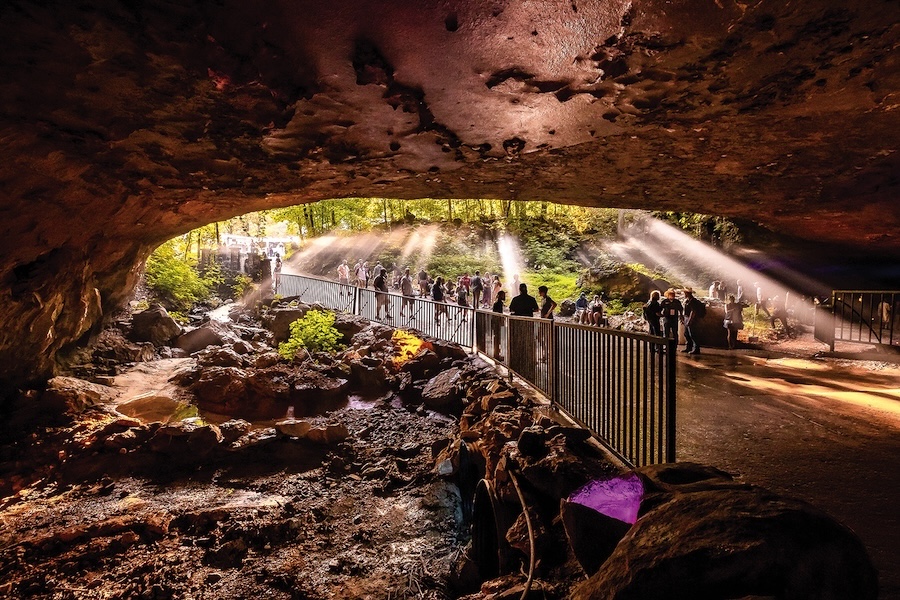
For those who worry about claustrophobia when surrounded by rock, the ceiling is about 20 or so feet high. The wall-to-wall width varies, but nothing up, down or sideways feels like being squeezed in a juicer.
Understated lights — blue, orange, red, yellow — are strategically placed around the space, all facing upwards, giving ambience while providing enough light to see.
Professional-grade lighting trusses and speakers hang from the roof and, somewhat surprisingly since you’re inside a cave, there isn’t any echo from the music.
“The Caverns is a naturally reverberant space — alive with sound — so getting the mix right takes precision,” Meltesen says. “Our team works closely with each artist’s crew to fine-tune the audio using a PA system designed specifically for the cave.”
Outside The Caverns are campgrounds for both RVs and tents, plus yurts — 300-square-foot round tents with wooden frames and beds, bathrooms and other accessories. If you want, The Caverns staff will even set up a sleep-ready tent before you arrive.
“After the natural beauty and acoustics, the most consistent praise we see in reviews is about how welcoming and helpful our team is,” Meltesen says.
Get more information about The Caverns at thecaverns.com.