
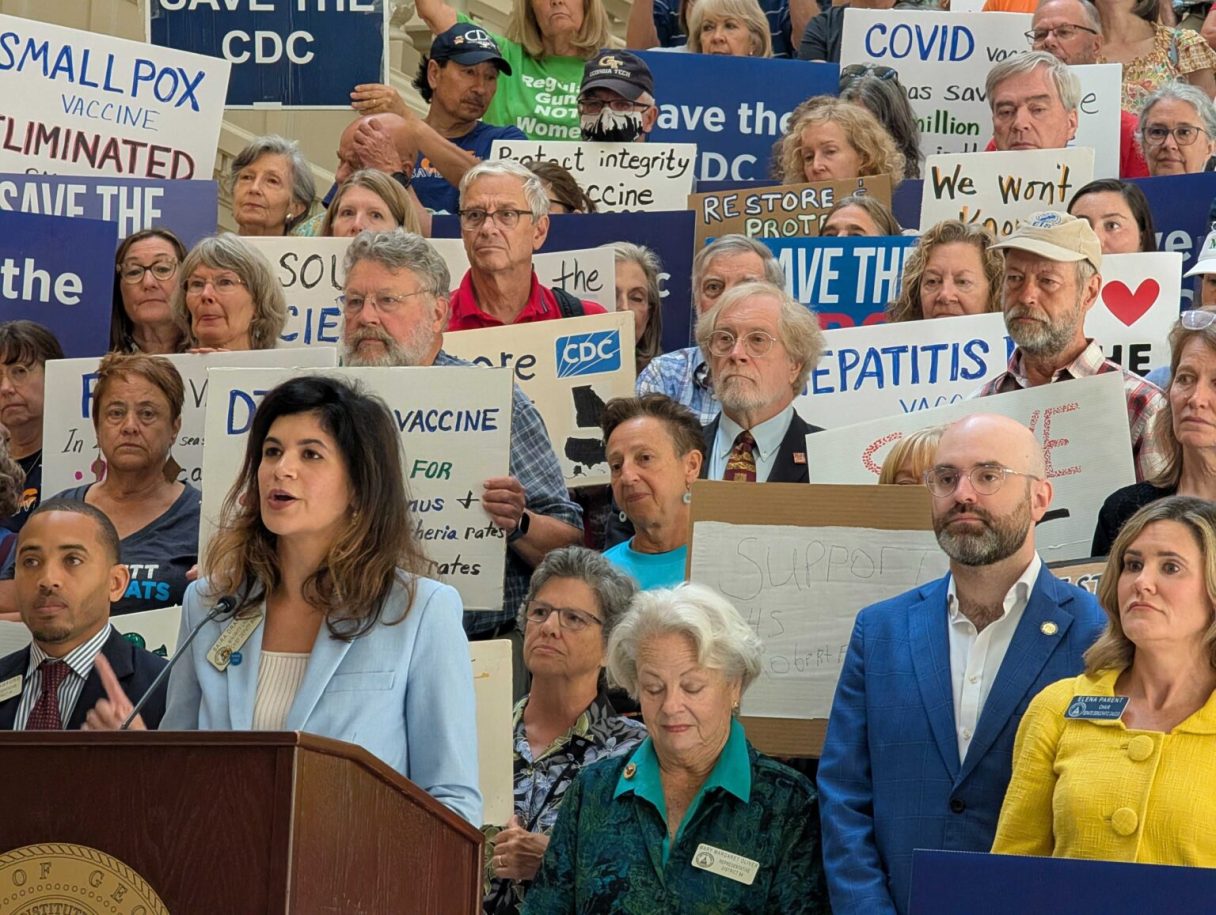
The Centers for Disease Control and Prevention is in turmoil following the ouster of the agency’s director, a series of high-profile resignations and an attack on its headquarters that killed a police officer, former CDC staff said Tuesday.
The former employees, including ex-deputy director for program and science and Chief Medical Officer Dr. Deb Houry and former director of the National Center for Emerging Zoonotic and Infectious Diseases Dr. Dan Jernigan — who both resigned Aug. 28 — described the current environment at the CDC as a “death” where science is currently being sidelined by political ideology. Houry and Jernigan joined Georgia House and Senate Democrats at the State Capitol on Tuesday to discuss the current climate at the CDC.
“You can almost see this as death by a thousand cuts: we’re cutting staff, we’re cutting resources, we’re undercutting science,” Jernigan said.
Jernigan said during a roundtable discussion before talking to the press that there has been an overall lack of transparency between the Trump administration and the CDC, saying that he has seen a shift in the CDC’s operations. Where past administrations, regardless of their political leanings, worked with scientists to let data guide policy, Jernigan said the current approach appears to start with a predetermined ideology and then attempts to find scientific justification to support it.
“I recognize you really can’t get politics completely out of public health. (Public health is) really a priority here. What are you putting first? And we’re asking that science go first before the policy development, and not starting with an ideology and then backing into the science,” Jernigan said.