
In little more than six months, the White House has sent uniformed troops into the streets of U.S. cities more frequently and on thinner pretexts than any of its modern predecessors; it’s even proposing to create standing units available for the president to deploy domestically on short notice. Administration officials say they’re restoring law-and-order. What seems clearer is that they’re undermining the world’s finest military and endangering its sacred bond with American citizens.
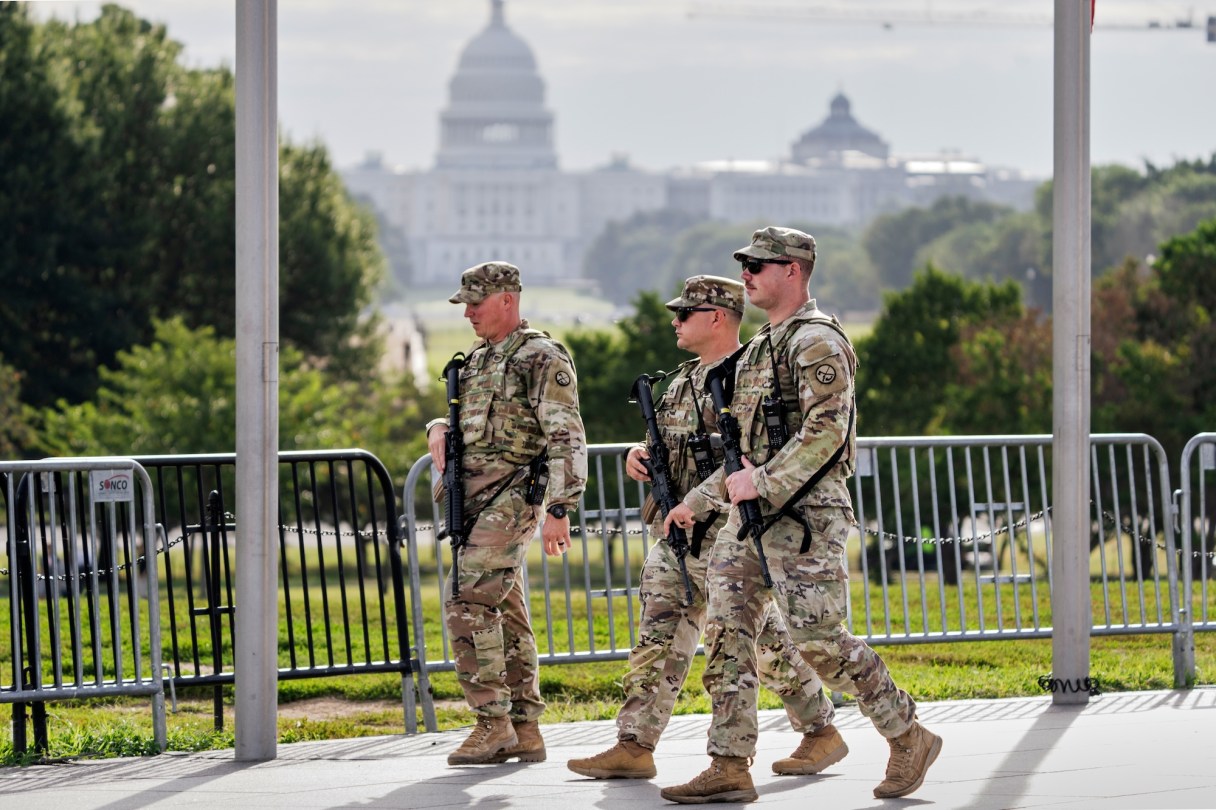
At the president’s direction, more than 2,200 National Guard troops from DC and six Republican-run states, some carrying arms and driving mine-resistant armored vehicles, have taken up positions across Washington.
Past presidents have maintained an extremely high bar for federalizing Guard troops. By contrast, the LA and DC cases risk being perceived as political stunts, meant to embarrass local Democratic officials and highlight the administration’s mass immigration crackdown.
While concerns about crime in Washington are valid, addressing them will require more police, prosecutors and judges — not soldiers drawn from far-off states.
Partisans cheering on the president should consider the longer-term impact on the military. While the troops involved have conducted themselves honorably and professionally, they’re not trained for urban policing.
Nor should one assume that soldiers are unaffected by the broader controversy surrounding their deployment. America’s troops are trained to fight wars and defend the country against foreign adversaries. Dragging them into partisan battles on one side or the other — and especially deeply controversial policies, such as the immigration crackdown — threatens to erode morale, undermine recruitment and retention, and open fissures within the ranks.
Meanwhile, the political furor can’t help but be a distraction to Pentagon leadership. At a time when the services are grappling with the rise of drone warfare, shortages of ships, submarines and missiles, budget constraints, and geopolitical instability, this is hardly where commanders’ attention should be focused.
Worst of all, encouraging the idea that troops are tools of whichever party happens to be in power will tarnish the military in the eyes of half the country and widen the divide between soldier and civilian. Trust in the armed forces began to recover in 2024 after years of decline but remains lower than before the COVID-19 pandemic. The risk is that Americans come to view the military the way many now see the Supreme Court — a force for good only so long as it appears to support one’s political preferences.
Uniformed commanders can only do so much. Although they can ensure discipline within the ranks and warn political leaders if asked about the perils of politicizing the military, they can’t publicly contradict their civilian masters; a slew of firings has made top brass even less likely to speak out. It will be up to Republican congressional leaders to push back against administration overreach and Republican governors to resist pressure to call up troops unnecessarily. Those wary of challenging a vindictive White House might want to ponder the precedent they’re setting for a future Democratic administration.
Americans rightfully honor their military in many ways — celebrating their service, ensuring they are well-trained and equipped with the most advanced weapons, and healing their wounds. The least civilian leaders owe them is the right to focus on the nation’s wars, not its culture war.