
The Big Ten’s lackluster schedule this week exemplifies a problem facing the conference that has produced the College Football Playoff’s past two national champions: Not enough teams are testing themselves outside of league play.
The Big Ten prides itself on having a nine-game conference schedule, which traditionally had set it apart from the Southeastern Conference. Yet the SEC will move to a nine-game league schedule starting in 2026 while continuing to require its league members to play at least one nonconference game against a power conference school or powerful independent Notre Dame, something the Big Ten doesn’t mandate.
That could put more pressure on the Big Ten to step up its nonconference scheduling. This week’s slate includes six games in which a Big Ten team faces a program from the lower-tier Football Championship Subdivision.
Six of the league’s 18 members (Indiana, Maryland, Northwestern, Penn State, Rutgers and Washington) aren’t playing any nonconference games against power conference schools or Notre Dame this year. Only four Big Ten programs (Michigan, Southern California, UCLA and Wisconsin) don’t have a FCS program on their schedules.
Texas, which lost at reigning national champion Ohio State two weeks ago in arguably the nation’s best matchup so far this season, is the only SEC school that isn’t playing an FCS team this year. But the SEC at least can point to all its nonconference games against power conference programs. In addition to the Big Ten and the SEC, the Atlantic Coast Conference and the Big 12 make up the Power Four, which with the Group of Five conferences makes up the top-tier Football Bowl Subdivision.
Penn State coach James Franklin said he wants more consistency in how each conference arranges its schedule.
“The reality is we don’t have a commissioner of college football, so that’s where the commissioners of the Power Four conferences, specifically the Big Ten and the SEC, need to get together and come up with what’s in the best interest of college football and the best interest of student-athletes and the fans,” Franklin said. “And then you won’t have to worry about all these different things when it comes to scheduling, because everybody is going to kind of have the same parameters.”
The problem is determining the specifics.
“Our schools are constantly evaluating the impact of nonconference scheduling across many variables — postseason access, home attendance, geographic rivalries, etc.,” the Big Ten said through a spokesman. “The conference will continue to engage with all 18 to determine the best strategies to balance these factors, using the most current information available about an evolving landscape.”
The Big Ten could strengthen nonconference schedules by prohibiting FCS opponents, something the league did in the 2015-16 seasons. Nebraska coach Matt Rhule noted that such a decision would hurt FCS programs that benefit financially from those games.
“I was in the FCS, and if you don’t have an FBS team, it’s hard to fund your football team, it’s hard to fund the rest of it,” said Rhule, who spent time as an assistant at Western Carolina, an FCS program in the Southern Conference.
FCS member Grambling State lost 70-0 at Ohio State last week but received $1 million for making the trip. This week, in similar matchups, Indiana State is earning $475,000 for playing at Indiana while Houston Christian is getting $500,00 for visiting Nebraska. Montana State returned from its season-opening trip to Oregon with a 59-13 loss and a $680,000 paycheck.
Another possibility would be to copy the SEC strategy of requiring each school to include at least one Power Four opponent in its nonconference schedule, which is taking on increasing importance. The College Football Playoff last month said its selection committee will place more emphasis on strength of schedule this year when determining which teams make the 12-team field.
Last year, Indiana reached the first expanded playoff — it was a four-team event from the 2014 season through 2023 — with a nonconference schedule that included lopsided wins over Florida International, Western Illinois and Charlotte.
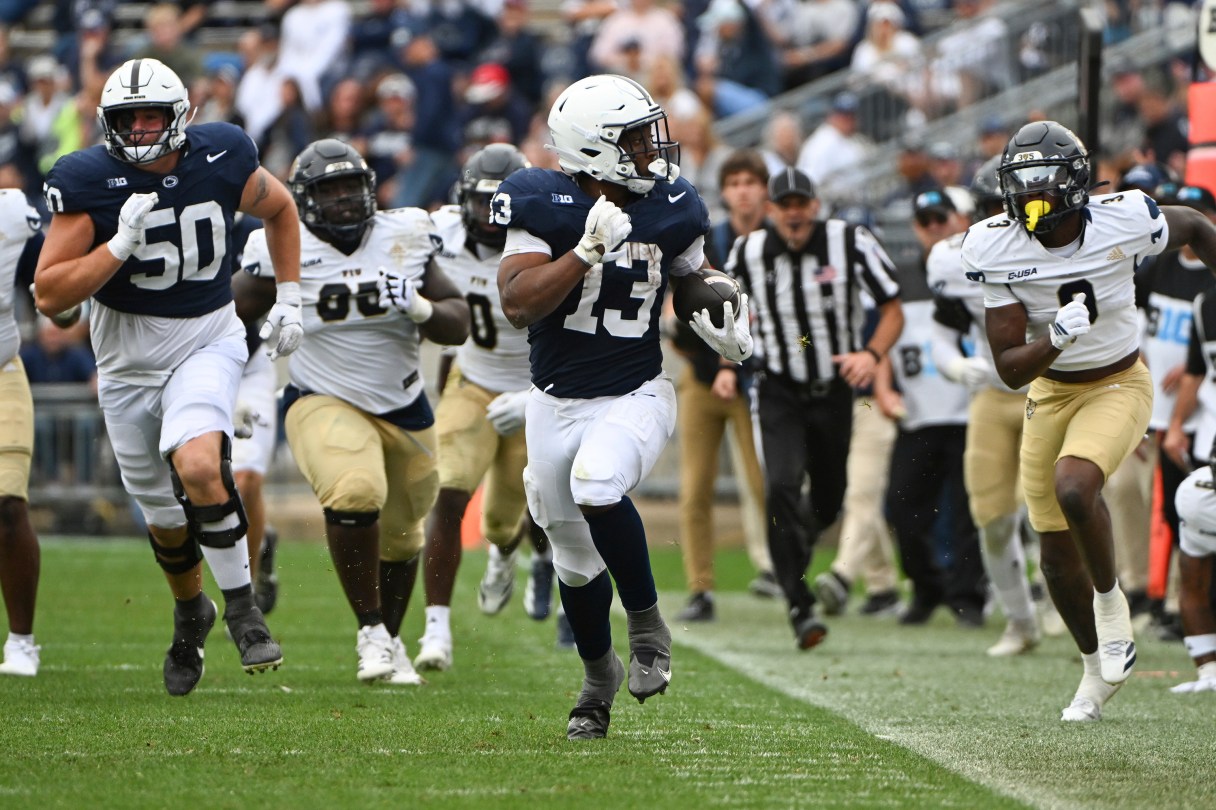
Penn State also made the CFP last year, and if the Nittany Lions return in December, it will be with a nonconference schedule of Nevada, Florida International and Villanova, but this season ended a string of eight straight years in which they played at least one nonconference game against a power conference school (except for the pandemic-shortened 2020 season). Penn State’s 34-0 win over Florida International was a game arranged after a matchup with ACC member Virginia Tech was canceled.
Northwestern isn’t playing any nonconference games against Power Four programs, but it did play at FBS member Tulane, an American Conference school that went a combined 32-10 from 2022-24. Northwestern lost that game 23-3.
“I think that as we’ve learned in college football, everybody by nature does what’s best for them and their program, and that’s the way you’ve got to look at it,” Wisconsin coach Luke Fickell said. “Whether you want to complain about the way somebody else schedules or the way you schedule, let’s be honest, we’ve all got to do what’s best for us.”
Michigan State athletic director J Batt, who was hired this year after two-plus years in that role at ACC member Georgia Tech, offered a similar assessment.
“At Michigan State, we’re building a football program to challenge for championships,” Batt said. “Toward that end goal, we’re going to look to play compelling, meaningful games which create opportunities for our team to prove themselves while also providing great content for fans and television partners. Given the overall strength of the Big Ten Conference in addition to any marquee nonconference matchups, it’s also important to create balance in the schedule, in whatever form that may take.”
There’s a general agreement on the need for consistency among the conferences to make things easier for the CFP selection committee. The trick is reaching a consensus on the best approach.
“If you’re in Power Four football,” Franklin said, “everybody should be playing a similar schedule so that the committee can get together at the end of the season and compare apples to apples as much as we possibly can.”