
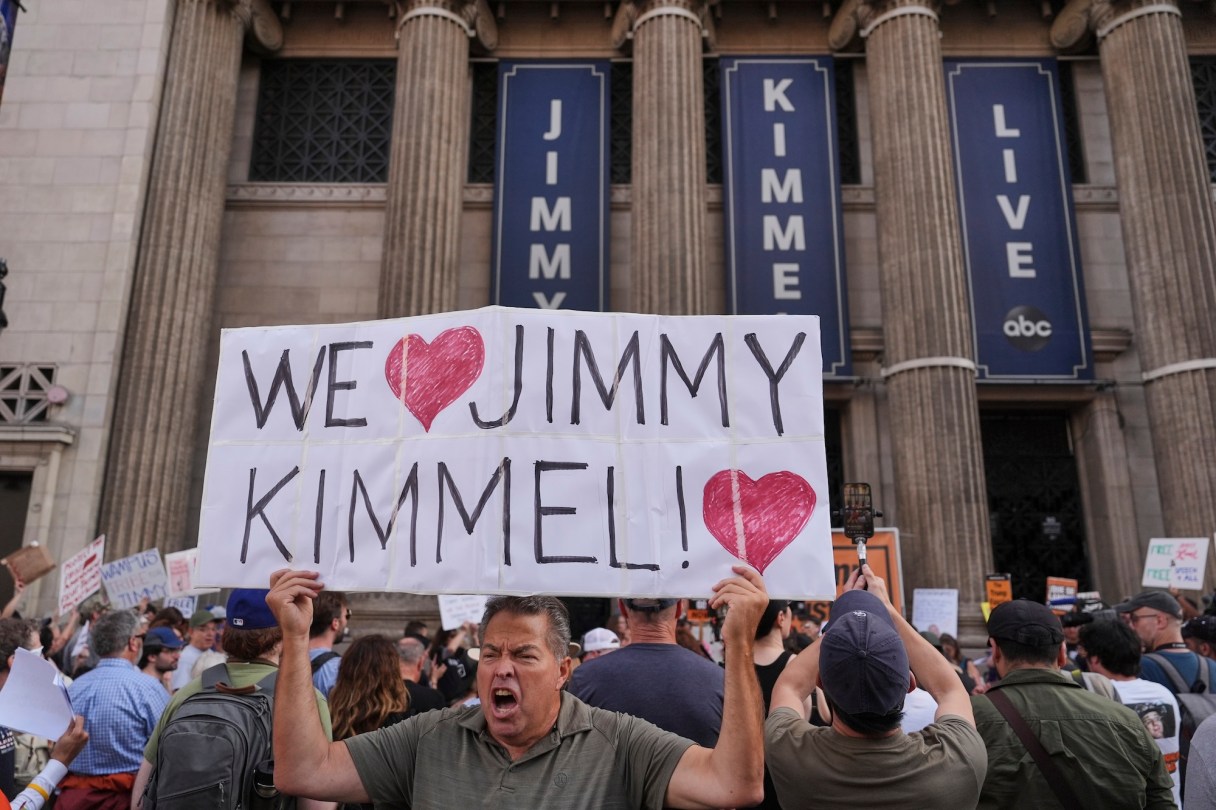
Seeing Jimmy Kimmel suspended from his late night show with, shall we say, the strong encouragement of the chair of the Federal Communications Commission, some conservatives immediately made an analogy to the “jawboning” that the Biden White House used to encourage social media companies to practice various forms of COVID-19 censorship.
This, in turn, prompted an interesting question from liberal writer Derek Thompson. Even conceding that the Bidenistas might have acted inappropriately, he wrote, their desire to police pandemic speech reflected a desire to serve the public interest by preventing unnecessary deaths. Whereas the Kimmel suspension, he argued, looks like pure partisanship: “I haven’t heard anybody even pretend that there’s a deeper principle at stake here.”
I think many conservatives do see a civic-minded purpose here, and I’ll accept Thompson’s challenge and try to articulate it. The argument starts with the assumption that America’s leading cultural institutions — broadcast networks, movie studios, major universities — are private enterprises but also a kind of public trust, with civic as well as commercial obligations.
Most cultural institutions have been staffed primarily by liberals since time immemorial (or at least since the 1960s), and while this has always been a source of conservative complaint, it’s something the right learned to live with.
From the conservative perspective, though, the nature of the stewardship changed in the 2010s. There was a shift within liberal culture, an increasing politicization, a ratchet to the left. This shift was mediated by generational conflict and novel technological forces and then embraced by a range of institutions, from academia to Hollywood to Silicon Valley, who collectively decided to enforce an emergent left-wing orthodoxy.