
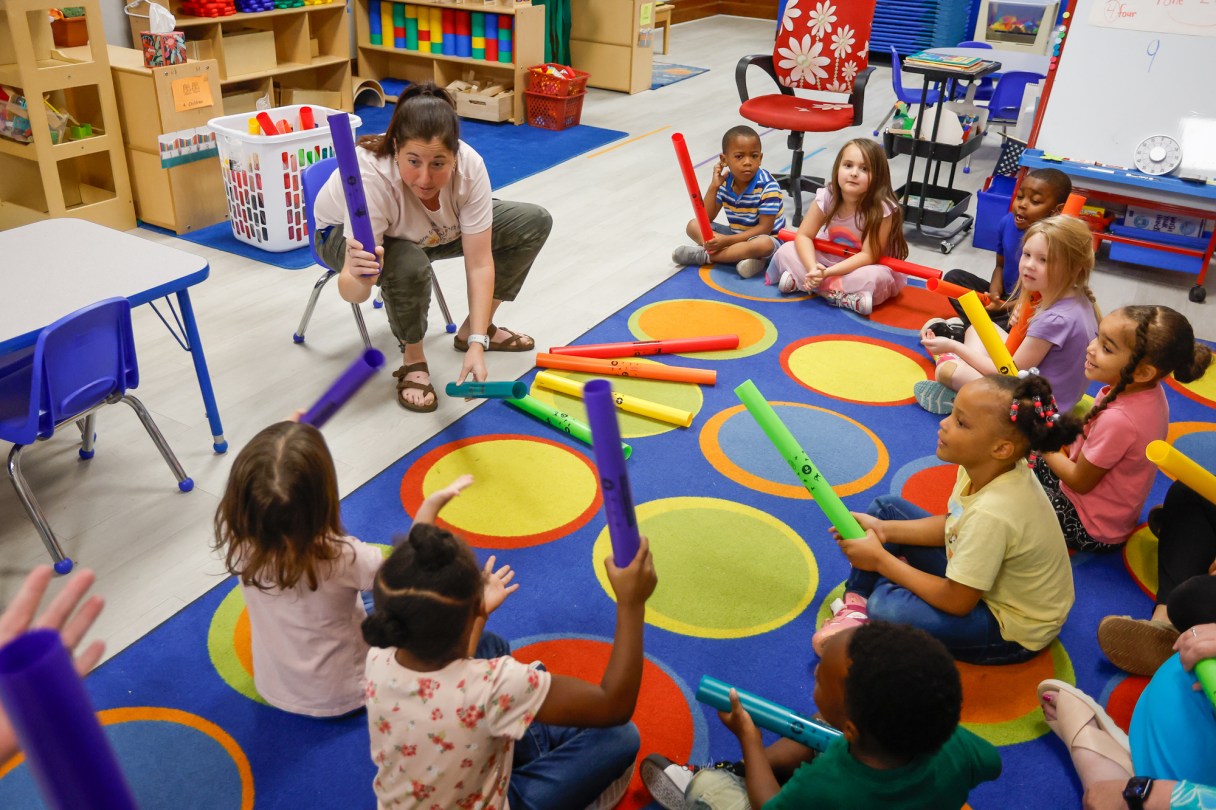
A new report praised the quality of Alabama’s Pre-K program for a 20th consecutive year, though the National Institute for Early Education Research did have criticisms for the state.
Alabama is now the longest-running state to hit all 10 of the institute’s research-based quality standards. Allison Friedman-Krauss, an associate research professor with the organization, said in an interview that the group looks at the state “as a poster child for preschool, especially at how they’ve been building the program.”
“Alabama’s really prefaced quality and has been gradually expanding their program over the last 10 (to) 15 years to add more children as fast as they can without compromising their commitment to quality,” she said.
The institute, however, said Alabama should be working toward making its Pre-K program universal. According to the institute’s report, about 40% of 4-year olds in the state — over 24,000 children — are enrolled in Pre-K.
“The majority of Alabama’s 4-year-olds still do not have the opportunity to attend Alabama’s First Class Pre-K program,” institute Director Steve Barnett said in a press release. When states invest in quality preschool programs that can produce strong outcomes, they invest in a better future for children and taxpayers.”
Friedman-Krauss said serving more children would give the youngsters an advantage when they go to primary school.
“If you look nearby to Georgia, Georgia is serving 53% of 4-year-olds this year. Florida’s program has an even larger reach,” she said. “So there’s 60% of children who don’t have access to this really high quality program, and we know that the program helps prepare the 4-year-olds to enter kindergarten next year, and when children attend high quality preschool programs, that puts them ahead of when they start school and really keep gives them this boost throughout their schooling and can have long-term impacts even later in life.”
Georgia is the first state to meet all 10 of the institute’s benchmarks and enroll over 50% of the state’s 4-year-olds into Pre-K programs. Friedman-Krauss said Alabama isn’t far behind.
“We’re hopeful that in a few years, Alabama will join Georgia on that very small list,” she said.
Alabama does not have universal preschool. According to an interview the institute did with the Reflector in 2024, in order to be considered a universal Pre-K program, the state has to serve at least 70% of the children the program is made for.
Experts have said a lack of pre-K teachers, a lack of adequate space for pre-K programs and sometimes uncompetitive teacher salaries have been obstacles for universal pre-K in Alabama.
Friedman-Krauss said there are several things Alabama could do to increase reach for its Pre-K program such as increasing funding and opening more classrooms, but paying teachers more could also lead to the program seeing more reach.
The Department of Early Childhood Education, which administers Alabama’s Pre-K program, is slated to receive $226.6 million in fiscal year 2027, which begins Oct. 1. That represents an increase of $13.4 million (6.2%).
But overall enrollment dropped by 402 students from the previous year. Friedman-Krauss said that even states with long-standing universal pre-K had seen declines.
“We don’t know if that’s because parents are opting for homeschooling (or) if parents are opting for private schools,” she said. “But in the case of Alabama, I don’t think this is a signal that parents don’t want the program.”
–––
Read more at AlabamaReflector.com.