
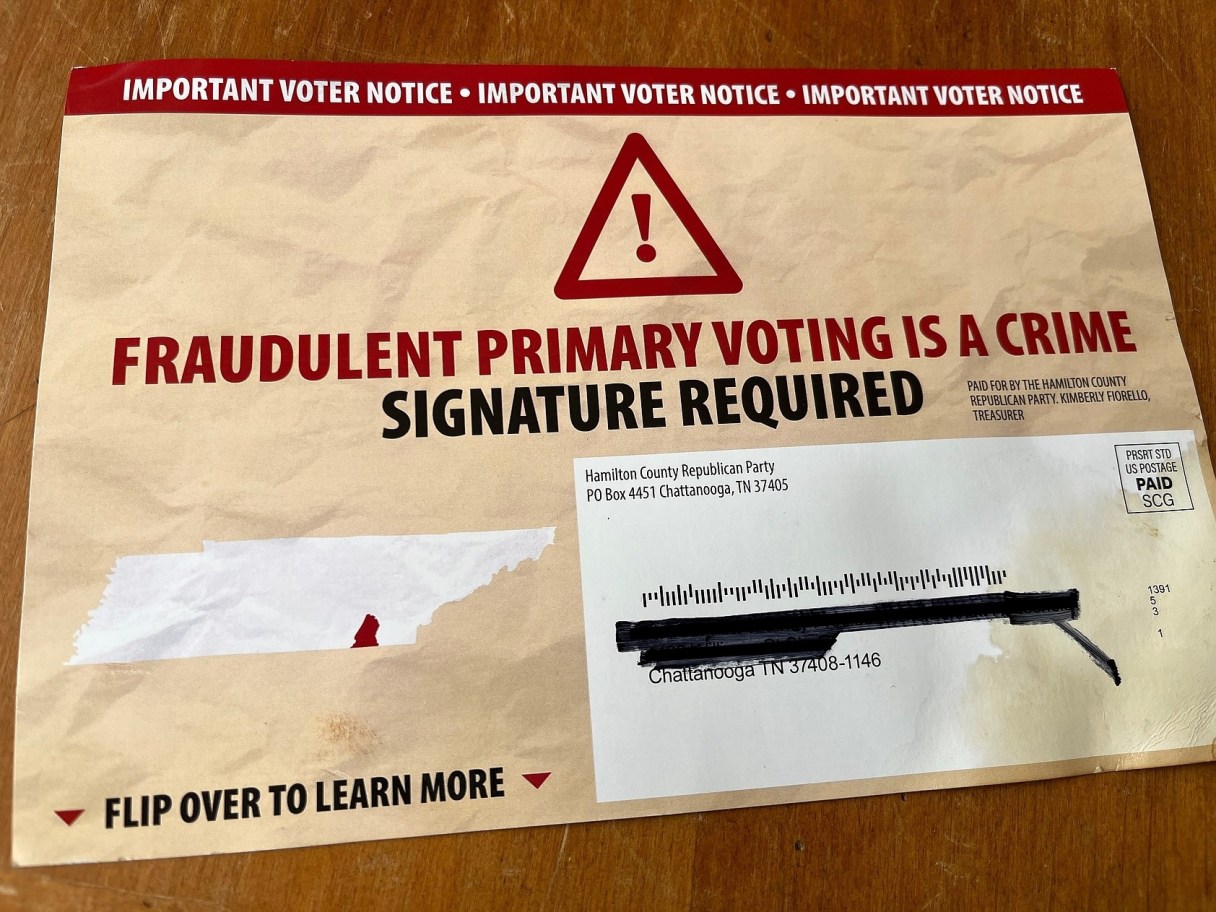
At a time when Tennessee already struggles with some of the lowest voter turnout in the country, the last thing we should be doing is discouraging people from participating in elections. Yet that is exactly what the Hamilton County Republican Party has done with its recent mailer warning residents that “fraudulent primary voting is a crime.”
The mailer, sent to certain voters across the county, features bold red language and references to criminal penalties. It suggests voters could face consequences if they are not “bona fide” members of the party whose primary they choose.
It is difficult to read it as anything other than an attempt to intimidate.
Tennessee does not have party registration. We have open primaries. That means a voter can choose which party’s ballot to pull on Election Day. The law cited in the mailer requires only that a voter either be a bona fide member of the party or declare allegiance at the time they vote. That declaration happens in the moment. It is not permanent. It is not subject to investigation by poll workers. It is not realistically enforceable.
Hamilton County’s district attorney has acknowledged that no one has ever been prosecuted for this and that proving such a case would be extremely difficult. The administrator of elections has made clear that poll workers do not verify party affiliation. The system relies on the voter’s declaration, nothing more.
So what is this mailer really trying to accomplish?
We are told it is “voter education.” But education does not come in the form of warnings about criminal prosecution, highlighted in red, sent to targeted voters. Education does not suggest that casting a ballot could expose you to legal risk when, in practice, it will not.
Education informs. This mailer discourages.
And that matters, because in Hamilton County, the primary is often the election.
Given the political makeup of this county, many races are effectively decided in the Republican primary. For independents, and for Democrats who want a voice in selecting the officials who will govern them, the primary may be the only meaningful opportunity to participate. That is not a partisan observation. It is a practical reality.
Closing that door, or even appearing to close it, does not strengthen democracy. It narrows it.
It also raises a broader question. How does a political party expect to grow if it actively discourages participation from voters who may not yet identify fully with it? Political parties are not private clubs. They are vehicles for public representation. If someone is willing, even in that moment, to declare allegiance and participate, that should be seen as an opportunity, not a threat.
There is also a constitutional dimension that should not be ignored. Voting is a core form of political expression, protected at the highest level of our system. The idea that a citizen could face criminal consequences for participating in a primary election, based on something as subjective and fluid as “allegiance,” pushes uncomfortably close to those protections. That tension is likely one reason this law has never been meaningfully enforced in more than 50 years.
And for good reason.
A voter can wake up on the morning of an election and decide which direction they believe the state, the county or their community should take. They can decide which candidate best reflects that view. That is democracy.
The most troubling part of this episode is not the legal argument. It is the tone.
Threatening voters with criminal consequences for participating in an election sends exactly the wrong message in a state that already struggles to get people to the polls. We should be encouraging participation, not casting suspicion on it. We should be building confidence in the system, not undermining it with warnings that even prosecutors acknowledge are unlikely to result in charges.
There is a difference between protecting the integrity of elections and discouraging people from voting. One strengthens democracy. The other weakens it.
This mailer falls on the wrong side of that line.
–––
Lee Davis is an attorney and mayor of Walden, Tennessee.