
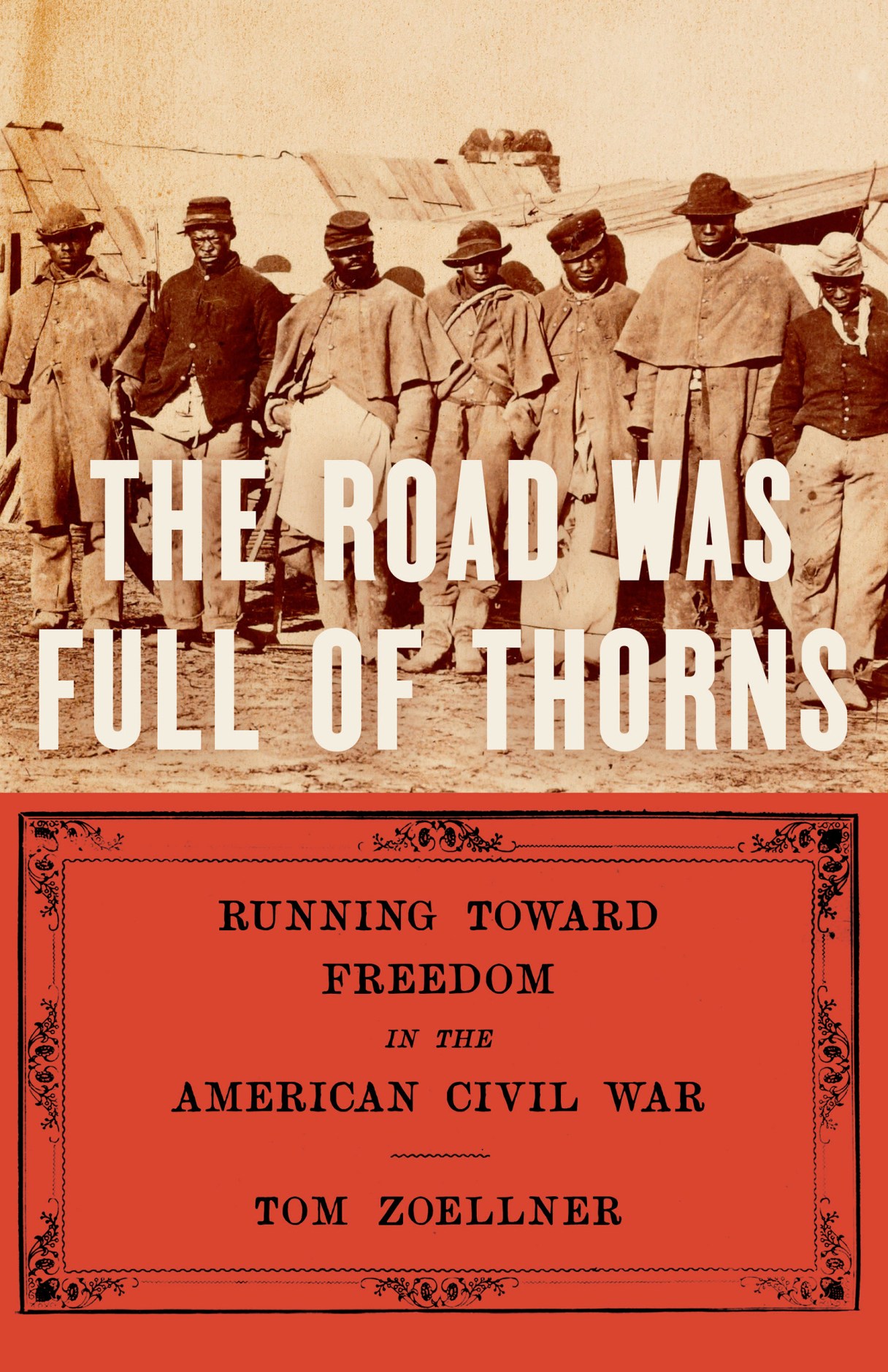
“The Road Was Full of Thorns: Running Toward Freedom in the American Civil War” By Tom Zoellner (The New Press, 336 pages, $34.99)
In his latest book, Tom Zoellner addresses a little-known aspect of the American Civil War and one of the key elements in the destruction of America’s “peculiar institution.” “The Road Was Full of Thorns: Running Toward Freedom in the American Civil War” describes how classifying escaped enslaved people as “contraband” resulted in hundreds of thousands fleeing to Union army lines. Under protection of federal guns, newly free individuals established camps and even semi-permanent settlements where autonomy could be savored for the first time.
Zoellner, author of multiple nonfiction books and a professor at Chapman University and Dartmouth College, wrote about the end of slavery in the British Empire in Island on Fire, winner of the 2020 National Book Critics Circle Award. In “The Road Was Full of Thorns,” he examines the death of U.S. slavery, highlighting the symbiotic relationship between the enslaved and the United States government, which pursued a wartime policy that encouraged people to leave their masters and seek freedom in areas controlled by the army. It was a remarkable migration that drove events as much as it was a product of them.
In civilian life, Benjamin Butler was a lawyer, a champion of the working class in his native Massachusetts. As a brigadier general commanding Fort Monroe in Virginia during the first spring of the war, Butler was confronted with a problem in the form of three escaped enslaved men who turned themselves over to the U.S. Army. The general, needing workers to build fortifications, decided they should remain with the military as civilian employees. When their enslaver came looking for them, Butler, an attorney not afraid to push the bounds of legal precedent, refused to return the men. They were, he decreed, “contraband of war” who could not be handed over to an enemy engaged in combat against the United States.
Word of Butler’s action spread quickly through the enslaved population and to the halls of government. By the end of the year, the Confiscation Act of 1861 effectively made Butler’s improvised decision an official policy, setting free any enslaved person who could get to U.S. Army lines. The law created a flood of people seeking a new life of independence. As Zoellner notes, “As many as eight hundred thousand people — a fifth of the enslaved population of the entire South — left a plantation and lived in a contraband camp at some point during the Civil War.”