
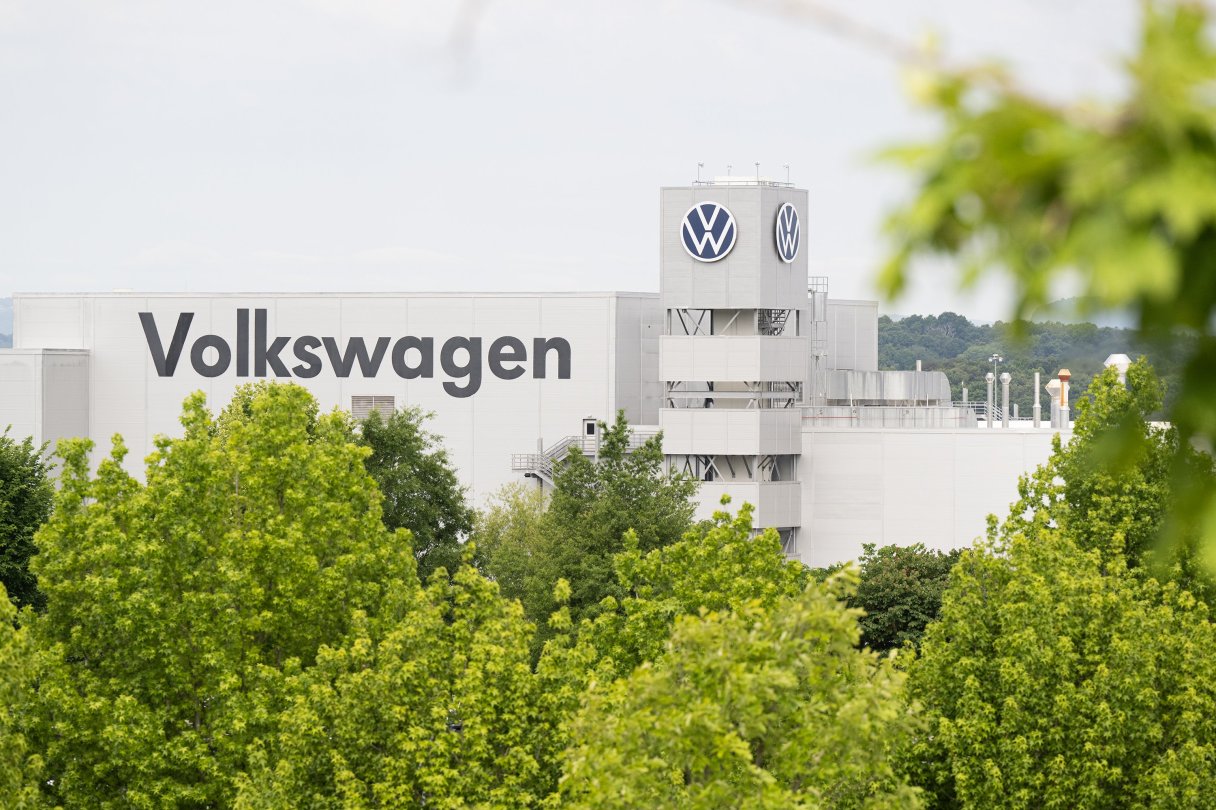
When German representatives from Volkswagen hopped into a TVA helicopter almost two decades ago to get a bird’s-eye view of Enterprise South Industrial Park, they generally liked what they saw.
But they couldn’t get a thorough sense of the site because of the dense foliage and trees that obscured much of the land.
After hearing their feedback, Ron Littlefield, Chattanooga’s mayor from 2005-2013, said he and the then-Hamilton County Executive Claude Ramsey diverted their combined public works crews to Enterprise South to help clear the site. They had about 10 days before the Volkswagen delegation returned for another peek at the property, Littlefield recalled in a phone interview.
At the time, Littlefield said, practically every city in America was courting automotive manufacturers in the hopes of bringing a plant to their community — a win that many hoped would induce the creation of thousands of good-paying jobs. In February 2007, Chattanooga had missed out on a chance to attract Toyota to the Scenic City, losing the manufacturer to Tupelo, Mississippi. This time, leaders hoped to prevent another company from slipping through their fingers.
(READ MORE: Remember When? First VW rolled off the assembly line here)
“Nothing is permanent in economic development,” Littlefield said, citing former local employment anchors like DuPont and the foundries on Chattanooga’s Southside. “Everything has a sell-by date. It’s going to falter at some point, so you have to keep moving. You have to keep building. You have to keep adding to it. And an auto plant was the best way to keep adding to it.”
PUSHING LIMITS
Today, Littlefield said, Volkswagen has lived up to its potential, employing about 4,000 people at its Chattanooga plant and spurring multiple associated parts suppliers to set up shop near its facility. Chattanooga was the winner out of a field of more than 100 other prospective sites in the United States, he said.
Recalling the scramble to clear the land of overgrowth, Littlefield said he and Ramsey were on tenuous legal ground because they didn’t have budget items for what they were doing.
“I mean, it wasn’t illegal, but it was just pushing the limits,” he said. “Volkswagen people came back, and they were impressed. So we moved to stage two. They tentatively selected us.”
Government officials were able to recruit unions and local companies to help finish the cutting process. Astec Industries, a maker of road construction equipment, loaned machinery to help grind logs, Littlefield said.
One of Chattanooga’s chief competitors in this endeavor to land Volkswagen was Huntsville, Alabama, Littlefield said, which could have had an edge because of its generous incentive package and its historic role in developing rocket technology.
Wernher von Braun, a German engineer brought to the United States after the fall of the Nazi regime, worked at Redstone Arsenal near Huntsville, leading the development of ballistic missiles. A rocket based on his team’s designs launched the United States’ first satellite into space.
“Volkswagen kept us guessing right up until the last — I mean the last day,” Littlefield said.
Littlefield had someone from his office stay at the VW delegation’s hotel in Huntsville to keep tabs on which members of the company’s leadership team were in town, he said.
“We figured out that we had the main delegation, and Huntsville had the backup delegation,” Littlefield said. “Now, this was the night before the announcement, but we breathed a little easier at that time.”
OVERWHELMED
Former U.S. Sen. Bob Corker was in an energy meeting in Washington, D.C., when he got a call on his BlackBerry from Volkswagen leaders with the news: They had chosen Chattanooga.
“I was so emotionally overwhelmed knowing the impact that was going to have on Chattanooga and people in our region,” Corker said by phone. “That thousands of people were going to be employed, and it was going to affect thousands of other people just with the offshoots and the suppliers and all the people who deal with the construction and the accountants … that I couldn’t even talk.”
When Corker originally ran for Chattanooga mayor in 2001, he said one of the main pillars of his campaign was building out Enterprise South. Officials also sought to develop a sophisticated recruitment effort that would lure a company like Volkswagen to Chattanooga, and they received input from Toyota on how to design a site that would be suitable for an automobile manufacturer.
He and Ramsey also met with then-Tennessee Gov. Phil Bredesen, who agreed to build a multimillion-dollar interstate interchange at the site, Corker said.
Corker recalled officials feeling disappointed when Toyota chose Mississippi for its auto plant, but it seemed like the next day that he had the Volkswagen team in his office. Corker hosted meetings at his Chattanooga home that involved state and local government officials, area business leaders and members of the Volkswagen delegation.
During one of their trips to Chattanooga, Volkswagen leaders explored the revamped Tennessee Riverfront that Corker had spearheaded during his tenure as mayor. Standing at the Hunter Museum overlooking the water, Corker recalled, one of the officials turned to him and said, “Senator, I had no idea that Chattanooga was like this.”
“I knew right then we had them,” Corker said.
CORE PART
On July 15, 2008, Volkswagen announced its decision during a press conference at the Hunter Museum — the same sweeping vista splayed out behind them.
Volkswagen of America’s CEO at the time, Stefan Jacoby, said at the event that the decision ultimately came down to intangibles, stating there was “something inside our guts and hearts” that told company officials that Chattanooga’s values were compatible with theirs.
“We agree this is America at its best,” Jacoby said almost two decades ago.
Littlefield said he still gets a bit misty-eyed when he thinks about those remarks. While the financial incentives offered to Volkswagen by various communities ultimately “balanced out,” he said, company officials fundamentally wanted to live and work in a community that felt vibrant and livable.
(READ MORE: UAW, Volkswagen reach tentative agreement on contract for Chattanooga workers)
“That was really the deciding factor in attracting this auto plant, which was the biggest economic development prize at the time that anybody could expect,” Littlefield said.
Eric Reilly, head of planning for Volkswagen’s Chattanooga operations, said the company selected the city for several reasons. The region offered a skilled and capable workforce and easy access to major transit networks. Additionally, the company was prioritizing a site with room to expand, and the city provided a large, ready-to-develop location that aligned with the company’s long-term needs.
In 2011, the company started production of the Passat, and it has invested $4.3 billion into its operations as well as expanded its workforce. It has evolved from assembling a single model to now producing the Atlas family of SUVs. The company recently halted production of its electric SUV, the ID.4, in Chattanooga amid slow sales.
“Today, the Chattanooga plant is a core part of Volkswagen’s North American strategy, supporting our transition into SUVs in the mid-2010s and continuing to create thousands of jobs and long-term opportunities in the region,” Reilly said by email. “This impact extends beyond our plant walls through a strong supplier network and broader economic activity, helping drive continued growth across the Chattanooga community.”
NOT EMBARRASSED
Ultimately, the time and money spent on the effort to clear the site was worthwhile, Littlefield said, but if it had failed, his and Ramsey’s political careers could have been fatally wounded. And instead of an automobile plant, Littlefield recalled Ramsey joking, Enterprise South would have instead held two tombstones: one for Littlefield and one for Ramsey.
The front page of the Huntsville Times on July 16, 2008, bore a hammer headline that declared, “Wheels fall off city’s VW dream.” Littlefield said he kept a copy of that paper on his desk during the remainder of his tenure at City Hall, and he pointed to it anytime someone questioned the tax incentives leaders provided to Volkswagen.
“Look at that headline,” Littlefield said. “That could have been Chattanooga if we hadn’t done everything we could do to get Volkswagen. And we did. We’re not embarrassed about it.”
Contact business reporter David Floyd at dfloyd@timesfreepress.com or 423-757-6249.