
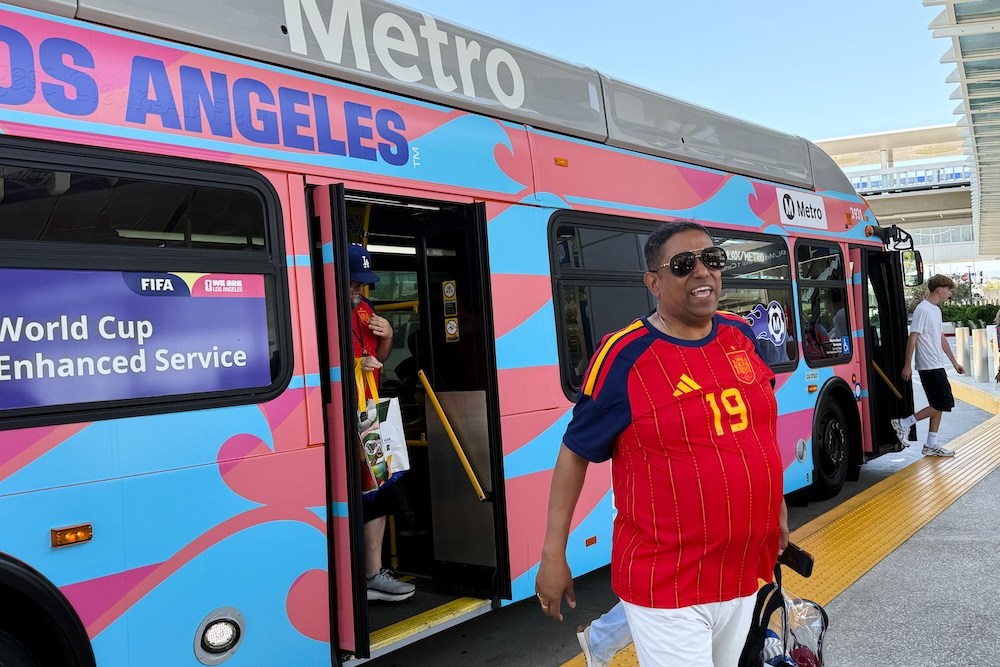
LOS ANGELES (AP) — When Matthew Smith took his five-year-old son to a World Cup game in the Los Angeles area earlier this month, they opted to take public transit instead of driving from their nearby coastal city.
It was Smith’s first time on the LA Metro in a decade, and the experience exceeded his expectations.
“Seems like a very functioning transit system, which is somewhat surprising given its reputation,” he said.
That is the reaction Metro officials were hoping for as they used the 2026 FIFA World Cup’s eight LA games to introduce — or reintroduce — people to the region’s public transit system, often an afterthought in car-centric Los Angeles. It is an early test run of sorts for the 2028 Olympics, which organizers have billed as a “no car” Games where there will be no parking for attendees at any of the venues. Spectators will have to rely on transit and shuttles to get to events.
Nearly 50,000 rides were taken on rail lines for the July 2 Spain-Austria game that Smith and his son attended. There is no train that runs directly to SoFi Stadium in the LA suburb of Inglewood, but Metro has added 15 shuttle lines to transport people there from major rail stations and transit centers — the farthest route taking one hour and 15 minutes. More than 30,000 rides were taken on those shuttles for that game alone, the agency said.