
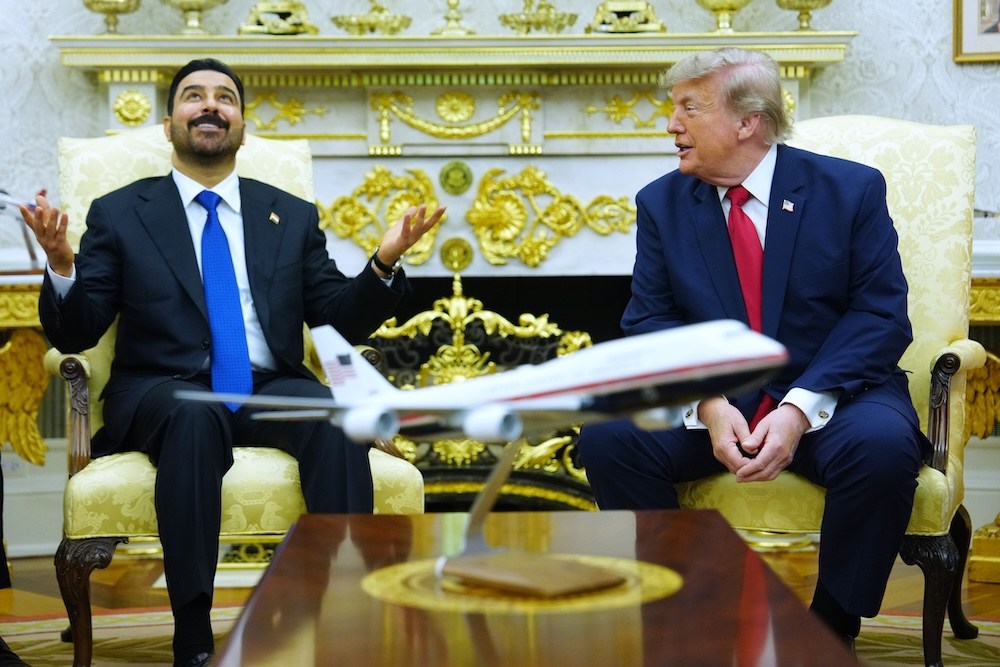
WASHINGTON (AP) — President Donald Trump gave Iraq’s new prime minister an effusive welcome at the White House on Tuesday, promoting the “tremendous chemistry” between him and a fellow wealthy businessman who arrived at the seat of governmental power without any prior political experience.
Ali al-Zaidi emerged as a consensus candidate in Iraq after months of deadlock over the premiership following last year’s parliamentary elections. Trump endorsed al-Zaidi for the job after he threatened to cut off U.S. support for Iraq if another candidate became the country’s next prime minister.
“Mark my words, I knew what I was doing,” Trump said in the Oval Office as he sat alongside al-Zaidi for his first visit outside Iraq as prime minister. “This man is going to be a great leader in the Middle East, beyond Iraq. His influence is going to spread all throughout the Middle East.”
Speaking through an interpreter, al-Zaidi said that he was conveying his greetings from the “oldest civilization in the world” and that the focus of his U.S. visit would be to announce an “economic partnership” between the two countries.
The issue of Iran loomed large in the discussions Tuesday. Iraq has been under pressure to disarm a network of Iran-backed militias operating in the country, some of which launched attacks on U.S. bases and diplomatic facilities after the U.S. and Israel launched their war against Iran in February. Officially, the Iraqi government has given non-state armed groups until the end of September to disarm, but some of the most powerful militias have said they have no intention of doing so.