
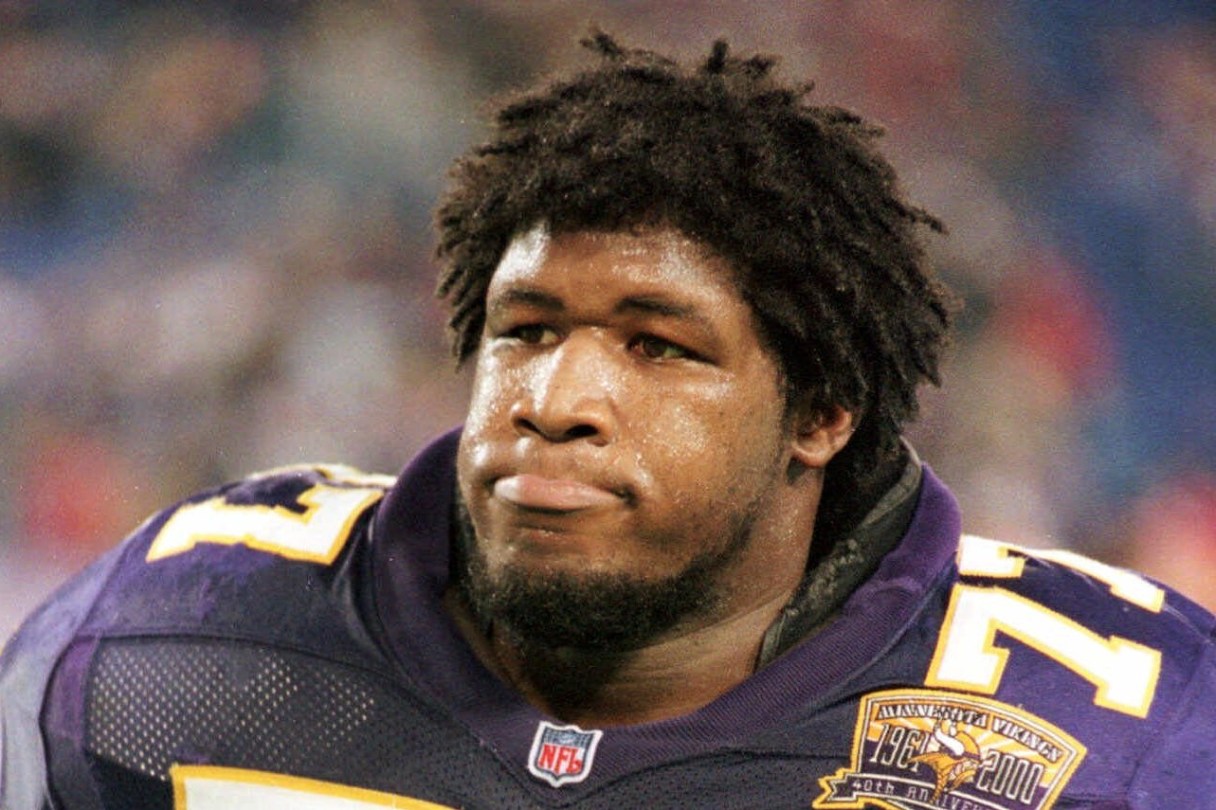
EAGAN, Minn. — The memory of losing her husband is so hauntingly clear 25 years later that Kelci Stringer could still draw a detailed picture of her hurried path to the hospital room where Korey Stringer died from exertional heat stroke.
Having arrived in the middle of the night, Kelci realized she was too late once she saw two of Korey’s teammates with the NFL’s Minnesota Vikings, receivers Cris Carter and Randy Moss, sobbing on the floor.
For all that went tragically wrong at the beginning of that preseason training camp in 2001 in Mankato, she has since made it her lifelong mission to help keep others from such a preventable death.
“The work we’re doing and the way we’re doing the work is most important to me,” Kelci said, “because we’re giving back in a way that’s very exemplary of Korey.”
Named after the only NFL player known to have died from heat stroke, the Korey Stringer Institute opened in 2010 with three employees at the University of Connecticut and now has a 100-person staff and a satellite branch in Florida. Chief executive officer Douglas Casa, a professor of kinesiology who survived his own brush with death at age 16 when he collapsed while running a 10-kilometer race, has counted 463 laws and policies over all 50 states that have been changed or created by the institute’s advocacy.
“Not too many medical situations are 100% preventable when you do the right things,” Casa said.
Funding for KSI was part of the settlement of the wrongful death lawsuit filed against the NFL by Kelci, who with Korey’s former agent, Jimmy Gould, was inspired to bring about lasting good from the regret and sadness.
“It wasn’t about the money. We lived that life long enough. What is a couple million dollars going to do? That can’t bring him back,” Kelci said this week in a phone interview with The Associated Press. “My purpose was to find answers. It wasn’t to find any blame. It was, ‘Can I just know?’ That was part of the closure and part of the peace.”
The Vikings will mark the tragedy’s 25-year anniversary Saturday afternoon prior to their first open-to-fans practice of training camp this preseason. Kelci is set to speak at the tribute, and KSI will staff a tent with a public display of the work being done on heat safety with athletes at all levels, day laborers and military members.
Despite the decade of litigation, the late player’s inner circle has forged a lasting and respectful relationship with the Vikings and the NFL. Casa is on the league’s general medical committee. Jeff Miller, an NFL executive vice president who oversees health and safety, is on KSI’s board of directors.
“Kelci’s commitment to Korey’s legacy and the good that can come from it is exceptional and probably unusual that somebody can channel tragedy into something so constructive,” Miller said. “It’s fair to say she and the advocacy she has pursued have saved numerous lives across all levels of sports.”
This summer in the United States has been marked by persistent heat waves, creating particular danger for strenuous exercise — even for well-conditioned professional athletes.
As highs routinely rise past 110 degrees in Las Vegas, the Raiders with new coach Klint Kubiak have been starting practice at 7:30 a.m. at their suburban facility.
The Arizona Cardinals started camp inside State Farm Stadium, the domed venue in Glendale where they play their home games, but when they move outside in a couple of weeks, they’ll do their on-field work in the morning.
“We don’t need to mess with the heat,” Cardinals coach Mike LaFleur said.
Like the Cardinals, the New Orleans Saints are in a locale where summer can be brutally hot but also play their home games in a domed stadium at the Superdome. Air conditioning means synthetic turf, though, which players dislike for the increased injury risk and harder overall toll on their bodies.
“The heat’s good. It’s a good exposure. We’re trying to find different margins when we can kind of minimize that when it’s not necessary, but when we do most of the bulk of football we want to be outside as much as we can,” said Saints coach Kellen Moore, who has his team stretch inside before heading out.
The ideal balance, of course, is between being overexerted and being underprepared.
“We have an advantage to go into the year knowing we’ve been in the heat,” Saints tight end Juwan Johnson said. “We’ve been grinding away, and when we get into a cooler area or a dome, then we can really go and get after some teams.”
Medical and technological advancements have given NFL clubs real-time data for tracking player performance and flagging potential problems before they get bigger.
Hydration before, during and after practice is second nature now, thanks in no small part to Korey Stringer’s death. Cold tubs are mandatory equipment near the practice fields. The need for recovery is more deeply embedded in protocols, too.
The Saints, as an antidote to their hot and humid environment, give players three hours off after practice before reconvening for meetings.
“I’ve never been in a place where you get that much time off to get your body back,” Johnson said.
The majority of players in the league now were either not born yet in 2001 or are too young to have known about Stringer’s death. Those who were contemporaries of his, though, will never forget.
“That was probably one of the hottest camps I had ever been in,” said Detroit Lions radio announcer Lomas Brown, who played offensive tackle like Stringer and was with the New York Giants in 2001. “When the news came out, it just stung. He was such a great dude, a big-time player, and then for that to take him out?”
Training camps these days are much more of a mental challenge than a physical grind, with mastering complex playbooks and perfecting techniques outweighing full-pad post-practice sprints after three hours on the field.
“We grew up in an era where you got after it. Workouts were designed to be very hard,” said Buffalo Bills defensive coordinator Jim Leonhard, who was a walk-on freshman safety at the University of Wisconsin in 2001 and played 10 seasons in the NFL. “I think it made everyone from coaches, players and medical staff to kind of step back and reevaluate: ‘Is this the right way to do things?'”
The collective bargaining agreement with the NFL Players Association has had plenty to do with this evolution, but so have Kelci and Korey Stringer.
“Going through hard things as a team brings you together, right? There’s a lot of good behind running a training camp or a conditioning session a certain way,” Leonhard said. “But being young as a player, it was one of those things, like, ‘We’re not invincible.’ That was the biggest piece you took from it. It was like, ‘Oh, man, we better take care of ourselves and take care of each other.'”