
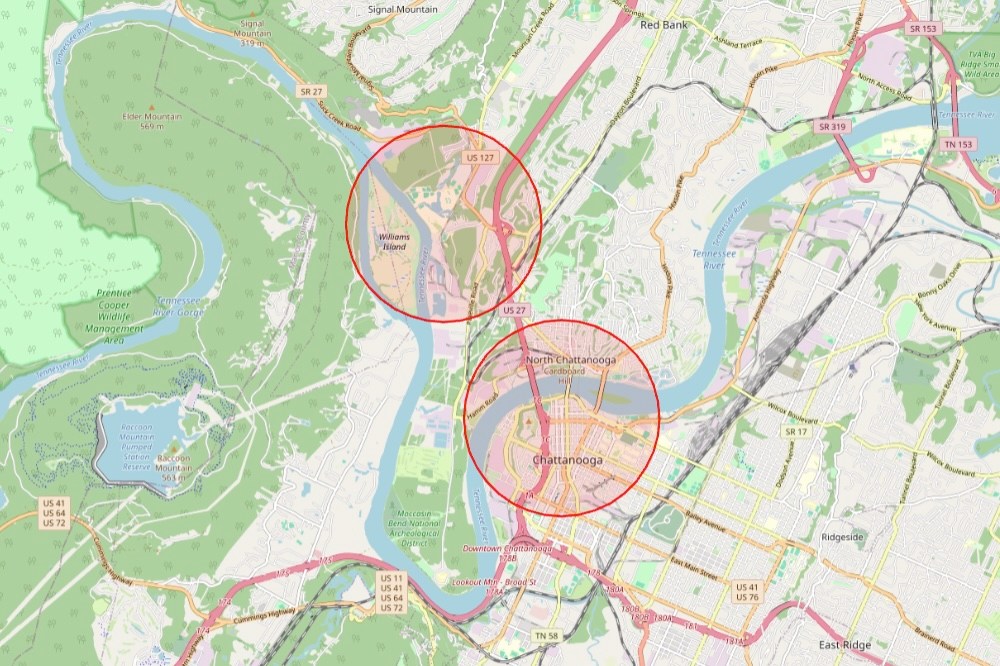

If Chattanoogans think ground security for the Spanish soccer team is intense, wait until they meet the security in the sky.
Drone operators could face steep fines and federal criminal charges for flying drones within 1.15 miles of where the team is living and training for the World Cup. The Federal Aviation Administration’s no-fly zones include virtually all of downtown Chattanooga and the North Shore, including popular flying spots at Coolidge Park.
Drone operators who enter the restricted air space without authorization can face fines up to $100,000, drone confiscation and federal criminal charges, according to the FAA. Federal law enforcement, including the Department of Homeland Security and the Department of Justice, will work to identify operators, seize drones and prosecute violators.
(READ MORE: Hosting Spanish national team has ‘massive’ value for Chattanooga)
The federal agency issued the temporary flight restrictions related to the World Cup in May, and they last from June 1 until July 20, one day after the final match in New Jersey. The restrictions are broader around the 16 North American stadiums hosting official matches.
The Spanish team arrived in Chattanooga on Friday afternoon and is expected to stay for most of June during the initial group stage of the competition.

The no-fly zones cover a radius of 1 nautical mile around the Embassy Suites on Broad Street, where the team is staying, and Baylor School off Signal Mountain Road, where the team is training between matches in Atlanta and Mexico. A nautical mile is equal to 1.15 miles. The zones cover the space from the ground to a 400-foot altitude.
“As fans from around the world gather at stadiums and fan events across the country for the FIFA World Cup, the FAA is using every available tool to protect the airspace, including stronger drone-enforcement efforts,” FAA Administrator Bryan Bedford said in a press release. “Drone operators should expect swift action if they violate restricted airspace.”
The only exception to the restriction is drone operation in direct support of national defense, Homeland Security, law enforcement, firefighting or search and rescue missions. Commercial drone operators with a valid statement of work can apply for a waiver at waivers.faa.gov at least 72 hours before requested operations.
LOCAL WARNING
One local consultant and entrepreneur knows what can happen when drone operators don’t understand the restrictions of their hobby or business operations.
“My biggest concern isn’t for professional pilots,” said Nate Jordan, founder of Views From Above, in an email. “It’s for the hobbyist who flies at Coolidge Park every weekend and has no idea these restrictions are in place.”

Views From Above is a Chattanooga-based drone services company that provides aerial documentation and drone compliance consulting. The company helps businesses understand drone regulations, reduce risk and safely integrate drone technology into their operations, Jordan said.
“Most businesses treat drones like they’re just cameras, but they’re aircraft. That’s why checking the airspace and having the proper licensing is so important,” Jordan said. “I don’t want to see someone lose their drone, get fined or face enforcement action simply because they didn’t know these restrictions existed.”
It only takes five minutes for a drone operator to check airspace restrictions from the FAA before taking off, Jordan said.
That small action, he said, is “a lot easier than explaining a violation to the FAA.”

Contact business reporter Daniel Dassow at ddassow@timesfreepress.com or 423-757-6318.