
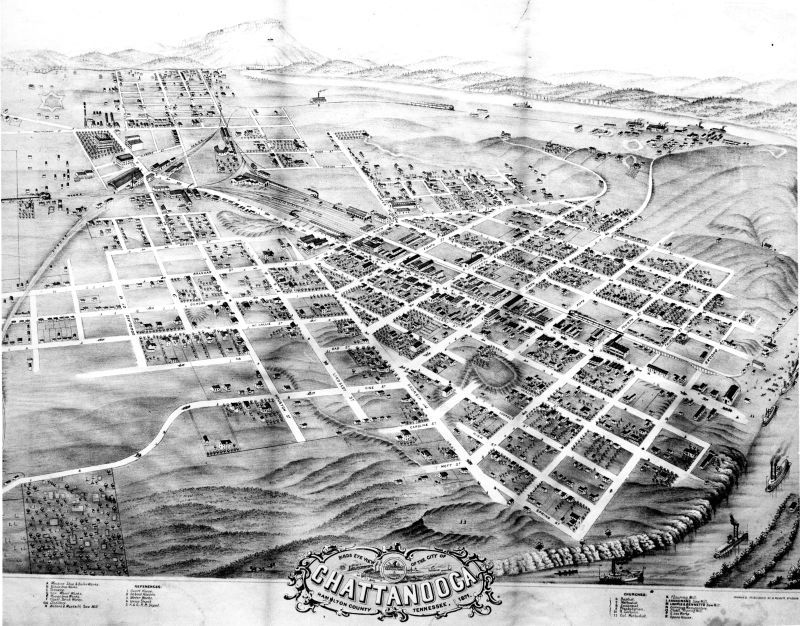

In 1838, Ross’s Landing, the town that would become Chattanooga, was home to about 200 people living in a vast, forested landscape.
The site of the actual landing near today’s Olgiati Bridge over the Tennessee River was established by Cherokee Chief John Ross, who operated a trading post, warehouse and ferry on the south side of the downstream bank of the Tennessee River. In 1816, Ross and the local population established a town called Ross’s Landing, according to Chickamauga-Chattanooga National Military Park historian Jim Ogden and related historical information. Hamilton County was established a few years later, in 1819.
In 1838, Ross’s Landing was the site of one of the river crossings used to force thousands of the Cherokee in East Tennessee and North Georgia, including the Ross family, on a path to present-day Oklahoma on what would become known as the Trail of Tears. At least 4,000 Cherokee died during the march.
The year after the Cherokee removal, the Tennessee General Assembly officially renamed the town Chattanooga, a name believed to have been associated with the Muscogee people, who lived in the region before the Cherokee.
Newspaper archives offer a glimpse of the town of Ross’s Landing through an article in the July 26, 1838, edition of the Hamilton Gazette, one of the regional newspapers of the day. While the town of Chattanooga wouldn’t be formally established until Dec. 20, 1839, the name Chattanooga was beginning to replace Ross’ Landing in 1838 as the transition took place. The article’s author, “P,” likely refers to the newspaper’s publisher, Ferdinand Augustus Parham.