
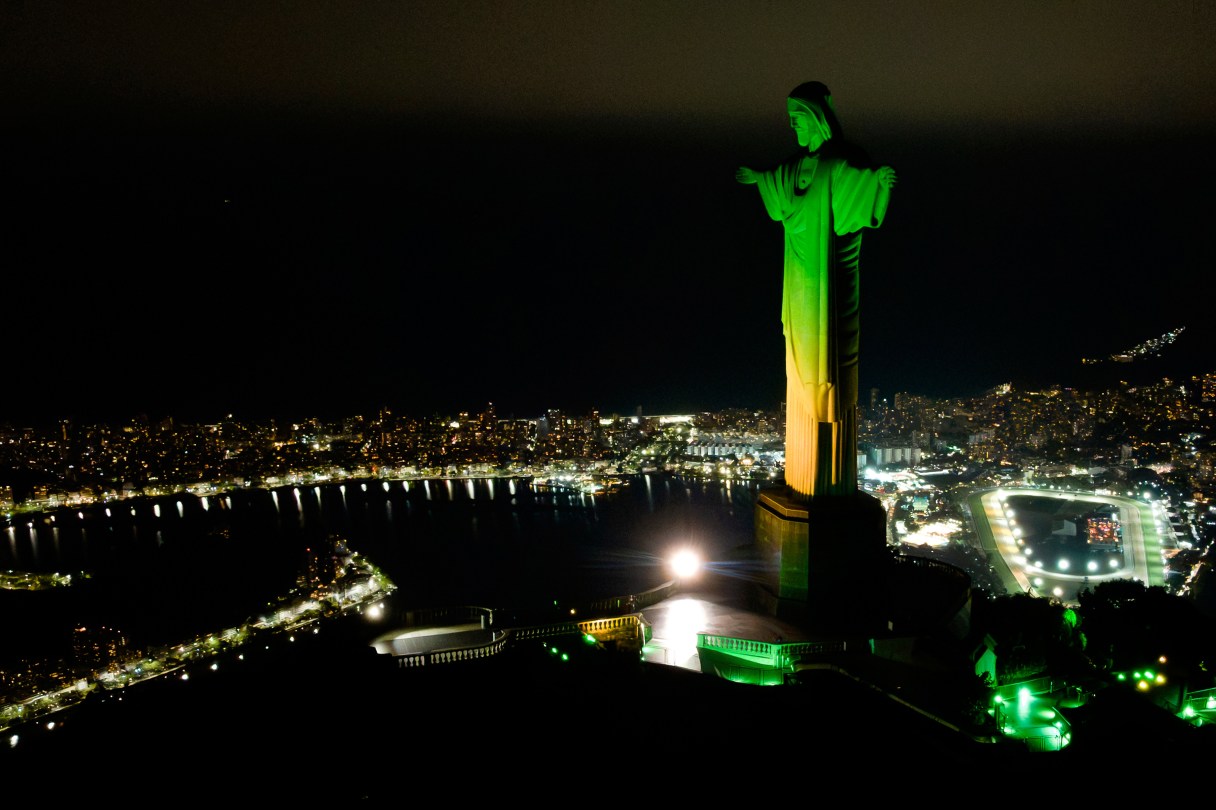
While most of the soccer world is focused on the men’s teams currently competing at the 2026 World Cup, a 48-team tournament being held in Canada, Mexico and the United States, the countdown has begun for the next Women’s World Cup in Brazil.
The 32-team women’s tournament is set to start June 24, 2027, hosted by a South American country for the first time. Brazil hosted the World Cup in 1950 and 2014, and it has won the quadrennial men’s tournament a record five times (1958, 1962, 1970, 1994, 2002).
“I think that the host country, it sleeps and breathes football,” FIFA chief football officer Jill Ellis said at an event Wednesday in Miami to help begin the countdown to Brazil. “So I think just the energy you’re going to see from the public, the general public, and obviously the teams touching down in Brazil, I mean, it’s such a unique, special country — I think the same energy you’re going to feel right now when you bring the world together, and you have an incredible product in women’s football, I mean, the level of quality the players is so extraordinary that I think, honestly, it will be an epic showcase of football and fandom.”
In addition to Miami, a countdown event was also held in Rio de Janeiro. Even in Vancouver, British Columbia, at Wednesday’s World Cup match between Switzerland and co-host Canada, video signage flashed with ads for the upcoming women’s tournament.
All eight cities that will host women’s matches next year also hosted men’s games in 2014: Rio, Belo Horizonte, Brasilia, Fortaleza, Porto Alegre, Recife, Salvador and Sao Paulo.
Qualification for the tournament has already begun. Brazil, which has an automatic spot as host, has never won the women’s tournament — its best finish was as the runner-up in 2007 — and it remains to be seen whether Marta, the six-time FIFA women’s world player of the year, will be on the national team. The 40-year-old forward has never won a major international tournament.
Thirteen other teams have also qualified: Argentina, Australia, China, Colombia, Denmark, France, Germany, Japan, New Zealand, North Korea, the Philippines, South Korea and Spain.
“There is only one year left until the moment that will be marked in the history of our country. For the CBF (Confederacão Brasileira de Futebol) and for all Brazilians, it is a source of great pride to host the Women’s World Cup,” Samir Xaud, the CBF’s president, said in a released statement. “It will be an opportunity to show the world our passion for football and, above all, the strength of Brazilian women’s football. We are certain that this will be a transformative World Cup, capable of inspiring girls in all regions of Brazil and leaving a lasting legacy.”
The first Women’s World Cup was hosted by China in 1991. The United States has won the most titles with four, taking the inaugural tournament plus the 1999, 2015 and 2019 events. Spain won the most recent championship in 2023 at the tournament co-hosted by Australia and New Zealand.
Women’s soccer has experienced exponential growth in the past decade, with new leagues, increasing viewership and revenues. The Women’s World Cup in Brazil will be the last with 32 teams. In 2031, the event will include 48 teams, like the men’s tournament.
The 2031 World Cup is expected to be hosted by Costa Rica, Jamaica, Mexico and the United States. The formal decision will likely be announced in November.
“I think when we went to 32, there was some noise, are we ready, are there going to be blowouts?” FIFA’s Ellis said. “We saw an incredibly competitive landscape. We saw debutantes making the knockout rounds. I think the global game is accelerating so fast that countries are closing the gap a lot faster.
“Our job is to make sure teams come in there as prepared and ready as they can, so we have the most competitive World Cup. So I think the growth of the game is accelerating rapidly, and I think by 2031, we certainly will have a very competitive World Cup.”