
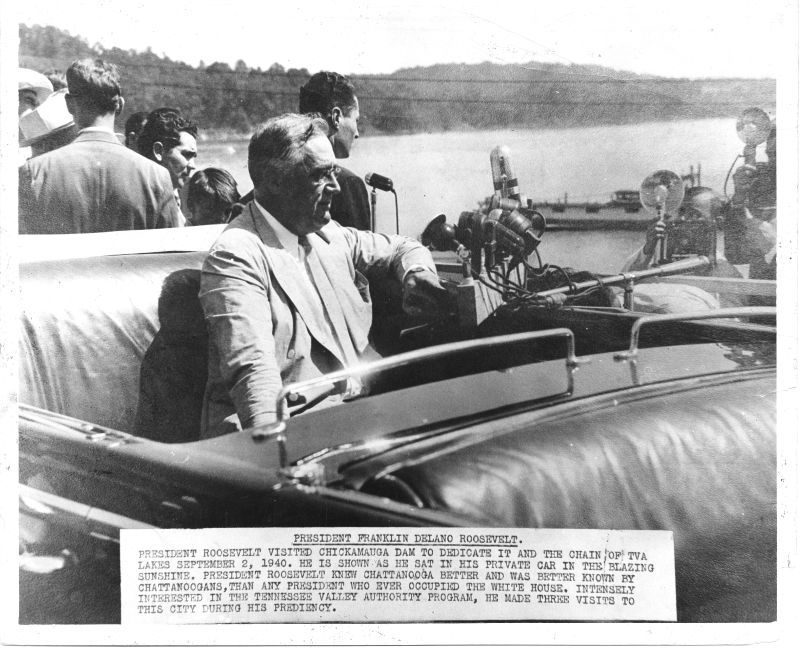
The term Tennessee Valley Authority first appeared in the Chattanooga Times on April 8, 1933, in an announcement of a daring federal proposal from newly elected President Franklin D. Roosevelt.
The name has since appeared in Chattanooga’s daily newspapers nearly 50,000 times as TVA made Chattanooga the centerpiece of operations for a power grid that has transformed daily life across seven states and prevented an estimated $5 billion in local flood damage.
Today, TVA is the nation’s largest public power provider and among Chattanooga’s top employers. It owns the city’s largest office complex, a 1.4 million-square-foot cascading edifice between Chestnut and Market streets that opened in 1985. But when the paper first announced TVA, it was little other than a plan to fulfill a longtime goal of harnessing the Tennessee River for the development of the region.
TVA would serve as “Exhibit A” in a nationwide development program, the Chattanooga Times reported. As a Democratic candidate, Roosevelt campaigned on challenging the profit-hungry private electricity industry and bringing power to rural areas. Four government developments on four rivers in the corners of the U.S. — the Colorado, Columbia, St. Lawrence and Tennessee — would serve as “a national yardstick to prevent extortion against the public,” Roosevelt said in a 1932 campaign speech.
The agencies would bring electricity to rural communities in particular that had been left out of a private electricity market that favored dense urban areas with more affluent residents.