
Editor’s note: first in a two-part series.
Long before white settlers arrived, Native American tribes, including the Creek and Cherokee, used natural passes to climb to the top and hunt white-tailed deer, black bear and turkey on Walden’s Ridge. Amidst the rhododendron, mountain laurel and picturesque gorges on the south end of the ridge, now known as Signal Mountain, stood a promontory.
Historians believe Signal Point, since early times, served as a place to send fire and smoke signals across the Tennessee Valley — a strategic communication practice common among indigenous peoples.
In the fall of 1863, with their troops under siege in Chattanooga, Federals used Signal Point as their communications site. Here they observed the entire valley, including Confederate movement along the Tennessee River. A young Signal corpsman from Iowa wrote, “We connected with the station at Bob White’s on the Haley Trail [in today’s Prentice Cooper State Forest] some five miles to the northwest of our station … From Bob White’s, a field telegraph was run across the tableland to the far side of Walden’s Ridge. Thence messages were sent to Jasper in Sequatchie Valley. On the side towards Chattanooga we signaled direct to Cameron Hill, and the station there flagged or torched our messages to Signal Corps Headquarters in Chattanooga.”
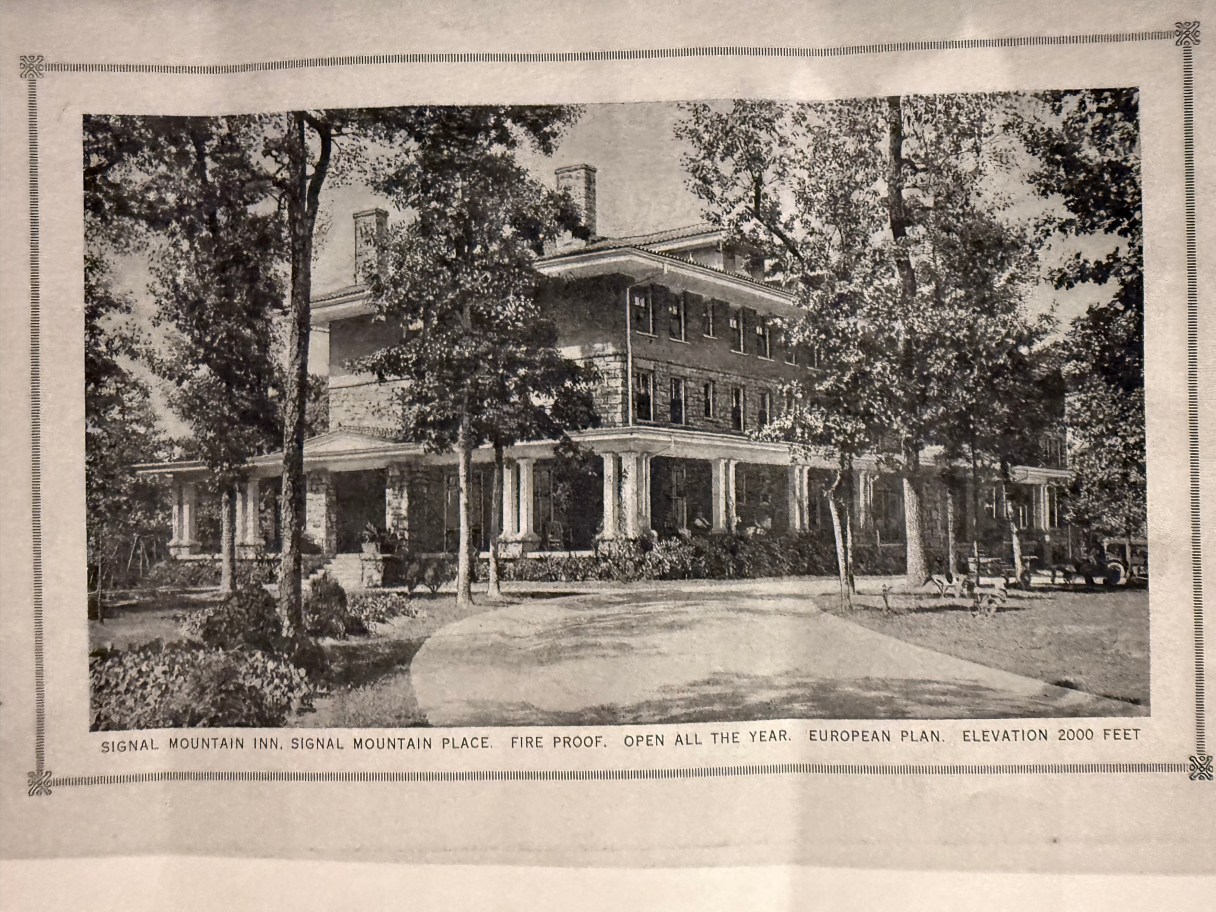
In about 1912, Charles James purchased 4,400 acres around Signal Point. He saw the potential to develop a resort-like community on the ridge and began selling parcels of land for homes. That same year, a contract was awarded to the Chattanooga Traction Company with James as a principal for the construction of a 12-mile streetcar line connecting the mountain community to Chattanooga. (The car tracks display themselves today embedded in James Boulevard as they run through the historic district).