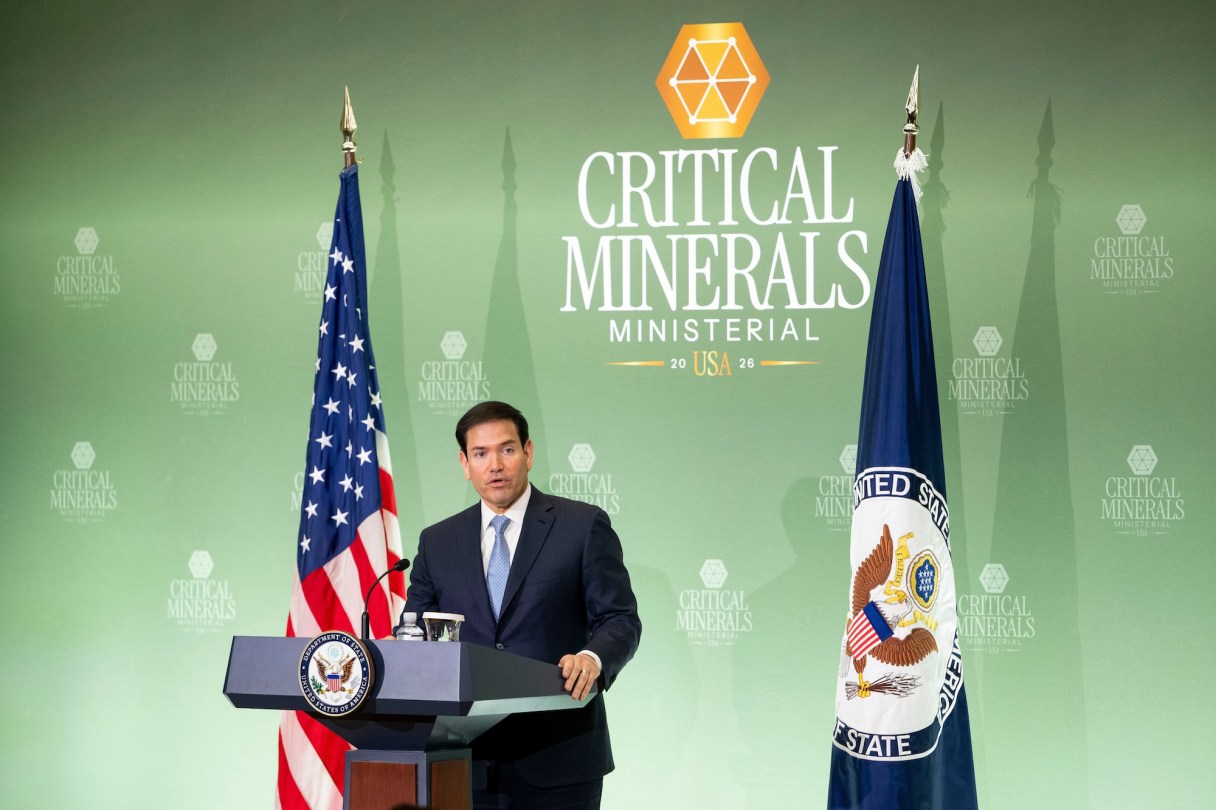
Washington has begun to grasp a strategic reality that much of the world has long understood: Critical minerals are the foundation of modern power.
From advanced weapons systems to electric vehicles and consumer electronics, the metals that underpin these technologies now carry the same geopolitical weight that oil did in the 20th century.
The United States effort to establish a strategic critical minerals reserve is a welcome development. Project Vault is a public-private supply chain security initiative that establishes the reserve.
Financed through a $10 billion lending commitment from the Export-Import Bank and $2 billion from private partners, the project will seek to source and store critical minerals in facilities nationwide. This strategy will provide America with some insulation against supply shocks and geopolitical pressure, especially in an era of intensifying competition with China and instability across global supply chains.
Building a strategic reserve will require more than expanding domestic mining, because domestic production is only part of the solution. The government understands this, which is why it has moved to accelerate permitting and unlock the country’s significant untapped mineral resources. Initiatives such as the government’s FAST-41 transparency process are steps in the right direction. By streamlining regulatory reviews and improving coordination among federal agencies, the process can help move long-stalled projects toward construction and operation.
As an example, NewRange Copper Nickel’s NorthMet project in Minnesota illustrates the scale of what could eventually come online. Once permitted, the project could produce 32,000 tons of copper and nickel-copper concentrates daily.
However, building a mine from discovery to production can take decades. Even when minerals are extracted domestically, the United States often lacks the downstream processing capacity required to refine them. One of the country’s most active rare-earth mines is in California, yet much of the material extracted there is processed in China. To make matters more complicated, the United States holds only 2% of the global supply, even though it possesses the fifth-largest known copper reserves. The United States still imports the majority of the critical minerals it needs.
Closer to home
Some players in our region are hoping to do their part to reduce the United States’ reliance on foreign minerals.
Chattanooga-based manufacturer Novonix has begun producing samples of synthetic graphite, a material used in the lithium-ion batteries that power many electronics, from smartphones to electric cars.
(IN THE NEWS: Novonix prepares to take on China from custom-built Chattanooga factory)
If the company meets its goal of reaching mass production by next year, it would be North America’s first mass-production site for high-quality synthetic graphite, Novonix says. Panasonic is the company’s largest customer.
Producing synthetic graphite uses a byproduct of refining crude oil, which is broken down and passed through a furnace. The material is a good conductor of electricity and withstands high heat well, which makes it ideal for batteries.
The Australian-founded company moved into the former Alstom plant off Riverfront Parkway and recently said it is looking to expand next door (rather than to a planned site at Enterprise South Industrial Park), a move that could threaten its roughly $54 million local tax break.
In December, Gov. Bill Lee also announced that South Korean metals company Korea Zinc would invest $6.6 billion to build a minerals refinery on the site of a shuttered mine in Smith County. The company plans to create 320 jobs there and another 420 at a planned U.S. headquarters in Montgomery County.
The federal government will have a 40% stake in Korea Zinc’s U.S. operations and a 5% stake in its global operations.
In other words, the United States will require a steady flow of external supply for the foreseeable future.
When it comes to the obvious partner nations, Australia, Canada and Argentina are the clear targets. These are stable economies with established mining industries, robust legal systems and long trading histories with the United States. All three have an abundance of copper, nickel, zinc, lithium and other rare-earth elements. Colombia is also a natural ally.
Still, there are additional considerations. A reserve designed to protect U.S. national security should not rely on opaque supply chains or intermediaries whose internal operations are difficult to scrutinize and/or don’t have strong governance standards. Authorities in the United States and Europe have pursued high-profile cases involving companies operating across the global commodities trade.
Last, there are substantial environmental considerations as well. Responsible mining requires companies that are well governed and properly capitalized so they can restore landscapes, protect water sources and rehabilitate land after extraction.
A strategic mineral reserve should not come at the cost of long-term stewardship of the land. Instead, this initiative should demonstrate that responsible resource development and environmental protection can coexist through ethical stewardship and close cooperation across nations and industries.
Regardless, America’s strategic mineral reserve should ultimately rest on two pillars: strong domestic production and long-term cooperation with trusted allies. Just as important, it must avoid the governance risks that come with opaque commodity trading practices.
Chadwick Hagan is an American investor, entrepreneur, author and executive producer.