
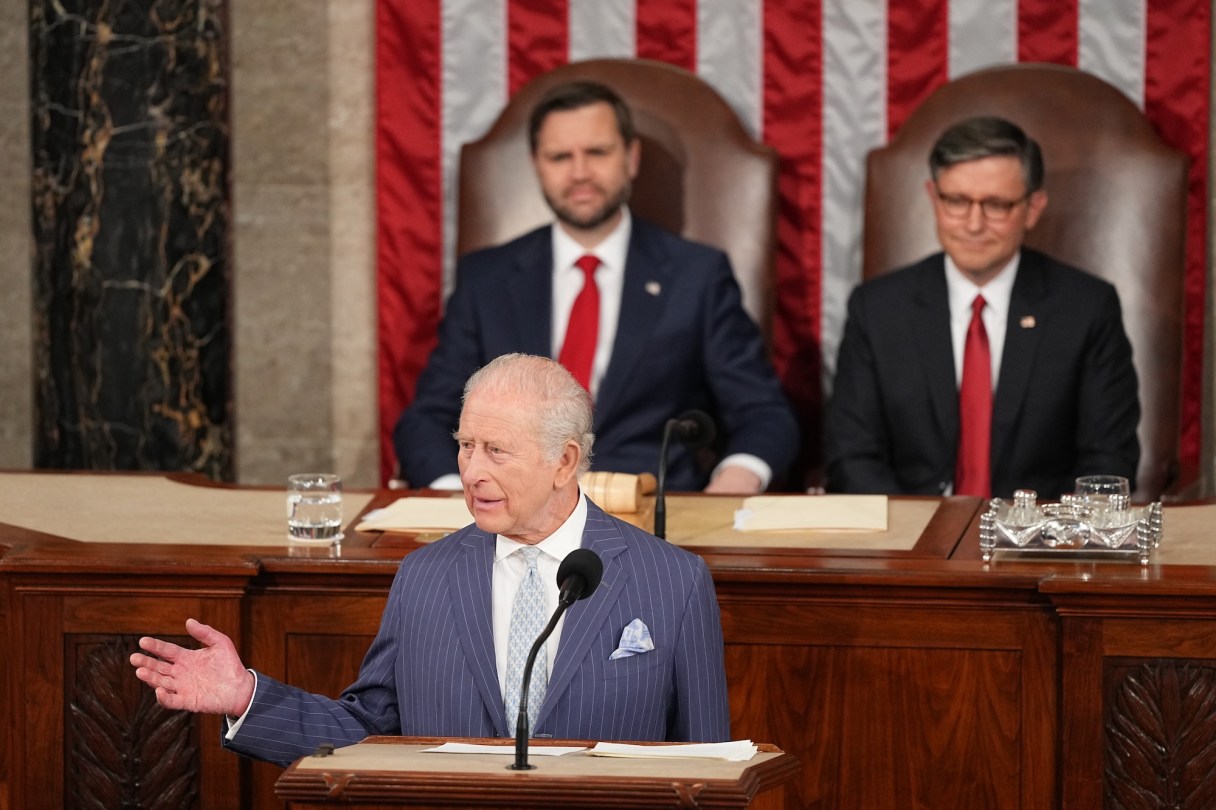
Most Americans think of the Bill of Rights as a bespoke 1789 creation for a nation that was, in the signature “Hamilton” lyric of Lin-Manuel Miranda, “young, scrappy and hungry.”
Not so fast, said the great-great-great-great-great grandson of King George III before the U.S. Congress last week.
King Charles III knew his audience. “The Founding Fathers were bold and imaginative rebels with a cause,” he began, softening it up. “By balancing contending forces and drawing strength in diversity, they united 13 disparate colonies to forge a nation on the revolutionary idea of ‘life, liberty and the pursuit of happiness.'”
Then he got to what he really wanted to say: “They carried with them, and carried forward, the great inheritance of the British Enlightenment — as well as the ideals which had an even deeper history in English common law and Magna Carta.”
Charles was, of course, historically correct, as he was when he went on to note that the Magna Carta is cited in at least 160 Supreme Court cases since 1789 and when he pointed out that England’s 1689 Declaration of Rights, the document that established the constitutional monarchy and thus prevented its eventual obliteration (for now), was, shall we say, heavily sourced in the Bill of Rights in 1791. Charles had a sly addition to that assertion, noting that the one was used by the other, “often verbatim.”