
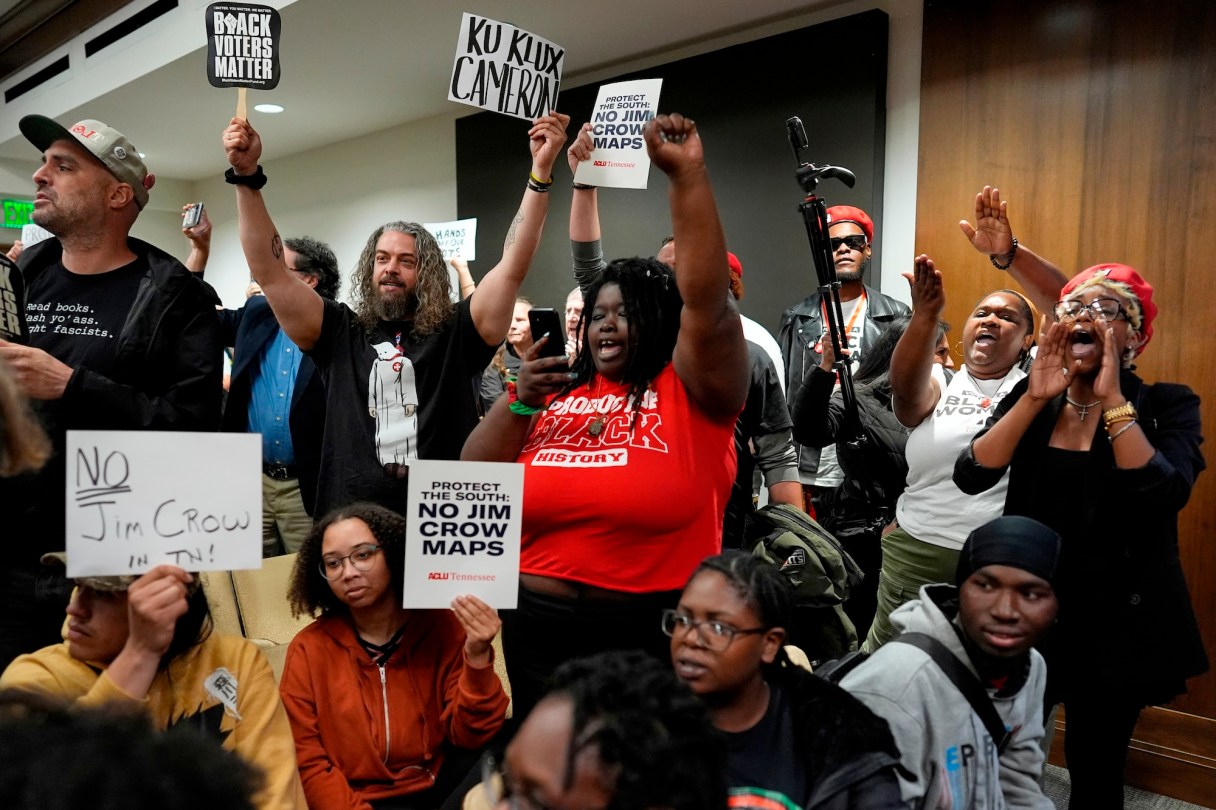
The Unity Group of Chattanooga is deeply concerned by the United States Supreme Court’s decision in Louisiana v. Callais.
We do not view this ruling as an isolated incident or an accidental shift in the law. We view it with memory. As Justice Elena Kagan wrote in her dissent, the Court’s majority “avails itself again of the tools used before to dismantle the Act: untenable readings of statutory text, made-up and impossible-to-meet evidentiary requirements, disregard for precedent, and disdain for congressional judgment.”
(IN THE NEWS: Tennessee Gov. Bill Lee calls special session for redistricting)
The right to vote should not be denied or abridged. This is not a suggestion in our system; it is a constitutional principle and one of the hallmarks of our democracy.
The fundamental premise of these standards proclaims that this should be a nation governed by the will of the people, grounded in the consent of the governed and guided by the idea of one person, one vote.
This decision raises serious concerns about whether those principles are being misconstrued, diluted or virtually undermined into irrelevancy.
In the American Civil War, the price of freedom was paid in blood. And that victory was carried forward in law through the 15th Amendment to the United States Constitution, which was meant to ensure that the right to vote could not be denied on the basis of race.
We remember what happened at the Colfax, Louisiana courthouse during the Colfax massacre, when Black citizens were killed for attempting to exercise that right. The result was a case eerily similar to Louisiana v. Callais — United States v. Cruikshank.
(READ MORE: Times Opinion: Tennessee redistricting plan doesn’t serve the people)
We remember how that promise was undermined through poll taxes, literacy tests and grandfather clauses — systems designed to restrict access to the ballot without openly stating their purpose.
We remember James Chaney, Andrew Goodman and Michael Schwerner in Mississippi, murdered while working to expand democratic participation and register voters.
We remember the bridge in Selma during the Selma to Montgomery marches, Bloody Sunday, where peaceful citizens were met with violence for demanding access to the ballot. We remember John Lewis, who told us voting was precious, almost sacred.
We remember the long legal struggle for equal protection and equal access reflected in Brown v. Chattanooga, and note that the very mechanism used to come to that determination has now been decimated and usurped by a purely contradictory tool of remedy.
We remember local citizens like Ms. Dorothy Cooper, who at 96 years old was denied the right to vote for many years, but who still stood firm in the belief that voting rights must be real; not theoretical or hypothetical, but real, tangible and accessible to everyone.
And in more recent times, the citizens of this great community can rightly attest that the right to vote does not start at the ballot box; it begins with a fair, fully transparent and open process.
During the last redistricting cycle, our community showed up and demanded this type of openness and transparency, including public maps, open meetings and a real opportunity to provide citizen feedback and recommendations through a public hearing. As this process advanced, to our shock and dismay, an investigation by the Chattanooga Times Free Press uncovered that many of the discussions and agreements concerning various maps had been deliberately conducted out of view of the general public.
(IN THE NEWS: Hixson Rep. Reneau has legal and ethical concerns about congressional redistricting)
This prompted a lawsuit by the Times Free Press, which resulted in the Chancery Court ruling that there had indeed been violations of the Tennessee Open Meetings Act. The remedy the court ordered was:
1. Compliance with the Tennessee Open Meetings Act;
2. Oversight of the City Council by the court for no less than one year; and
3. Semi-annual reports by the city regarding compliance with those standards.
This ruling was meaningful because it demonstrated that not only is the voice of the people essential in the development of our processes, but that the press also has an important role in the establishment of transparency and accountability.
So when we read the Louisiana v. Callais decision, we do not see it as a technical adjustment in legal doctrine. We see it through a much larger historical frame and lens.
We see the Three-Fifths Compromise. We see the Dred Scott decision. We see the end of Reconstruction. We see Plessy v. Ferguson and “separate but equal.” We see Jim Crow denying millions of Americans opportunity and basic human dignity.
We also see a society that has lost a semblance of civility, decorum and courageous statesmanship once displayed by public servants like Howard Baker, Marilyn Lloyd and Dalton Roberts.
The right to vote is not abstract. It is either protected in principle, or it is diminished in practice.
And if we are to preserve it, we must do as John Lewis urged us on so many occasions: “Stand up. Speak out. Get in the way. Get into trouble, good trouble, necessary trouble.”
The Unity Group of Chattanooga remains committed to the work ahead — education, organization and advocacy — to ensure that the promises written into law are reflected in lived reality.
Because this we know: A democracy only survives when its people — all its people — can fully participate in it. And that participation must never be treated as optional.
Eric Atkins is a co-chair of Unity Group of Chattanooga, a civil rights organization.