
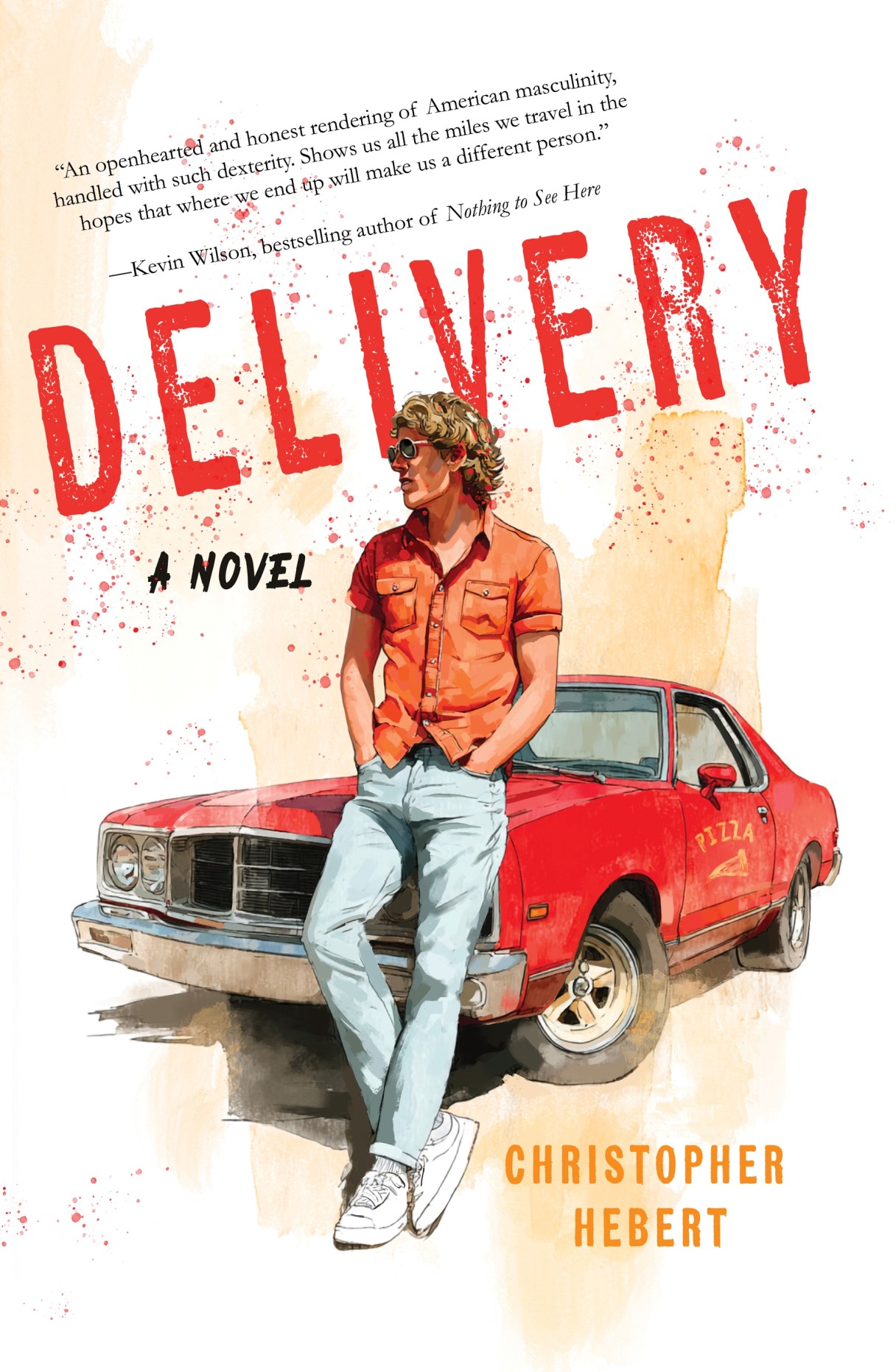
“Delivery” By Christopher Hebert (Regal House, 216 pages, $19.95)
Early in Christopher Hebert’s novel “Delivery,” 17-year-old Gabe Sanders declares, “There were two things in the world I loved, baseball and Nell. One had promised to make me famous. The other had said she’d love me back.” Now, both his loves are in danger of slipping away: A mysterious foot injury cost him most of the spring baseball season, and his girlfriend has been spending a suspicious amount of time with her ex-boyfriend. It’s June 30, 1993, and Gabe’s future hangs in the balance.
Hebert’s imminently readable novel follows its hero for 15 hours as he delivers pizza in his hand-me-down 1982 Plymouth TC3 (dubbed the Bobcat) and reckons with past missteps. Gabe’s injury, a stress fracture that may not be healed, serves as a metaphor for his general malaise — an existential crisis for the hormonal set. No outward sign corresponds to his inward pain, yet with every step he fears a recurrence of the feeling that he’d stepped on a “rusted nail.” He worries he’ll never live up to the hype. “What if I was nothing now?” Gabe thinks. “What if the only thing I’d ever been good at was something that was now entirely in the past?”
Stripped of his athletic fame, Gabe seems a pathetic figure. A sub-mediocre student raised by an oddball single mother, without baseball Gabe might be trapped in his unnamed upstate New York town with no prospects beyond pizza delivery. But, as Hebert makes clear, Gabe’s physical prowess has been an essential part of his identity since grade school. “Back then I was the skinny kid single-handedly wiping out entire dodgeball teams. I wasn’t cruel about it. I just never missed,” he says.
Hebert, the director of creative writing at the University of Tennessee in Knoxville and author of “The Boiling Season” and “Angels of Detroit,” portrays the pressures that a great athlete endures from well-meaning outsiders and the resentment he engenders among his less-talented peers. One of his longtime teammates, Powell, complains to Gabe, “I’ve probably swung a bat ten thousand times more than you. What good has it done me?” Powell doesn’t know that years ago, Gabe procured the key to their school’s batting cage and has spent countless hours perfecting his craft. “Ten thousand was nothing,” he thinks.