
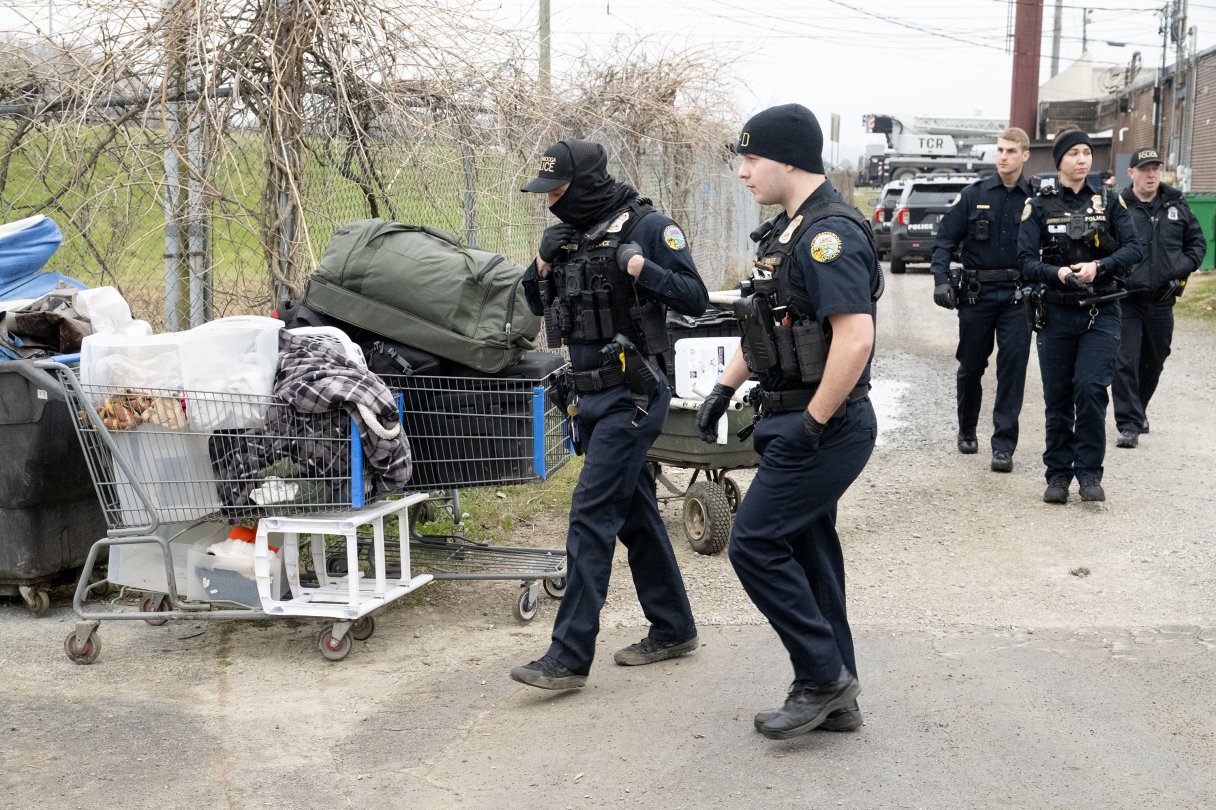

The Chattanooga Police Department will not give trespassing law exemptions to volunteers and nonprofit employees who venture onto private property to provide services to homeless encampments, Police Chief John Chambers said after the outreach community took issue with an email from a Chattanooga police officer.
Officer Brandon Watson sent an email, obtained by the Chattanooga Times Free Press, to several city and county employees directly connected to outreach activities. In the email, Watson said that he had been responding to calls from property owners about suspicious vehicles, likely outreach workers providing services to residents of homeless encampments on private property.
He said the department would “trespass” the people, meaning asking them to leave and not return or face arrest.
“I will state this clearly so that there is no confusion: should PD respond to a private property for a trespass enforcement, everyone located on said property will be trespassed by the TCA by order of the property manager/owner,” Watson said in the email.
Word spread quickly through volunteer groups, religious organizations and nonprofits involved with doing outreach to homeless encampments, and many were shocked by the contents of the email because it represented a stance they say they have not seen from the Police Department before. But Chambers said, in an interview Monday, that the law has always been the law.
“We don’t get to decide who we enforce it on and who we don’t, right?” Chambers said. “That’s selective enforcement, and then you’re going to open the door to bias and all types of other stuff, so we’re not going to go down that road.”
(READ MORE: City to donate former Airport Inn as homeless shelter, increase beds by 66%)

The email was written to be informative and a friendly warning to outreach workers, reminding them that they do not get a special exemption from the law, Chambers said. The end of Watson’s email requested that the outreach workers acquire permission from landowners before traversing private property to offer services. Chambers said that when outreach workers have permission, there are no issues, as Watson spelled out in his letter.
“That is what he’s communicating. And I know people’s perception of that wants to get twisted, but that’s not his words,” Chambers said. “His words are, emphatically, ‘You don’t get to be treated any differently. We understand you’re out to do a good thing, but there’s a right way to do a right thing.'”
Chambers said that there has been an exponential increase in the number of private property complaints, and now some of the complaints are directly against the individuals providing outreach. When private property owners choose to exercise their right to determine who is allowed on their property, the Police Department has no option but to enforce the law, whether that be homeless people or those aiding homeless people.
“I feel like it would be irresponsible of us not to provide a bit of warning to say, ‘Hey, please understand that if you put us in this position, then this is what we have to do because we’re not going to selectively enforce trespass laws,'” Chambers said. “‘And it would apply to you, too, if you’re trespassing.'”
Kacy West, an employee of the Chatt Foundation who visits homeless encampments with the Regional Outreach Cooperative, knows that she and her team trespass daily. But she said that is essential to outreach.
Notifying property owners ahead of time contradicts the cooperative’s code of ethics, in which street outreach workers commit to prioritizing the anonymity of camp locations. Maintaining relationships with people living in encampments requires trust, and keeping camp locations confidential is one part of that fragile trust, West said.

(READ MORE: Homeless woman says she’s stuck in Chattanooga without shelter)
If outreach workers alert property owners that there is an encampment on their property, it’s possible they will call the police to clear the camp, West said. Trust is lost, and then the outreach workers have to start from square one in trying to help.
“None of us want to get arrested,” she said. “We’re not going to stop doing what we’re doing, because what we’re doing is right. And so if that means we get arrested, then that’s what it means. But none of us want that to happen.”
Chambers suggested that the organizations in question clear their parking lots and invite the homeless people onto their property for services and help.
“Provide the service for them, but do it the right way. We don’t want people to go in ignorantly and go about trying to do a good thing the wrong way, and then put us in a position where we have to enforce the law, and we don’t want to do that,” Chambers said, again referencing the communication from Watson to the outreach groups. “He doesn’t want to go out there and take some pastor to jail or have to write a citation to a pastor who’s just trying to help people.”
Contact breaking news reporter Kailee Shores at kshores@timesfreepress.com or 423-757-6659.