
In 1941, the death of a family member prompted President Franklin Delano Roosevelt to say how he should be remembered.
One of America’s greatest presidents wanted only a plain block of stone, about the size of his desk, to be placed on the front lawn of the National Archives Building, with the words “In memory of …”
Friends — not the government — installed it, 20 years after he died. It’s still there, although a more elaborate memorial now stands beside the Tidal Basin.
Another great president, Thomas Jefferson, also insisted on simplicity. The epitaph on his gravestone would state only that he had written the Declaration of Independence and Virginia’s Statute for Religious Freedom and had founded the University of Virginia — not that he was elected president twice.
The accidental president, Gerald Ford, pocket-vetoed a bill to name a Michigan post office for him, writing that it would be “improper for me as an incumbent president to approve legislation which places my name on a federal building. This is a precedent I do not wish to establish.”
Such modesty is lost on Donald Trump, who constantly memorializes himself with monuments to bad taste.
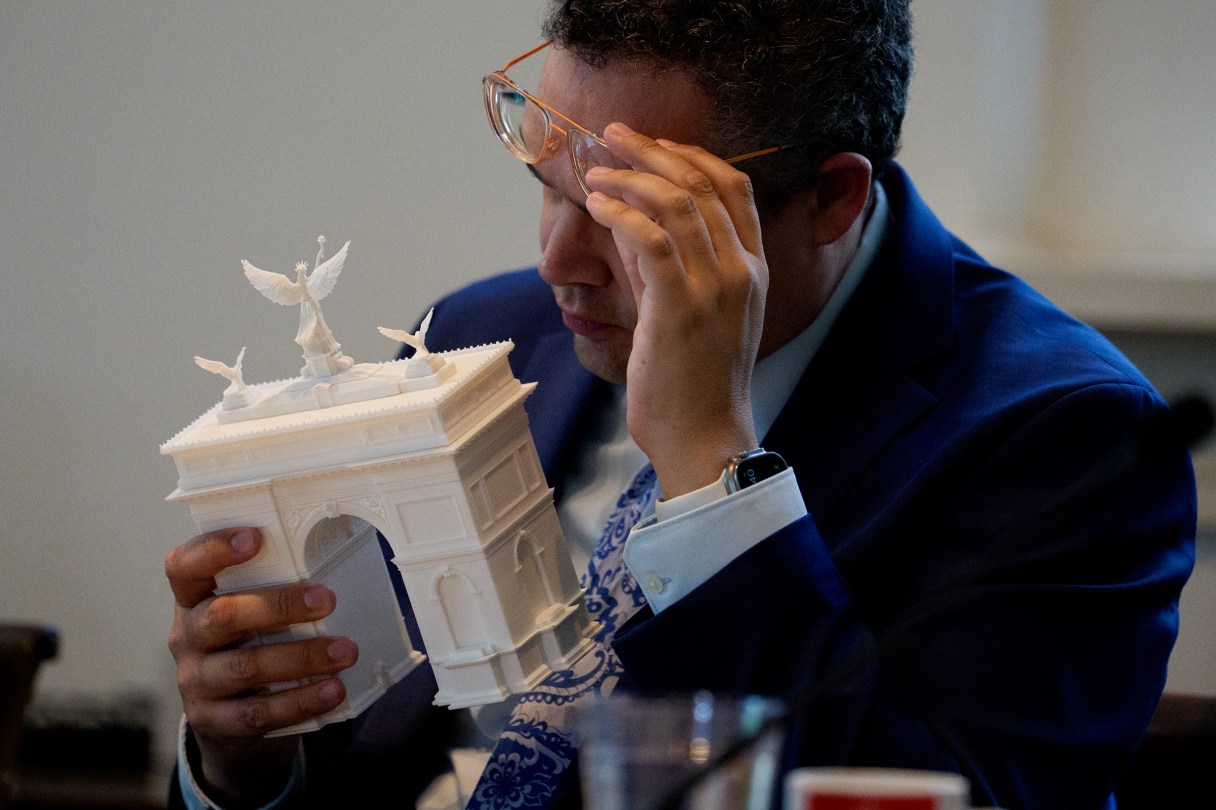
He slapped his name on the Kennedy Center for the Performing Arts; intends to build an oversized ballroom in place of the White House East Wing he razed without Congress’ consent; proposes a triumphal arch that would crudely overshadow Arlington National Cemetery; and plans an enormous “Garden of Heroes” with 250 statues of notable Americans among whom, one suspects, there will be yet another gilt image of Donald John Trump.
When asked by a CBS News reporter whom the arch would honor, Trump replied, “Me.”
His name is on a State Department building. His image is on gold coins, passports and national park passes. His signature is going on paper currency. He wants a new class of battleships to be named for him.
The licensing deal for Palm Beach International Airport to be named for him, as demanded by a law passed without local consent, requires a logo resembling the White House seal, in — you guessed it — gold.
The renaming and branding will cost taxpayers $5.5 million and Trump will control who will be allowed to operate concessions there.
Trump’s personal edifice complex is unmoored to any qualifying achievements or to any corresponding esteem from the public, other than MAGA diehards.
In a new Washington Post-Ipsos poll, Trump’s approval rating has sunk to 37% and his disapproval has climbed to 62%. His approval among Republicans was 85%, but among independents it’s 25%.
The public disapproves of how he’s handling every major issue, especially inflation, the cost of living, the economy and his illegal war.
He argues heedlessly that he needs the ballroom to protect him, with the recent attempt at the White House Correspondents’ Dinner as the pretext.
But that thought presumes he would hunker down in the White House, never leaving for MAGA rallies or rounds of golf. It would not be an acceptable venue for independent associations that need to keep a respectful distance from whoever is president. The East Room was adequate for John F. Kennedy’s state dinners and for the one to which Trump welcomed King Charles III.
A poem by Percy Bysshe Shelley, “Ozymandias,” taught to generations of Florida high school students, is still listed in the state language arts curriculum. It behooves Trump to read it. It’s short enough that he could do so:
I met a traveller from an antique land,
Who said: “Two vast and trunkless legs of stone
Stand in the desert … Near them, on the sand,
Half sunk a shattered visage lies, whose frown
And wrinkled lip, and sneer of cold command,
Tell that its sculptor well those passions read
Which yet survive, stamped on these lifeless things,
The hand that mocked them, and the heart that fed:
And on the pedestal, these words appear:
My name is Ozymandias, king of kings:
Look on my works, ye mighty, and despair!”
Nothing beside remains. Round the decay
Of that colossal wreck, boundless and bare
The lone and level sands stretch far away.