
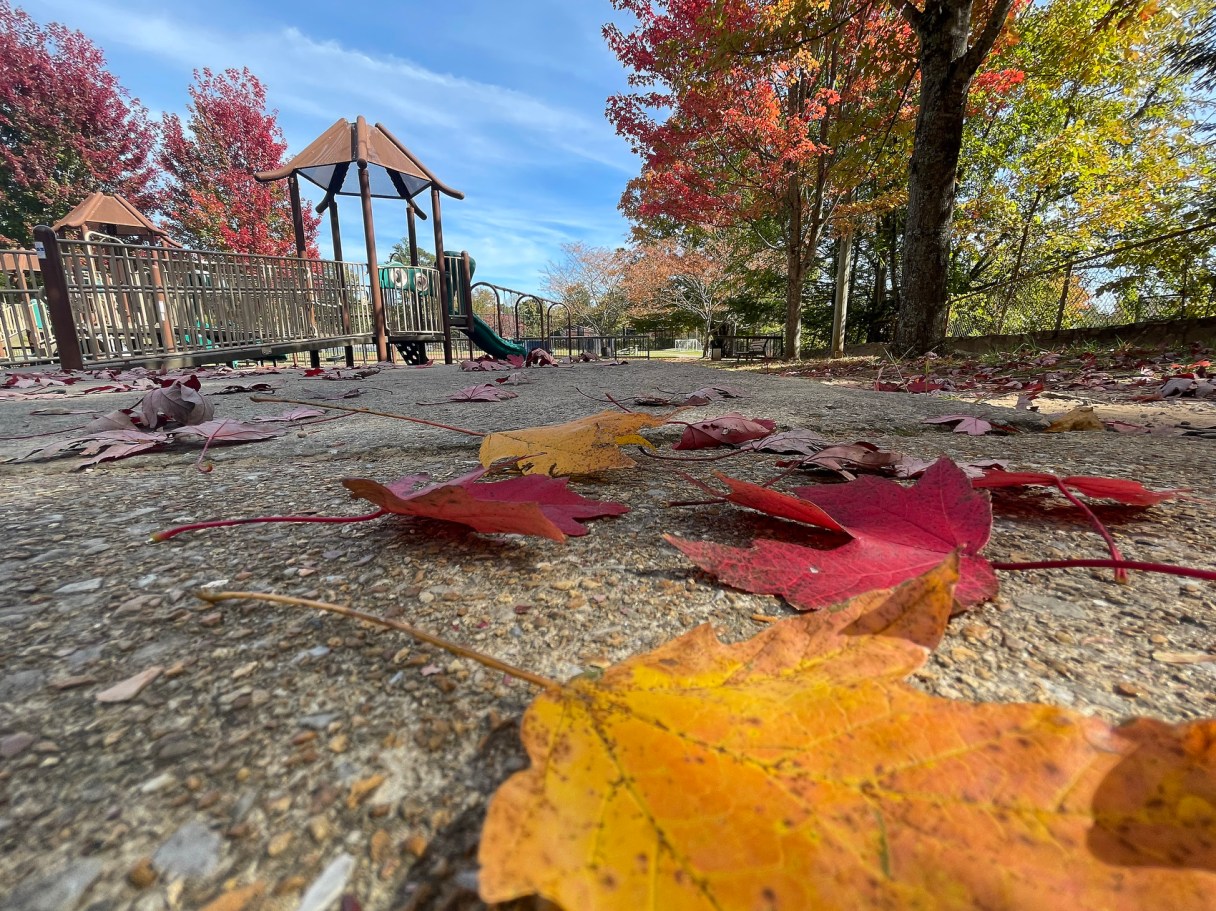
Despite warmer temperatures and dry conditions in early fall, changing leaves are still expected to offer a colorful display in the Tennessee Valley going into November.
This year, the Valley experienced one of the driest Septembers on record while also facing record-setting high temperatures. Those conditions have had an effect on the changing of the leaves, causing early leaf drops and duller colors in some tree species, according to State Climatologist Andrew Joyner with the Tennessee Climate Office at East Tennessee State University.
(READ MORE: August rains bring drought relief to Tennessee, but dryness lingers)
But overall, the Chattanooga area has fared better with rainfall compared to Middle and West Tennessee, Joyner said by phone. That means there should still be good fall color in this neck of the woods as the season progresses.
“It may be a little bit delayed by a few days based on when we normally see peak color, depending on the elevations,” Joyner said of the changing leaves. “But I think it should be pretty good.”
Higher elevation areas around Chattanooga, such as those along the Cumberland Plateau, should see the best mixture of colors as the fall foliage peaks, Joyner said. The color shift should then progress down the mountains into the valley.
Northwest Georgia should expect to see peak colors a few days after Chattanooga, if not around the same time, Joyner said.
Going into the Halloween weekend, Southeast Tennessee, Northwest Georgia and Northeast Alabama should see moderate color in the leaves, according to a fall foliage map at explorefall.com. Some communities in higher elevation areas, such as Monteagle and Sewanee in Tennessee, should see high color in the leaves over the weekend.
Through the first week of November, many of the mountainous areas of the region should see high color with some even starting to see peak color, according to the foliage map. Low-lying communities around Chattanooga should still see moderate color at this time, but they should also start to see the creep of the high color.
By the end of the second week of November, fall color should peak in most of the region outside of Chattanooga proper, according to the map. The city of Chattanooga might not see peak color until the beginning of November’s third week.
Peak color should fully dissipate in the region by Thanksgiving, the map shows.
(READ MORE: Thursday high notches Chattanooga record for consecutive days over 90 degrees)
The changing of the leaves every fall is the result of slower chlorophyll production as the days get shorter and nights get longer, according to the U.S. Forest Service. Chlorophyll gives leaves their green color, but with less chlorophyll produced during the fall, leaf color shifts due to two chemical compounds: carotenoids and anthocyans. The carotenoids give leaves yellow, orange and brown colors, while anthocyans give them red colors, the Forest Service website said.
Different tree species have varied leaf colors in the fall, according to the Forest Service. For example, oak trees have red, brown or russet leaves in the fall, while hickory trees have golden bronze, the service’s website said.
While November may bring delayed peak fall color, it could also bring above-average temperatures at least in the first part of the month, Joyner, the state climatologist, said. November could also see a slightly increased chance of rainfall in Southeast Tennessee, Joyner said.
Looking ahead at winter, the season could start off on the warmer side in November and December, Joyner said. But, as the season progresses, a potential cold anomaly in February and March, caused by the dipping-down of the jet stream, could bring the chance of above-average snowfall.
Contact contributor Sam Still at samuelstill@proton.me.